The main difference in 2026 executive powers vs 2024 executive powers is scale and legal footing: the 2026 presidency has signed far more executive orders, claims firmer control over federal agencies, and operates under recent Supreme Court rulings that expanded some authority while leaving other claims open to challenge. The constitutional text did not change between the two years. What changed is how the office uses its tools and how courts have responded.
This comparison covers order volume, removal authority, emergency and war powers, agency restructuring, and the checks that still apply. Each section stands on its own, so you can go straight to the topic you need.
How the Constitution Defines Executive Power in Both Years
The Constitution vests executive power in the president and requires the president to ensure that federal laws are faithfully executed, according to the Constitution Annotated at Congress.gov. That language is identical in 2024 and 2026.
The president's formal tools fall into a familiar set:
- Executive orders that direct federal agencies and officials
- Proclamations and memoranda for ceremonial, trade and policy actions
- Appointment and removal of executive branch officers
- Commander in chief authority over the armed forces
- Pardons and reprieves for federal offenses
- Treaty and diplomatic power, shared with the Senate
- Veto power over legislation
These are the usual answer to the question of the seven executive powers, though scholars group them differently. For a plain-language primer on the first item, see executive orders explained simply. For the broader relationship with Congress, the legislative power vs executive power analysis covers the structural tension.
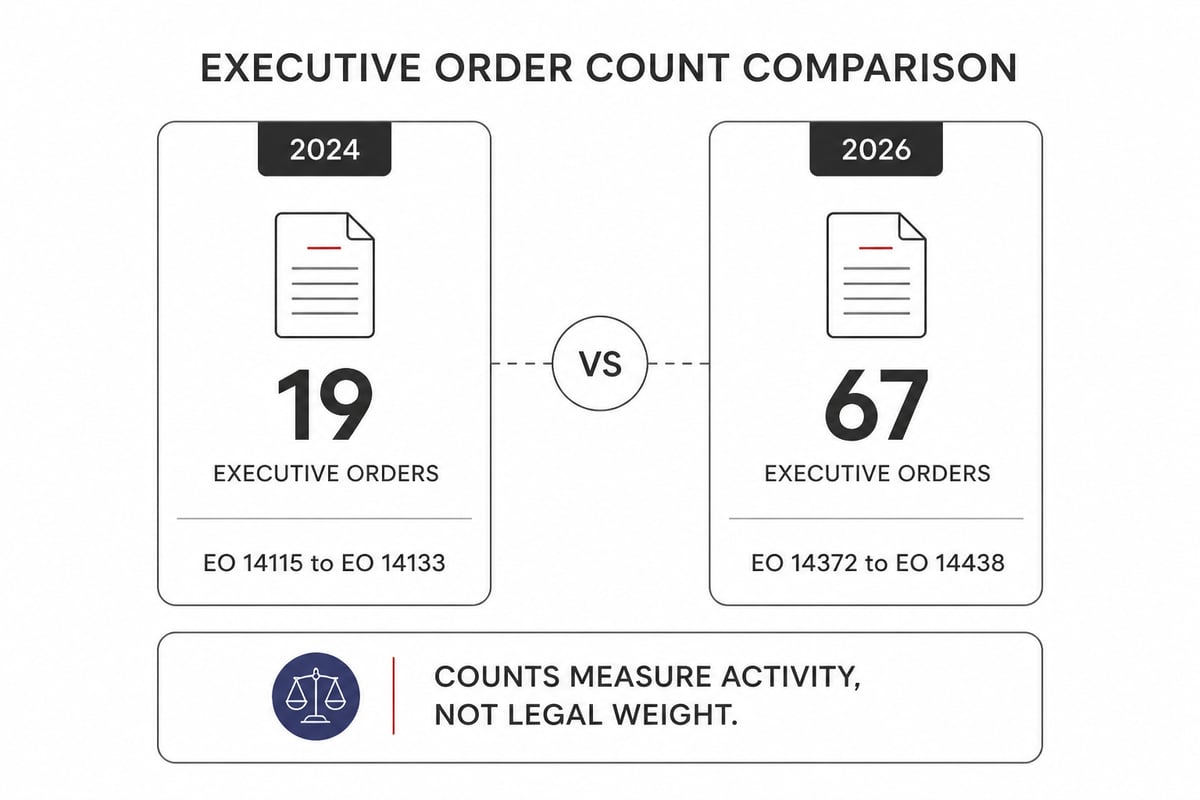
Executive Order Volume: 19 Orders in 2024 Versus 67 in 2026
The raw numbers show a large gap. The Federal Register lists 19 executive orders signed by President Biden in 2024, numbered EO 14115 through EO 14133. For 2026, it lists 67 executive orders signed by President Trump, numbered EO 14372 through EO 14438, with the page updated November 6, 2026.
That is roughly 3.5 times as many orders in a single year.
| Measure | 2024 | 2026 (as of Nov. 6) |
|---|---|---|
| Executive orders signed | 19 | 67 |
| Numbering range | EO 14115 to EO 14133 | EO 14372 to EO 14438 |
| Signing president | Biden | Trump |
Two cautions apply when reading these figures. First, an executive order count measures activity, not legal weight. A single order can restructure an agency, while several others may do little more than rename a program. Second, the Federal Register explains that orders are numbered consecutively and published after the Office of the Federal Register receives them, with publication typically following signing by at least a day. Totals for late 2026 may therefore still shift.
Orders are also only one category. Memoranda, determinations and notices appear in the Federal Register’s index of other presidential documents, and a full count of presidential action would include them. For a running tally of what has been signed this year, see what executive orders the president has signed in 2026 and the summary of new executive orders.
Control Over Federal Agencies and Removal Power
Presidential control over the executive branch is stronger in 2026 than it was in 2024, mainly because of Supreme Court decisions on removal authority. The Constitution Annotated's discussion of presidential supervision and removal authority covers how the president's supervisory and removal powers relate to the executive branch.
Commissioners at multimember independent agencies have long been treated as having some insulation from at-will removal, and the scope of that protection is a matter of ongoing legal debate.
Two related developments sit beside the removal question:
- Immunity for official acts. Court decisions on presidential immunity for core constitutional powers have shaped how oversight and accountability are debated among legal commentators.
- Agency reorganization. Presidents in 2026 have pursued structural changes to federal departments, tracked in our coverage of federal agency restructuring in 2026.
For readers following the news, legal challenges to presidential orders at independent agencies often turn on questions of process and statutory limits.
Emergency Powers and War Powers in 2026
Emergency and war powers are where 2026 executive powers vs 2024 executive powers show the sharpest practical contrast in how the tools are used. In 2024, emergency declarations were mostly tied to established statutory frameworks and were often continuations of earlier ones. In 2026, the president has relied on emergency authority more broadly and in more policy areas, and courts and Congress have pushed back on several of those claims.
The core legal question has not changed: emergency statutes delegate specific powers, and the Constitution does not give the president a general emergency authority. Our explainers on presidential emergency powers and emergency powers vs constitutional limits lay out where statutory delegation ends. Our 2026 emergency powers review covers the latest developments. For a broader view of how power is split between Washington and the states, see our guide to federal vs state authority in 2026.
War powers add a separate layer. The commander-in-chief role gives the president wide room to direct military operations, while Congress holds the power to declare war and fund the military. Recent debate over the Iran ceasefire, covered in our report on the Iran ceasefire and war powers, shows how those two constitutional claims collide in real time.
Has Presidential Power Increased Over Time?
Presidential power has grown over the long run, and many observers see recent years as continuing that pattern. Congress has delegated broad authority to the executive in areas such as trade, national security and regulation, and administrations have often built on precedents set by their predecessors.
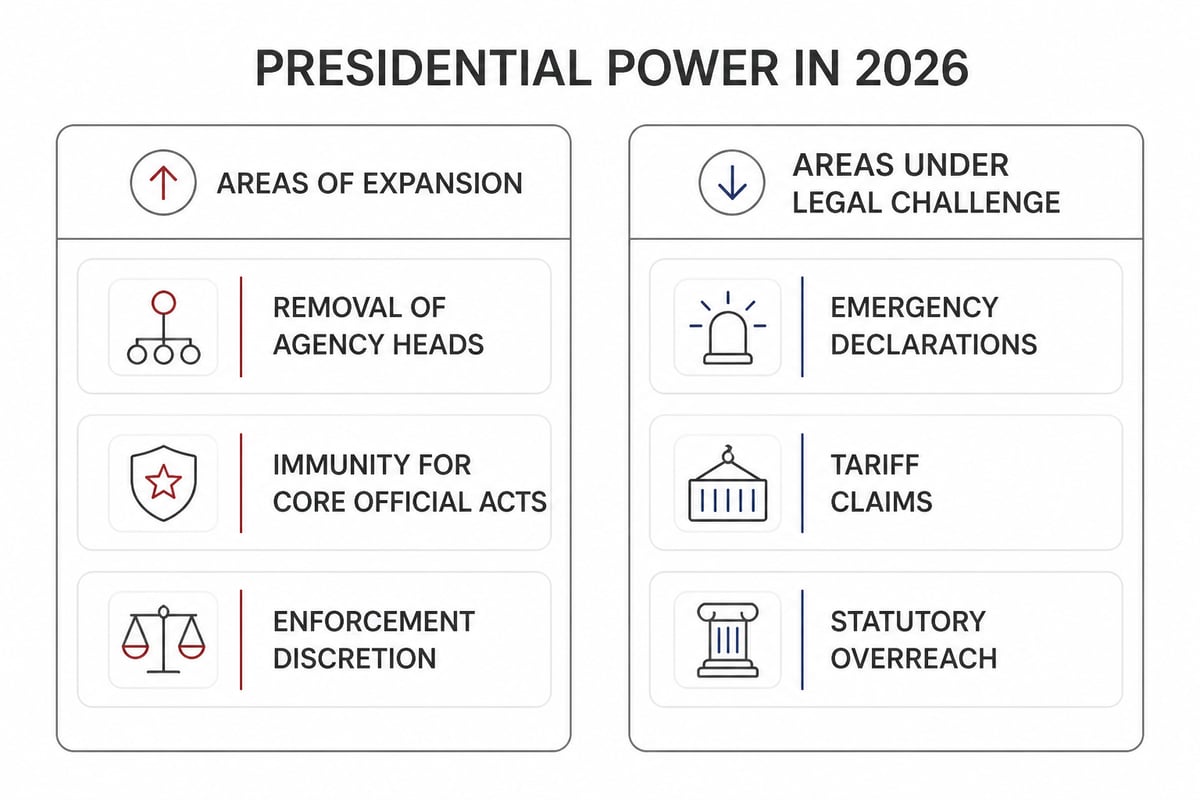
That growth is uneven, though. Courts have both expanded and trimmed it, and the current direction is mixed:
- Expanded: removal authority over agency heads, immunity for core official acts, and wide discretion over enforcement priorities.
- Constrained: claims that stretch statutes beyond their text, such as novel uses of emergency or tariff authority, which face active litigation.
The useful frame for 2026 is not a single rising line. It is a presidency with stronger command over its own branch and, at the same time, more frequent legal tests of policies that reach outside it. Our look at Supreme Court rulings vs executive authority challenges follows that tension case by case.
Who Can Overrule a Presidential Executive Order?
Three bodies can overrule or undo a presidential executive order: the courts, Congress, and the president who issued it or a successor. Each works differently.
Courts. A federal court can strike down an order that exceeds constitutional or statutory authority, and judges can pause enforcement while a case proceeds. Recent Supreme Court review of executive actions is covered in our coverage of executive orders under Supreme Court review and the wider 2026 executive authority legal challenges.
Congress. Lawmakers can pass legislation that overrides an order, though if the president vetoes such a bill, it takes a two-thirds vote in both chambers to override the veto. Congress can also withhold funding or amend the statute an order depends on.
The president. An executive order can be revoked or replaced by a later order at any time. This is also the answer to whether a future president can reverse a predecessor's orders: generally yes, by issuing new orders, though reversals that conflict with statutes or require agency rulemaking can take months and face their own legal review.
The limit on reversal is procedural. An order that only directed internal agency behavior can be rescinded quickly. An order that already produced final rules, contracts or benefits cannot simply vanish, because those actions must be unwound through the process the law requires.

What the Comparison Means for Policy Areas Readers Follow
The difference between 2024 and 2026 shows up most clearly in specific policy areas, where orders are the primary tool. A reader who follows one issue closely can use the order numbering from the Federal Register to find every directive touching that issue, then check whether each one moved into agency rules, litigation or legislation.
- Energy. The 2026 approach centers on expanded production and permitting, as outlined in our coverage of the America First energy plan. Orders in this area tend to direct agencies to speed reviews, so the practical question is whether the underlying permitting statutes support the faster timelines.
- Border and immigration. Funding and enforcement choices are covered in the America First border funding analysis and the illegal immigration statistics for 2026. Enforcement priorities sit within executive discretion, while spending depends on appropriations from Congress.
- Technology. Artificial intelligence policy has been driven by executive action and shifting deadlines, as reported in the AI executive order delay. With no governing federal statute, an order is often the only instrument available.
- Firearms. Regulatory changes appear in our report on gun regulations rollback in 2026. Rolling back an existing rule generally requires agency rulemaking, not a signature alone.
In each of these areas, policy often moves first through executive action, then faces litigation, and only sometimes becomes statute.
A Practical Way to Compare Any Two Years
You can apply a consistent method to compare executive power across any pair of years, including future ones. The Federal Register supplies the primary data, so you do not need to rely on summaries.
- Count the orders using the Federal Register's yearly lists, noting numbering ranges. The 2024 list runs from EO 14115 through EO 14133, and the 2026 list from EO 14372 through EO 14438, so the subtraction is simple. Remember that publication typically follows signing by at least a day, so a count taken in the final weeks of a year may be incomplete.
- Read the subject lines to separate substantive orders from ceremonial or administrative ones. An order that creates a new directive for several agencies carries more weight than one that adjusts a single program's name or schedule.
- Check other presidential documents such as memoranda and determinations, which can carry real policy weight. A year with fewer orders may still show heavy activity in this category.
- Track litigation on each major order to see which survive court review. Note whether courts paused enforcement early or allowed the policy to proceed.
- Note congressional response, including funding limits and oversight hearings. Appropriations language often reveals whether Congress accepted or resisted a presidential priority.
This method keeps the comparison grounded in documents rather than rhetoric, and it can be applied regardless of which party holds the White House.
FAQ
Can the next President reverse all of Trump's executive orders?
A new president can revoke most executive orders by issuing new ones, since orders rest on presidential authority rather than statute. Orders that have already produced final regulations, contracts or funded programs usually require a formal process to unwind, which can take months and invite legal challenges.
What are the 7 executive powers?
The commonly cited executive powers are issuing executive orders, appointing and removing officers, serving as commander in chief, granting pardons, conducting diplomacy and making treaties with Senate approval, vetoing legislation, and ensuring that laws are faithfully executed. Scholars sometimes group or list them differently, but the Constitution's Article II is the source for all of them.
Do executive orders have the force of law?
Executive orders carry legal force when they rely on a constitutional power or a valid delegation from Congress. They cannot override statutes or the Constitution, and courts can strike them down when they exceed those boundaries.
To keep up with how these powers are tested in court and in Congress, follow the Federal Register's presidential documents pages and compare new orders against the checklist above. U.S. Presidential Report publishes daily, non-partisan coverage of presidential action, and our readers who want to discuss it with others can Start Your Own Political Club around the stories they follow most closely.