The federal government landscape is undergoing significant transformation as federal agency restructuring 2026 initiatives take shape across multiple departments. This year marks a pivotal moment for government operations, with proposed budget cuts, departmental consolidations, and workforce reductions affecting agencies from the Department of Homeland Security to the Small Business Administration. These changes reflect broader efforts to streamline federal operations, reduce spending, and refocus agency missions on core priorities. Understanding these restructuring efforts is essential for anyone following presidential policy decisions and their impact on governance.
Overview of Federal Agency Restructuring 2026
The current administration's approach to federal agency restructuring 2026 represents one of the most comprehensive reorganization efforts in recent decades. Multiple agencies are implementing structural changes designed to eliminate redundancies, reduce operational costs, and improve service delivery to American citizens.
These restructuring initiatives stem from the FY2026 budget proposal, which outlines massive cuts and agency eliminations across the federal government. The budget document serves as a blueprint for transformation, identifying specific departments targeted for consolidation or reduction.
Key drivers behind federal agency restructuring 2026 include:
- Budget deficit reduction priorities
- Elimination of duplicative programs
- Technology modernization requirements
- Workforce efficiency improvements
- Mission refocusing across departments
The restructuring efforts vary significantly by agency, with some departments facing complete reorganization while others experience targeted adjustments to specific offices or programs.

Department of Homeland Security Reorganization
The Department of Homeland Security represents a major focus area within federal agency restructuring 2026 plans. The administration has proposed folding the DHS Office of Intelligence and Analysis into headquarters, a move designed to streamline intelligence operations and reduce administrative overhead.
This consolidation affects one of DHS's key analytical units, which has faced criticism regarding operational effectiveness and resource utilization. By integrating this office directly into departmental leadership, officials aim to improve coordination between intelligence gathering and operational decision-making.
Impact on Intelligence Operations
The DHS restructuring raises important questions about intelligence capabilities and inter-agency cooperation. The Office of Intelligence and Analysis currently serves as a critical node connecting federal, state, and local law enforcement with national security intelligence.
| Current Structure | Proposed Structure | Expected Outcome |
|---|---|---|
| Standalone office | Integrated into HQ | Reduced overhead |
| Separate leadership | Direct HQ reporting | Faster decisions |
| Independent budget | Consolidated funding | Cost savings |
| Multiple layers | Streamlined hierarchy | Improved efficiency |
These changes reflect broader trends in crime and public safety policy, where the administration seeks to balance security requirements with fiscal responsibility.
Small Business Administration Transformation
Perhaps the most dramatic example of federal agency restructuring 2026 involves the Small Business Administration. The SBA announced an agency-wide reorganization that includes a 43% workforce reduction and significant consolidation of functions.
This restructuring eliminates what administrators characterized as wasteful spending while refocusing the agency on core small business support services. The reorganization represents a fundamental reimagining of how the federal government supports entrepreneurship and small business development.
Major components of SBA restructuring include:
- Consolidation of regional offices
- Elimination of duplicative grant programs
- Digitization of loan application processes
- Streamlined disaster assistance procedures
- Reduced administrative staffing levels
The SBA transformation directly impacts economy and tax policy considerations, as small businesses play a crucial role in economic growth and job creation.
Workforce Reduction Strategy
The 43% workforce reduction at SBA represents one of the largest proportional cuts in federal agency restructuring 2026 efforts. This reduction follows specific procedures designed to balance operational needs with budget constraints.
The administration has proposed changes to how these reductions occur. OPM’s proposed rule to prioritize performance over tenure in Reduction in Force procedures could significantly impact which employees remain after restructuring completes.
This policy shift moves away from the traditional "last in, first out" approach, instead emphasizing employee performance ratings and skill sets needed for future operations.
Federal Aviation Administration Modernization
The FAA provides another significant case study in federal agency restructuring 2026 initiatives. The FAA announced a comprehensive reorganization focused on enhancing safety, embracing innovation, and increasing transparency.
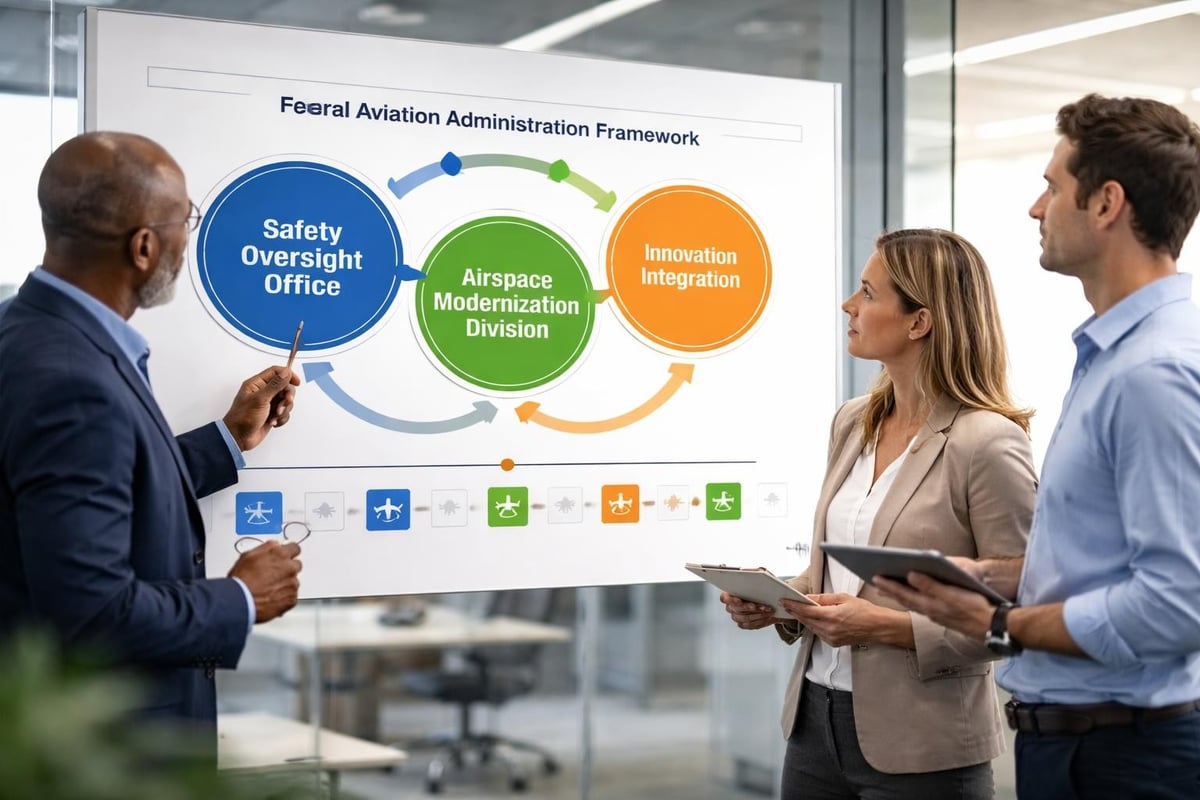
This restructuring creates new offices specifically designed to address emerging aviation challenges while consolidating overlapping functions.
New Organizational Components
The FAA reorganization establishes several new entities within the agency structure:
- Safety Oversight Office: Centralized safety monitoring and enforcement
- Airspace Modernization Office: Next-generation air traffic control development
- Innovation Integration Division: Emerging technology evaluation and implementation
These new offices reflect the agency's dual mandate to maintain the world's safest aviation system while accommodating technological advancement in areas like unmanned aircraft systems and advanced air mobility.
| Traditional FAA Structure | Modernized FAA Structure |
|---|---|
| Regional safety offices | Centralized Safety Oversight Office |
| Distributed modernization efforts | Dedicated Airspace Modernization Office |
| Ad-hoc innovation review | Structured Innovation Integration Division |
| Siloed technology adoption | Cross-functional technology teams |
The FAA restructuring demonstrates how federal agency restructuring 2026 efforts balance operational continuity with necessary transformation.
Budget Implications and Fiscal Impact
Federal agency restructuring 2026 carries significant budgetary implications that extend beyond immediate cost savings. The FY2026 budget proposal projects multi-year savings through reduced personnel costs, consolidated facilities, and eliminated programs.
Projected Cost Savings
Initial analyses suggest federal agency restructuring 2026 could generate billions in annual savings once fully implemented. However, restructuring itself requires upfront investment in severance packages, technology upgrades, and organizational change management.
Cost considerations include:
- Employee buyout and early retirement packages
- Technology system integration and upgrades
- Office consolidation and facility closures
- Contract renegotiation and termination fees
- Training programs for remaining workforce
The administration argues these upfront costs represent necessary investments that will yield substantial long-term fiscal benefits. Critics question whether projected savings account for potential operational disruptions and service quality impacts.
Workforce and Employee Impact
The human dimension of federal agency restructuring 2026 represents perhaps its most significant and challenging aspect. Tens of thousands of federal employees face potential job loss, reassignment, or role changes as agencies implement restructuring plans.
Performance-Based Retention
The proposed shift toward performance-based retention during Reductions in Force fundamentally changes federal employment dynamics. Under traditional systems, employees with longer tenure received priority protection during workforce reductions.
The new approach prioritizes:
- Recent performance evaluation ratings
- Critical skill sets for future operations
- Position classification and grade level
- Veterans preference (retained from existing rules)
- Tenure as a secondary factor
This change aims to retain high-performing employees while providing agencies flexibility to align workforce capabilities with restructured missions.

Cross-Agency Coordination Challenges
Implementing federal agency restructuring 2026 across multiple departments simultaneously creates complex coordination challenges. Agencies with interconnected missions must ensure restructuring efforts don't disrupt critical inter-agency cooperation.
The Office of Management and Budget serves as the central coordinator, but individual agencies maintain responsibility for implementation details. This distributed approach creates both opportunities and risks.
Coordination challenges include:
- Maintaining information sharing between restructured agencies
- Preserving critical inter-agency partnerships
- Synchronizing technology system integrations
- Managing shared service provider relationships
- Coordinating physical facility consolidations
Some agencies share personnel, facilities, or technology infrastructure, requiring careful sequencing of restructuring activities to avoid operational disruptions.
Transparency and Public Accountability
Federal agency restructuring 2026 raises important questions about governmental transparency and public accountability. As agencies eliminate offices and consolidate functions, maintaining public access to services and information becomes critical.
Reporting Requirements
The administration established reporting requirements to track restructuring progress and outcomes. Agencies must submit quarterly updates detailing:
| Reporting Element | Required Detail | Review Authority |
|---|---|---|
| Workforce changes | Position eliminations and reassignments | OPM and OMB |
| Budget savings | Actual vs. projected cost reductions | OMB and Congress |
| Service metrics | Public-facing service delivery statistics | Agency inspectors general |
| Implementation timeline | Milestones achieved and remaining | OMB coordination office |
These reporting mechanisms aim to ensure restructuring achieves stated objectives while maintaining essential government functions.
Interested readers can follow ongoing developments in foreign policy and other presidential policy areas as restructuring continues throughout 2026.
Long-Term Implications for Federal Governance
Federal agency restructuring 2026 represents more than temporary organizational adjustments. These changes could fundamentally reshape how the federal government operates for years to come, establishing new precedents for agency structure and workforce management.
The emphasis on performance over tenure in personnel decisions may permanently alter federal employment culture. Similarly, consolidated agency structures might prove difficult to reverse even if future administrations favor different organizational approaches.
Potential long-term effects include:
- Permanent reduction in federal workforce size
- Increased reliance on contractors and private sector partnerships
- Technology-driven service delivery as default approach
- Reduced geographic distribution of federal offices
- Changed relationship between agencies and stakeholders
These implications extend across democracy and governance considerations, affecting how citizens interact with their government and how effectively federal agencies fulfill constitutional responsibilities.
The restructuring also influences healthcare policy implementation, regulatory enforcement, and numerous other policy areas where agency capacity directly affects outcomes.
Political Context and Congressional Oversight
Federal agency restructuring 2026 occurs within a complex political environment where different stakeholders hold varying perspectives on appropriate government size and function. Congressional oversight plays a crucial role in shaping how restructuring proceeds.
Legislative Branch Response
Congress maintains constitutional authority over agency budgets and structures, giving legislators significant influence over restructuring outcomes. Committee hearings have examined proposed changes, with members expressing concerns about service delivery impacts and workforce reductions.
Some legislators support restructuring as necessary fiscal discipline, while others worry about diminished governmental capacity to address critical challenges. This political dynamic influences implementation timelines and final restructuring configurations.
The debate reflects broader ideological divisions about government's proper role in American society, making federal agency restructuring 2026 both a practical administrative matter and a political statement about governance philosophy.
Federal agency restructuring 2026 represents a transformative moment in American governance, with implications spanning budget policy, workforce management, and service delivery across the executive branch. These changes will continue evolving as agencies implement restructuring plans and stakeholders assess early outcomes. For comprehensive, non-partisan coverage of how presidential decisions shape federal agencies and impact American governance, U.S. Presidential Report provides timely analysis and updates on restructuring developments and their broader policy implications.