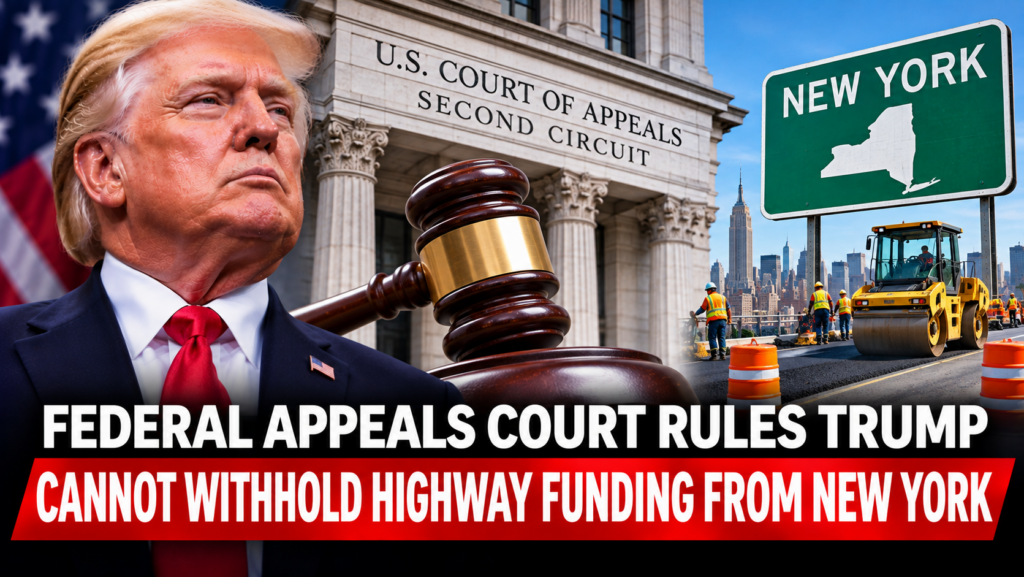
A federal appeals court has ruled that the Trump administration exceeded its authority when it withheld $73.5 million in highway funding from New York, siding with the state in a dispute over commercial driver’s licenses issued to foreign drivers. The decision by the Second U.S. Circuit Court of Appeals challenges the federal government’s authority to use transportation funding as leverage in enforcing its licensing requirements.
According to a report by Reuters, the U.S. Department of Transportation (USDOT) suspended the funding in April after New York refused to revoke certain commercial driver’s licenses. The court found that the department’s decision exceeded its legal authority and failed to comply with fair-notice principles.
Why the Trump Administration Withheld New York Highway Funding
The dispute began after a USDOT audit found that New York had routinely issued commercial driver’s licenses to foreign drivers in violation of federal requirements. The department subsequently demanded that the state revoke certain licenses and withheld $73.5 million in highway funding when New York refused.
The federal government argued that the state needed to address the licensing practices identified in the audit. New York challenged the funding suspension, arguing that the federal department had exceeded its authority by imposing financial penalties over the licensing dispute.
The USDOT had also threatened to withhold an additional $147 million annually if New York did not comply with its demands, increasing the potential financial consequences for the state.
Second Circuit Says Transportation Department Exceeded Its Authority
The Second Circuit ruled that the USDOT’s decision went beyond its legal authority. The court said the department’s action violated fair-notice principles, departed from the wording of existing regulations and underestimated the complexity of the requirements it sought to enforce.
The ruling means the federal government could not lawfully withhold the $73.5 million on the basis used in this case. It does not, however, resolve every dispute between federal transportation authorities and New York over commercial driver’s licenses.
Spokespeople for Transportation Secretary Sean Duffy and New York Governor Kathy Hochul did not immediately comment on the decision, according to Reuters.
New York Warned of Economic and Public-Service Consequences
New York argued that losing the highway funding could harm residents and disrupt industries that depend on commercial drivers. The state specifically warned that revoking the affected licenses could create driver shortages in key sectors and affect school transportation services.
The state also raised concerns about the broader economic consequences of restricting commercial driving eligibility. Transportation, logistics and other industries rely on qualified drivers to maintain supply chains and daily operations.
The dispute therefore extends beyond federal-state authority. It also concerns how changes to commercial licensing requirements could affect businesses, public services and workers across New York.
A Wider Pattern of Federal Transportation Funding Disputes
The ruling comes amid several legal disputes between the Trump administration and states or cities over federal transportation funding. New York, California and other jurisdictions have challenged federal decisions to withhold or suspend money for infrastructure projects, arguing that some actions exceeded the government’s legal authority.
Earlier court decisions required the Transportation Department to continue payments for the $16 billion Hudson Tunnel rail project connecting New York and New Jersey. Another ruling blocked federal efforts to terminate New York City’s congestion pricing program.
In Chicago, a judge also ordered the department to unfreeze approximately $3 billion in funding for rail projects after the government suspended reimbursements for previously approved grants. The city had described the funding suspension as unlawful political retaliation.
What the Ruling Means for Federal-State Relations
The Second Circuit’s decision establishes a limit on how the Transportation Department can use federal highway funding to enforce licensing requirements. Federal agencies must act within their statutory authority and follow the regulatory procedures that govern their decisions.
For New York, the ruling represents a legal victory in its challenge to the funding suspension. More broadly, it adds to the series of court disputes over the Trump administration’s use of federal funding to influence state and local policy decisions.
The case highlights the importance of clear legal authority and fair notice when federal agencies impose financial consequences on states. As similar disputes continue, the courts will remain central to determining the limits of executive power over infrastructure funding and state-level decisions.
Related Reading
- Trump Administration’s Push for Perpetual Futures Raises Wall Street Risk Concerns
- Richard Walters Leaves White House Deputy Chief of Staff Role Ahead of Stephen Miller’s Arrival
The Transportation Department withheld $73.5 million after New York refused to revoke certain commercial driver’s licenses issued to foreign drivers.
The Second Circuit ruled that the Transportation Department exceeded its legal authority and violated fair-notice principles when it withheld the funding.