Republican vs Democrat immigration policy in 2026 comes down to a core disagreement: Republicans prioritize border enforcement, mass removals and reduced legal admissions, while Democrats favor targeted enforcement, protections for long-resident immigrants, asylum access and legal pathways. Both parties say they want a secure border and a functioning legal system. They differ sharply on how to get there, what to do about the roughly millions of people already living in the country without status, and how much power the executive branch should have.
This guide compares the two parties' positions, what the data shows so far, and where the biggest fights are playing out in Congress, the courts and the states.
How Do Democrats and Republicans Differ on Immigration?
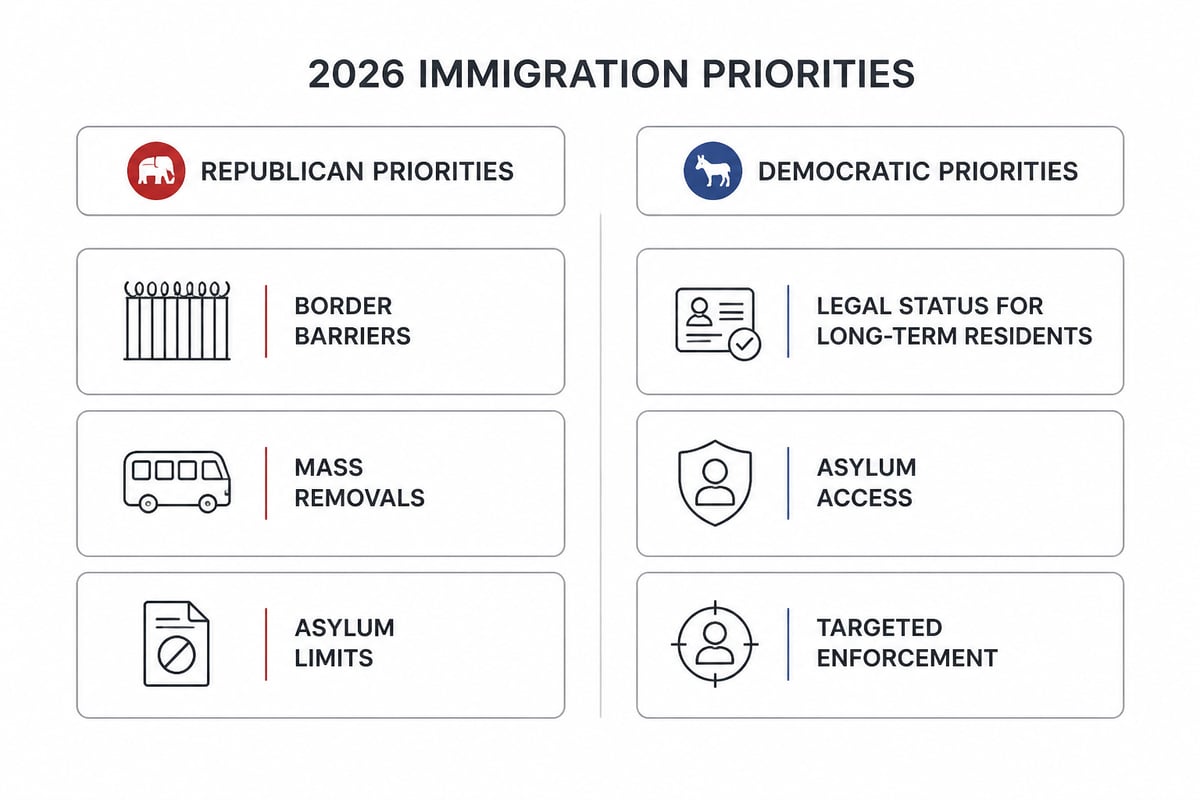
Democrats and Republicans differ most on the balance between enforcement and humanitarian protection, and on whether people living in the country without authorization should ever receive legal status.
The table below summarizes the main points of divergence.
| Issue | Republican position | Democratic position |
|---|---|---|
| Border security | Physical barriers, more agents, strict limits on entry between ports | Technology, staffing and port-of-entry processing alongside enforcement |
| Interior enforcement | Broad enforcement, large-scale removals, expanded detention | Priority on serious criminal threats, limits on sensitive-location arrests |
| Asylum | Tighter eligibility, faster denials, restrictions on claims | Preserve access to a hearing, invest in courts and processing |
| Legal immigration | Merit-based tilt, lower overall levels, limits on family categories | Maintain family and employment categories, reduce backlogs |
| Undocumented residents | Removal, no amnesty | Legalization paths for long-term residents and Dreamers |
| Federal-state role | State cooperation with federal agents encouraged | Limits on local cooperation in many Democratic-led states |
Neither party is monolithic. Republicans are divided between business-aligned members who want a workable labor supply and hardliners who want deep cuts to legal immigration. Democrats are split between members who emphasize enforcement credibility in swing districts and progressives who want to curtail detention and deportation operations. For more on how these internal tensions play out, see this look at Democratic Party internal divisions in 2026.
What Is the Republican Party's Stance on Immigration?
The Republican Party's stance in 2026 centers on border control first, large-scale interior enforcement second, and a more selective legal immigration system third.
The party's core commitments include:
- Border barriers and surveillance: continued wall construction and expanded patrol capacity.
- Large-scale removals: prioritizing deportation of people without legal status, with an emphasis on criminal records but not limited to them.
- Ending catch-and-release: holding or rapidly removing people rather than releasing them into the interior pending hearings.
- Asylum restrictions: narrowing eligibility and speeding adjudication so fewer claims succeed.
- Reforming legal immigration: favoring skills and employment over family ties, and curbing programs the party views as exploited.
- Opposing sanctuary policies: pressuring cities and states that limit cooperation with federal immigration authorities.
Republicans argue that enforcement creates deterrence, protects wages for American workers and restores public confidence in the legal system. Their opponents argue that mass removal is costly, disrupts industries that depend on immigrant labor and risks wrongful removals. The economic impact of illegal immigration remains one of the most contested parts of this debate.
What Do Democrats Propose on Immigration?
Democrats propose a mix of border management, targeted enforcement and expanded legal pathways, with an emphasis on due process and humanitarian protection.
Common Democratic positions in 2026 include:
- Legal status for long-term residents. Many Democrats support earned legalization for people who have lived in the country for years, with particular attention to Dreamers, farmworkers and those with U.S. citizen family members.
- Asylum access. Democrats generally defend the right to request protection and want more immigration judges and asylum officers to cut case backlogs, rather than blanket limits on who may apply.
- Narrower enforcement priorities. The party favors focusing resources on national security threats and serious criminals instead of broad sweeps, and many support limits on arrests at schools, churches and hospitals.
- Detention oversight. Calls for stricter standards, inspections and congressional access at facilities have grown, a theme covered in this report on immigration detention policy.
- Legal immigration reform. Democrats back reducing visa backlogs and keeping family-based categories intact.
Democratic leaders also stress that they support border security funding, particularly for technology and port-of-entry staffing. For a fuller treatment of the party's agenda, see this explainer on Democrat immigration policies.
Has Immigration Decreased Under Trump?
Yes, border encounters fell sharply during the first year of President Trump's second term, according to U.S. Customs and Border Protection (CBP) data.
CBP recorded 691,906 total enforcement encounters in fiscal year 2025, compared with 2,901,142 in fiscal year 2024, according to CBP’s FY 2025 enforcement statistics. That is a steep decline in a single year.
Monthly figures show the same trend. In May 2025, Border Patrol recorded 8,725 encounters between ports of entry on the southwest border, 93% fewer than the 117,905 recorded in May 2024, per CBP’s May 2025 monthly update. By July, CBP reported 24,628 nationwide encounters, which the agency described as the lowest monthly total in its history at that time, according to its July release.
Several points of context matter when interpreting these numbers:
- Encounters measure attempts, not total migration. Fewer encounters can reflect deterrence, but they do not capture people who enter undetected or visa overstays.
- Policy and enforcement drove the shift. Republicans credit asylum restrictions and stricter enforcement, while critics note that declines had begun in late 2024 under executive actions taken during the Biden administration.
- Interior numbers tell a different story. Declines at the border sit alongside expanded arrests, detention and removals inside the country, which is where much of the political and legal fight now occurs.
For a broader numerical picture, the site's illegal immigration statistics for 2026 page tracks updated data.
What Is the New Immigration Law for 2026?
No single comprehensive immigration law defines 2026; the changes come mainly from executive actions, funding legislation, agency rules and court rulings rather than one new statute.
The policy landscape is shaped by several moving parts:
- Executive orders and agency directives govern asylum processing, enforcement priorities and detention capacity.
- Appropriations and reconciliation funding supply money for enforcement, detention beds and border infrastructure. Republicans used the reconciliation process to pursue parts of their agenda, as described in this report on the Republican reconciliation plan.
- Court decisions determine which actions can take effect. The Supreme Court and Trump immigration policy has been a recurring focus as lower courts block some measures and appellate courts reverse others.
- Asylum enforcement changes continue to evolve, as tracked in this asylum policy enforcement update for 2026.
Readers hearing about a "new immigration law" should check whether the item in question is a statute passed by Congress, an executive order, or an agency rule, because each carries a different level of permanence and legal vulnerability.
Where the Parties Clash Over Enforcement and Detention
The sharpest disagreement in 2026 is not about whether to enforce immigration law but about how far interior enforcement should reach and how detained people should be treated.
Republicans emphasize that expanded removals restore the rule of law and note that enforcement has targeted people with criminal records. CBP reported 12,962 criminal noncitizens encountered in its Office of Field Operations and 8,814 in Border Patrol statistics for fiscal year 2025, according to the agency's enforcement data. Supporters cite these figures to argue that enforcement protects public safety.
Democrats and immigrant advocates respond that broad operations also sweep up people with no criminal history, including long-term residents with U.S. citizen families. They press for judicial warrants in some contexts, independent oversight of detention conditions and limits on military or National Guard involvement in civilian enforcement.
The most active flashpoints include:
- Detention capacity and conditions, including the use of warehouses and temporary facilities.
- Workplace raids and their effect on agriculture, construction and food processing.
- Sanctuary jurisdictions, where federal funding and state authority collide.
- Due process, including how quickly removals can occur and what review is available.
The distinction between immigration policy and border security policy is easy to blur, and this comparison of immigration policy vs border security policy helps separate the two.
Asylum and the Southwest Border
Asylum is where border enforcement and humanitarian law meet, and it is where the two parties' approaches produce the starkest numerical contrasts.
Southwest-border credible-fear inadmissibles were far lower by September 2025 than at the start of the fiscal year, according to CBP’s custody and transfer statistics. The drop reflects both fewer arrivals and a changed process for those who do arrive.
Southwest Border Patrol apprehensions have also stayed low and relatively stable, per CBP’s nationwide encounter data.
The partisan framing differs:
- Republican view: Tighter rules ended abuse of the asylum system and removed the incentive to cross illegally.
- Democratic view: Restrictions risk returning legitimate refugees to danger, and the right answer is faster, fairer adjudication rather than closing the door.
Courts remain central. Litigation over whether the executive branch can suspend or restrict asylum access has produced conflicting rulings, and outcomes could shift the data again.
State Politics, Congress and the Midterm Landscape
Immigration in 2026 plays out differently in Congress, state capitols and campaigns, and the political incentives for each party are not identical.
In Congress, Republicans have focused on funding enforcement and passing measures through reconciliation, while Democrats use appropriations leverage and oversight hearings to press for detention reforms and limits on certain tactics. Divided or narrow majorities make comprehensive legislation unlikely, so most movement comes through budgets, riders and oversight.
At the state level, the divide is geographic. Republican-led states such as Texas and Florida have expanded cooperation with federal agents and passed their own enforcement measures. Democratic-led states have limited local assistance with federal immigration enforcement and expanded legal aid. These conflicts often end up in federal court.
Voter attitudes add pressure to both sides. Immigration was a defining issue in the last presidential cycle, as covered in this look at immigration as the defining issue in the 2024 election, and it continues to shape midterm messaging. Republicans tend to benefit when the focus is border security and crime. Democrats tend to gain when attention turns to enforcement excesses, family separation and economic disruption. Turnout patterns also matter, as detailed in this analysis of Democrat vs Republican voter turnout trends in 2026.
Why Presidential Power Is the Hidden Variable in Republican vs Democrat Immigration Policy 2026
The biggest structural difference in Republican vs Democrat immigration policy in 2026 is how each party views the limits of executive authority, and that view tends to flip depending on which party holds the White House.
Congress has not passed major immigration legislation in decades, so presidents of both parties have governed through executive orders, enforcement memos, parole programs and emergency declarations. This creates three practical consequences:
- Policy is reversible. Actions taken by one administration can be undone by the next, which makes long-term planning difficult for employers, families and states.
- Courts become the real policymakers. When Congress is gridlocked, judges decide whether executive actions survive, which is why Supreme Court rulings carry such weight.
- Emergency powers expand the toolbox. Border emergencies and national security claims give presidents wide latitude, a topic explored in this review of presidential emergency powers in 2026.
Republicans currently defend broad executive action as necessary to address what they call a crisis. Democrats, who used executive tools during their own time in power, now argue that this authority is being stretched beyond lawful limits. Observers tracking the issue should watch the courts as closely as Congress, since the durability of any policy depends on legal outcomes more than on rhetoric.
FAQ
Do Republicans and Democrats agree on anything about immigration?
Yes. Both parties generally support border security funding, deportation of people who pose serious public safety or national security threats, and some form of reform for visa backlogs. They diverge on scale, tactics and what happens to long-term residents without legal status.
Will Congress pass a comprehensive immigration bill in 2026?
It is unlikely. Narrow majorities, filibuster rules and deep disagreement over legalization versus enforcement make a sweeping bill improbable. Most changes are expected to come through executive action, funding measures and court rulings.
Which party do voters trust more on immigration?
Polling varies by question and by month. Republicans have often held an edge on border security, while Democrats tend to do better on questions about enforcement tactics, deportation of long-term residents and legal pathways. Public opinion has shifted as enforcement operations moved from the border into the interior.
Start by tracking the primary data yourself: review the latest CBP monthly releases and compare them against court rulings as they land. For daily coverage of how immigration policy moves through the White House, Congress and the courts, U.S. Presidential Report offers non-partisan reporting you can follow, and you can use it to Start Your Own Political Club where friends and neighbors can discuss the issues with reliable facts in hand.