In federal vs state authority 2026 disputes, the federal government holds only the powers the Constitution grants it, the states keep the rest, and valid federal law wins whenever the two collide. That simple rule produces constant conflict, because many policy areas involve both levels of government and the line between them is drawn case by case by the courts.
For readers who follow the presidency, Congress and the courts, this framework explains why a single executive order, spending bill or enforcement directive can set off lawsuits from a dozen governors within days. The sections below lay out the constitutional basics, the tools each side uses, the issue areas where the fights are sharpest this year, and a method for judging who is likely to prevail.
How Does the Constitution Divide Power Between Washington and the States?
The Constitution divides power through federalism, which the Library of Congress Constitution Annotated describes as the division and sharing of power between the national and state governments. Washington is a government of limited, listed powers. The states hold authority over powers not delegated to the federal government.
Three provisions do most of the work:
- Enumerated powers (Article I, Section 8). Congress may act only within powers the Constitution specifies or implies, as the Congressional Research Service explains. Taxing, spending, regulating interstate commerce, declaring war and coining money are among them.
- The Tenth Amendment. Powers not delegated to the United States, or prohibited to the states, are reserved to the states or the people, according to the Constitution Annotated.
- The Supremacy Clause (Article VI). Valid federal law is supreme over conflicting state law when Congress intends that result, a principle the Congressional Research Service summarizes in its review of federalism-based limits on congressional power.
States generally exercise what is often called the police power, covering areas such as health, safety and most criminal law. Washington does not hold a general police power. It must tie each action to a specific constitutional grant, which is why so many legal fights begin with the question of whether Congress or the president had authority to act at all.
What Tools Does Each Level of Government Use?
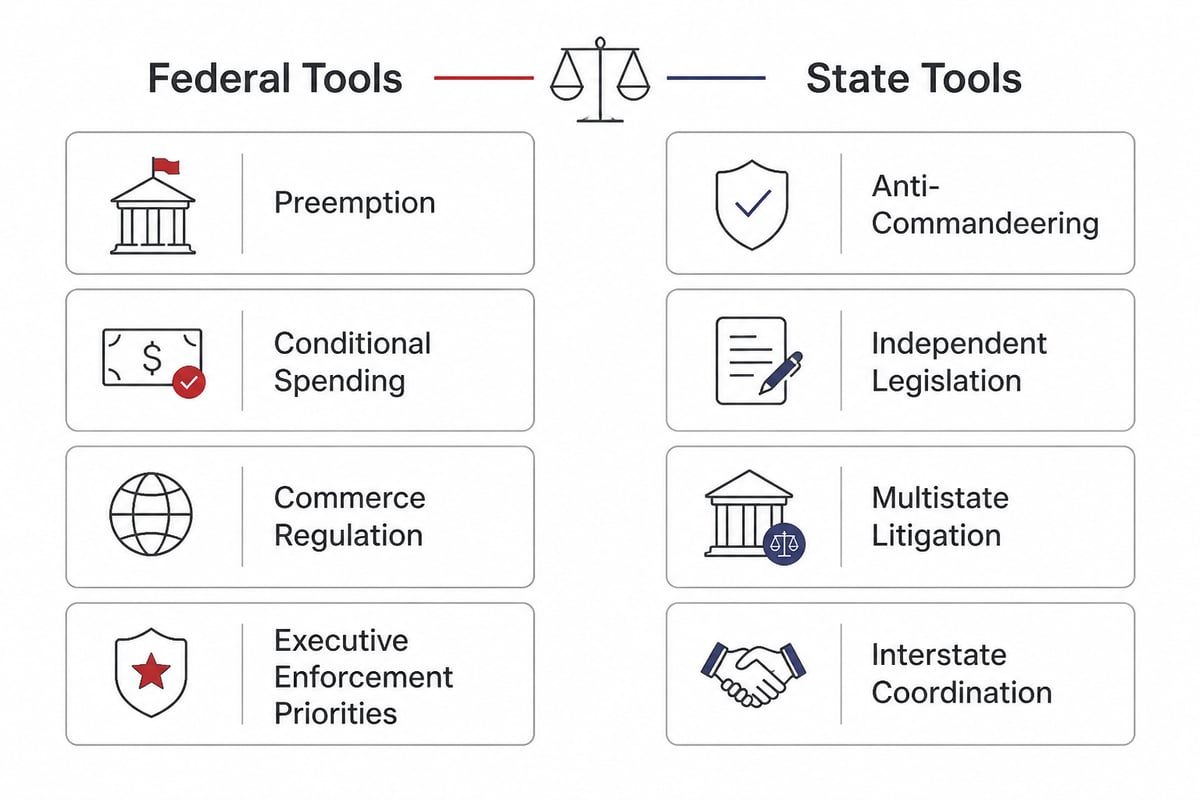
Each level of government has a distinct set of tools, and most 2026 conflicts can be traced to one of them. Knowing the tool tells you where a case is likely to be decided.
Federal tools
Washington typically relies on four instruments:
- Preemption. Congress displaces state law, expressly in statutory text or by implication when federal law occupies a field or directly conflicts with a state rule.
- Conditional spending. Federal grants carry conditions. States that decline the conditions risk losing the money, a lever courts have allowed within limits.
- Direct regulation of commerce. The Commerce Clause supports national rules on interstate markets, though the courts have set boundaries on it.
- Executive enforcement priorities. The president directs agencies on where to focus investigations, grants and prosecutions.
State tools
States answer with their own set:
- Anti-commandeering. Under the anti-commandeering principle, Washington generally cannot force state officials to carry out federal programs, which gives states leverage over cooperation.
- Independent state legislation. States write their own laws on elections, health, taxes, labor and public safety.
- Litigation. Attorneys general now file multistate suits as a routine first response to federal action.
- Interstate coordination. Groups of states adopt matching policies, creating de facto standards without federal legislation.
A federal rule that depends on state cooperation is usually weaker than it looks, and a state rule that touches a federally regulated field is usually more vulnerable than it looks. That asymmetry is a reliable guide when reading a new dispute.
Where Is Federal vs State Authority 2026 Being Contested Most?
The sharpest contests this year fall in five areas: executive power, immigration enforcement, elections, spending and energy. Each combines a federal claim of authority with a state claim of independence.
Executive power and enforcement
Disputes over how far a president may go without new legislation are central to the year's legal calendar. Our coverage of the executive authority legal challenge traces how courts are testing executive actions, and the review of presidential emergency powers explains why emergency declarations draw state objections. Reporting on federal pressure on Democratic-led states shows how funding and enforcement are used as leverage.
Immigration and sanctuary policy
States that limit cooperation with federal immigration enforcement rely on the anti-commandeering principle, while Washington relies on preemption and grant conditions. The result is litigation over which officials must share information and which benefits states may provide. A relevant example is the debate over sanctuary state policies and state-funded benefits, which shows how a state's spending choices can become a federal flashpoint.
Elections
The Constitution gives states substantial control over the administration of elections, with Congress holding power to set certain rules. That shared design makes election law a standing source of conflict. Readers can track the state-level variation in voter ID laws by state in 2026 and the national rulemaking context in the Federal Election Commission rules for 2026.
Spending and energy
Federal budget decisions flow through states as grants, and conditions on that money are a frequent trigger for suits. Energy and environmental policy also divide authority, since states regulate utilities and land use while Washington regulates interstate transmission and certain emissions. The America First energy plan is one example of a federal proposal that touches state regulatory territory.
How Do Courts Decide Who Wins?
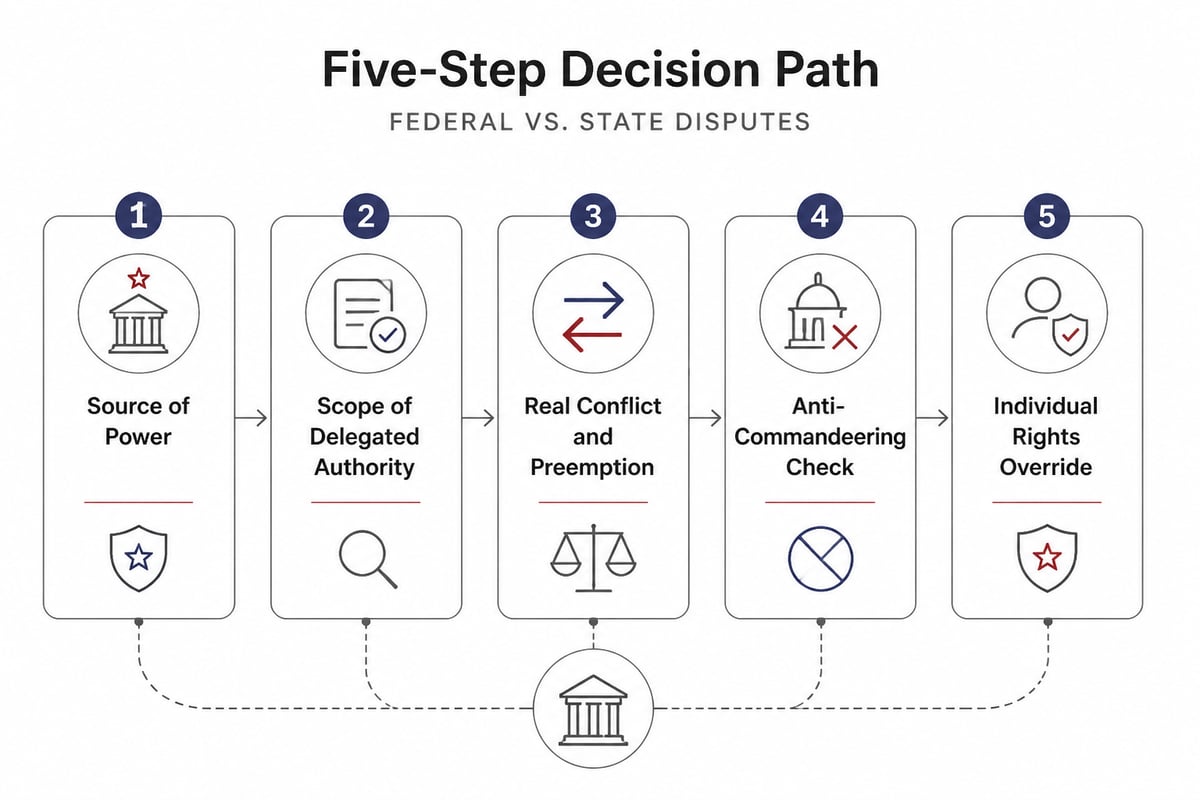
Courts often work through a short sequence of questions in these disputes, and the order matters. Applying a similar sequence yourself can help you anticipate an outcome.
- Is there a source of power? The federal government must point to an enumerated power or a valid implied one. The CRS overview of constitutional limits on Congress describes how enumerated powers and federalism constraints operate. If no source exists, the action fails before preemption is reached.
- Did Congress or the executive actually act within delegated authority? An executive action without statutory backing is on weaker ground than one resting on a clear law.
- Is there a real conflict? Preemption requires either explicit statutory language, a field Congress has occupied, or a direct clash that makes compliance with both laws impossible.
- Is a state being commandeered? If Washington orders state officials to administer a federal program, the anti-commandeering principle applies. If it merely conditions money, the analysis shifts to whether the conditions are clearly stated, related to the program, and not coercive.
- Does an individual right override both? Constitutional protections can limit federal and state action alike. Our piece on constitutional rights versus federal mandates explores that overlap.
A useful rule of thumb follows from this sequence. Statutory text generally carries more weight than presidential assertion, and clear statements generally carry more weight than implication. When a federal claim rests on a vague reading of old authority, expect a harder road in court.
Why Does Federal vs State Authority 2026 Matter for the Midterms and the Economy?
Federal vs state authority 2026 matters beyond the courtroom because it shapes campaign messaging, state budgets and the regulatory environment businesses must plan around. The same constitutional argument now appears in policy platforms, ballot fights and economic forecasts.
On the political side, candidates frame nearly every race around who should decide: Washington or the state capital. That framing runs through the Trump primaries and the contest for Senate control, where control of federal committees determines how aggressively Congress preempts or defers to states. Competitive races in key swing districts often turn on how voters feel about national mandates versus local control.
On the fiscal side, state governments depend heavily on federal transfers, so shifts in federal spending land on state budgets quickly. The analysis of the federal budget deficit and the federal spending increase breakdown show how large national decisions constrain what states can promise. Border funding is a clear case, covered in our look at border security funding status, where federal appropriations and state costs intersect.
Businesses feel the effect through compliance. A national rule offers uniformity. A patchwork of state rules creates cost and uncertainty, which is why many companies lobby for federal preemption even when they oppose a specific federal standard. Tracking small business confidence is one way to see how regulatory uncertainty registers in the economy.
How Should You Read the Next Federal-State Fight?
Reading the next dispute well takes a repeatable method rather than a partisan instinct. The following checklist applies to nearly any story about Washington and the states.
- Identify the claimed authority. Ask which constitutional provision or statute the federal side cites. If the answer is unclear, the claim is likely to be contested.
- Check who must act. If the policy depends on state officials to carry it out, expect resistance to have real force.
- Follow the money. Funding conditions are the most common lever, and the fine print of a grant often decides a case.
- Look for the statutory hook. Express preemption language in a statute is generally stronger than an agency's interpretation.
- Note the forum. Which court hears the case, and which circuit, often predicts the timeline and likely first ruling.
- Separate the legal question from the policy preference. A court can uphold a policy that is unpopular or strike down one that is popular. The question is power, not wisdom.
It also helps to watch for legal process signals. Preliminary injunctions, stays and emergency applications tell you how a court views the strength of each side long before a final ruling. The election law challenge status page is a practical example of how these procedural steps unfold in a live area of law, and a broader view of the argument appears in our explainer on the federal vs state power debate.
For a deeper look at day-to-day application, the discussion of federal authority versus state authority in policy enforcement shows how enforcement choices play out when agencies and states disagree.
What Can Change Before the End of 2026?
Several developments could shift the balance before year's end, and each is trackable in advance. Court rulings on pending executive actions are the most direct, because a single appellate decision can reset how much deference agencies receive. Congressional action is the second: a new statute with explicit preemption language can resolve a dispute faster than litigation, while a stalemate leaves the courts to fill the gap.
Elections are the third factor. The outcome of the midterms will determine whether Congress is inclined to expand federal standards or to defer to the states, and it will influence which federal-state conflicts escalate. Readers following the broader political picture can consult the House majority forecast and our running top US president news coverage for the latest developments.
The constitutional structure itself will not change this year. What changes is how aggressively each side tests it. Because federal vs state authority 2026 disputes are decided by text, precedent and procedure, the readers best positioned to anticipate outcomes are those who follow the legal steps rather than the headlines alone.
Pick one live dispute between Washington and a state this week, then apply the five-question court sequence from this article to it and see whether your read holds up as the case advances. U.S. Presidential Report publishes non-partisan news on presidents, Congress, the courts and federal policy, so you can follow each ruling as it lands, and if you want to discuss these questions with other engaged readers in your community, Start Your Own Political Club and bring the conversation to your neighbors.