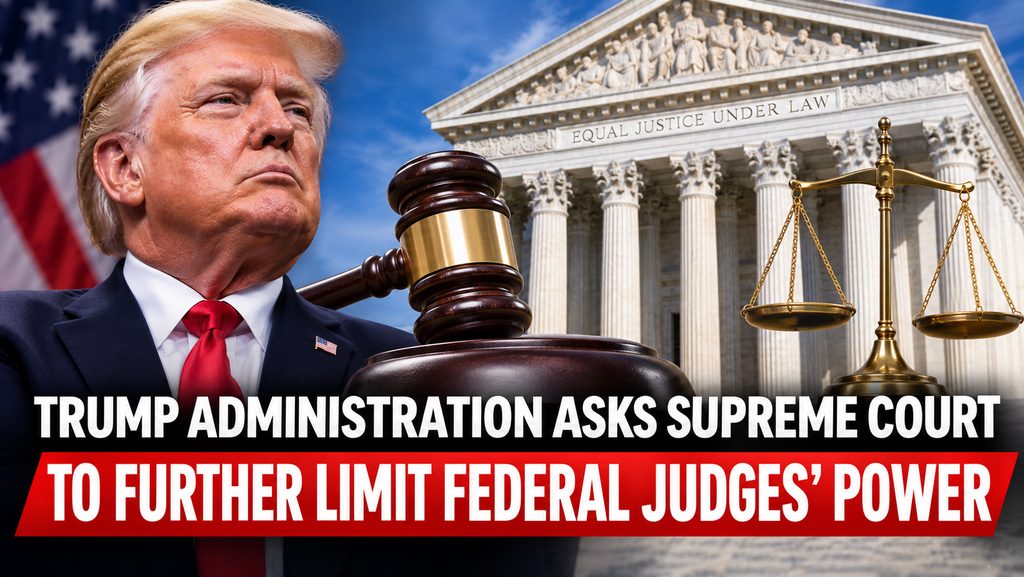
The Trump administration is asking the U.S. Supreme Court to further restrict federal judges’ authority to block government policies, opening another legal battle over the balance of power between the executive and judicial branches. The Justice Department argues that courts should generally limit relief against federal agency regulations to the specific plaintiffs who bring a lawsuit, rather than invalidate rules nationwide.
According to a report by Reuters, the appeal seeks to extend limits on judicial intervention established by a 2025 Supreme Court decision. If the justices agree, the administration could gain greater flexibility to implement federal regulations while legal challenges continue.
What Happened
The appeal before the Supreme Court stems from a legal dispute involving federal regulations designed to limit unexpected medical bills. A Texas association of medical doctors, air-ambulance providers and other plaintiffs challenged the rules, arguing that they violated the Administrative Procedure Act (APA) and artificially reduced insurance reimbursement rates.
In August 2026, the New Orleans-based 5th U.S. Circuit Court of Appeals voided parts of the regulation nationwide, citing violations of the APA. The Trump administration is not challenging the appeals court’s conclusion about the regulation’s legality. Instead, it is challenging the court’s authority to invalidate the rule nationwide.
The Justice Department argues that courts should be able to block enforcement only against the parties directly involved in a lawsuit. Its position is that the APA does not authorize judges to remove federal agency regulations from effect for everyone.
How the Legal Challenge Could Expand Presidential Power
The dispute concerns the Administrative Procedure Act, a 1946 federal law that governs how government agencies operate and implement regulations. Courts have historically interpreted the law as allowing judges to “hold unlawful and set aside” agency rules they determine are illegal.
The administration wants the Supreme Court to apply similar restrictions to those imposed on nationwide injunctions in June 2025. In Trump v. CASA, the justices limited federal judges’ ability to issue injunctions preventing the government from enforcing policies against people who were not parties to a case. However, that ruling did not resolve whether courts could use the APA to invalidate agency regulations nationwide.
A Congressional Research Service report published in July 2026 confirmed that the CASA decision left the question of nationwide relief under the APA open. The administration’s latest appeal therefore seeks to extend the limits on judicial authority into another area of federal litigation.
Opposition and Concerns Over Executive Overreach
Supporters of broad judicial remedies argue that the authority to invalidate unlawful regulations nationwide is an important safeguard against executive overreach. They also warn that limiting court decisions to individual plaintiffs could create inconsistent regulatory standards across the country.
Ronald Levin, a law professor at Washington University in St. Louis, argued that some regulations need to be removed entirely when courts determine they are unlawful. He pointed to food-safety and automobile-manufacturing standards as examples of rules that should not apply differently to different groups.
The administration could also face opposition from states that have historically challenged federal government actions. Texas, Florida and other mostly Republican-led states previously urged the 5th Circuit not to weaken the APA, arguing that it is an important tool for preventing federal overreach and protecting state sovereignty.
What Happens Next
The Supreme Court is expected to consider early in 2027 whether to take up the administration’s appeal. If the justices agree with the Justice Department, federal agencies could continue enforcing regulations against people and organizations that are not directly involved in a lawsuit, even after a court has found those rules unlawful.
Such a change could make it more difficult for individuals, organizations and state governments to secure nationwide relief against disputed federal regulations. It could also prolong legal uncertainty while affected parties pursue separate challenges.
The case represents another significant test of the limits of presidential and executive authority. Its outcome could shape how effectively federal courts can check agency actions and determine how much room future administrations have to implement policies while facing legal challenges.
Related Reading
- Trump Names Stephen Miller as 33rd White House Chief of Staff
- Trump Says AI Risks Can Be Managed, Signals Openness to Guardrails
The administration argues that courts should generally restrict legal remedies under the Administrative Procedure Act to the specific parties involved in a lawsuit, rather than invalidate federal regulations nationwide.
The Supreme Court is expected to consider early in 2027 whether to hear the administration’s appeal.