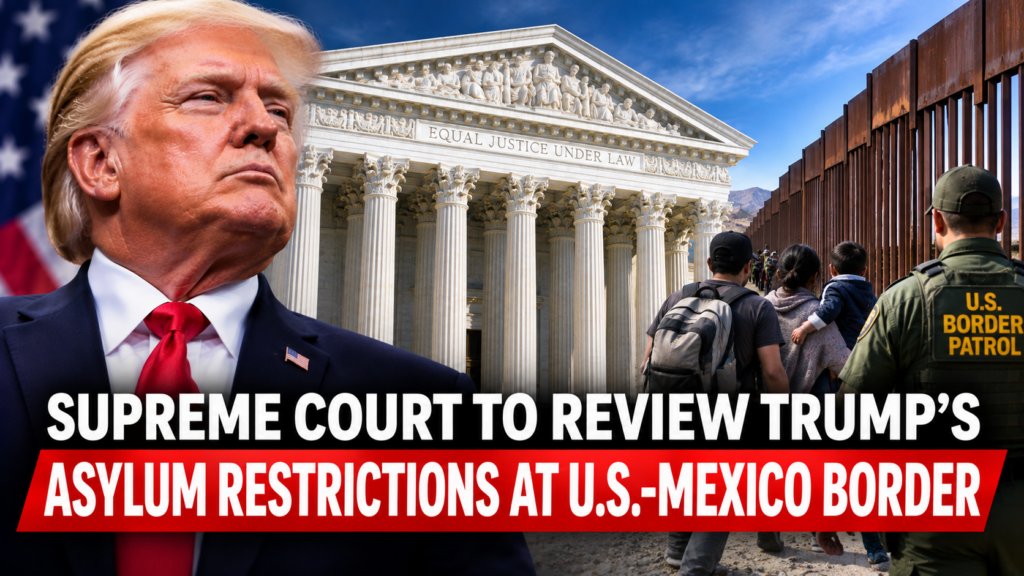
The U.S. Supreme Court has agreed to review President Donald Trump’s restrictions on asylum access at the U.S.-Mexico border, setting up a major legal test of the administration’s immigration policy. The case will determine whether the president can prevent migrants who enter the country illegally from applying for asylum and accessing other legal protections.
According to a report by Reuters, the justices accepted Trump’s appeal after lower courts ruled that his administration exceeded its authority. The Supreme Court is expected to hear arguments in the coming months and issue a decision by the end of June 2027.
What Happened: Supreme Court Takes Up Trump’s Asylum Policy
Trump introduced the restrictions on January 20, 2025, just hours after beginning his second presidential term. The policy bars migrants caught crossing the southern border illegally from pursuing asylum claims and also restricts access for certain people arriving at official ports of entry who cannot provide specified medical or criminal-history information.
The administration says the measures are intended to reduce illegal border crossings and enable faster deportations. The restrictions are set to remain in effect until Trump determines that what he describes as an “invasion” at the southern border has ended.
The Supreme Court’s decision to hear the appeal does not mean it has endorsed the policy. It means the justices will examine whether the administration had the legal authority to impose the restrictions.
Why Lower Courts Challenged the Restrictions
Immigrant-rights organizations filed a class-action lawsuit arguing that the administration unlawfully denied asylum seekers access to required legal procedures. The case includes claims that migrants were deported without receiving “credible fear” interviews, which are intended to assess whether individuals face persecution if returned to their home countries.
A federal judge in Washington ruled in favor of the immigrant-rights groups in July 2025. In April 2026, the U.S. Court of Appeals for the District of Columbia Circuit upheld that ruling, finding that the administration had exceeded its authority, although the decision was largely paused to allow the government to appeal to the Supreme Court.
The legal dispute centers on the relationship between presidential authority and federal immigration law. While the president has broad powers over border enforcement, the challengers argue that the administration cannot unilaterally eliminate protections and procedures established by Congress.
Political and Humanitarian Implications
The case could have significant consequences for people seeking protection from persecution, violence or political discrimination. Under U.S. asylum law, eligible individuals may seek protection based on persecution or a well-founded fear of persecution because of race, religion, nationality, membership in a particular social group or political opinion.
Immigrant-rights advocates argue that denying access to asylum procedures could expose vulnerable people to serious harm. The administration, meanwhile, maintains that its restrictions are necessary to control the border and manage immigration enforcement.
The case also forms part of a broader effort by the Trump administration to reshape U.S. immigration policy and the international asylum framework. Officials have sought support from other countries for changes to post-World War II humanitarian migration protections.
Supreme Court’s Immigration Decisions Under Trump
The Supreme Court, which has a 6-3 conservative majority, has issued several decisions favorable to Trump’s immigration agenda during his second term. In June 2026, the justices backed the federal government’s authority to turn away asylum seekers when officials determine that border crossings are too overwhelmed to process additional claims.
In September, the court also allowed the administration to resume deporting migrants to third countries without first giving them an opportunity to demonstrate the potential harm they could face there. The legality of that policy is scheduled for a separate hearing on December 9, 2026.
The upcoming asylum case therefore represents another important test of the court’s approach to executive authority over immigration and the legal protections available to migrants.
What Happens Next
The Supreme Court is expected to hear arguments in the coming months and issue a ruling by the end of June 2027. Until then, the Trump administration’s asylum restrictions remain in effect while the legal challenge proceeds.
A ruling in favor of the administration could strengthen presidential authority to restrict access to asylum at the southern border. A decision against Trump could reinforce the role of Congress and federal immigration law in protecting the rights of people seeking humanitarian protection.
The outcome could shape U.S. border policy for years, influencing how future administrations balance immigration enforcement with the country’s legal obligations toward asylum seekers.
Related Reading
- Trump Names Stephen Miller as 33rd White House Chief of Staff
- GAO Raises Concerns Over ICE Immigration Detention Oversight as Facilities Expand
The court agreed to hear the administration’s appeal after lower courts ruled that Trump exceeded his authority by restricting migrants’ access to asylum.
The justices are expected to hear arguments in the coming months and issue a ruling by the end of June 2027.