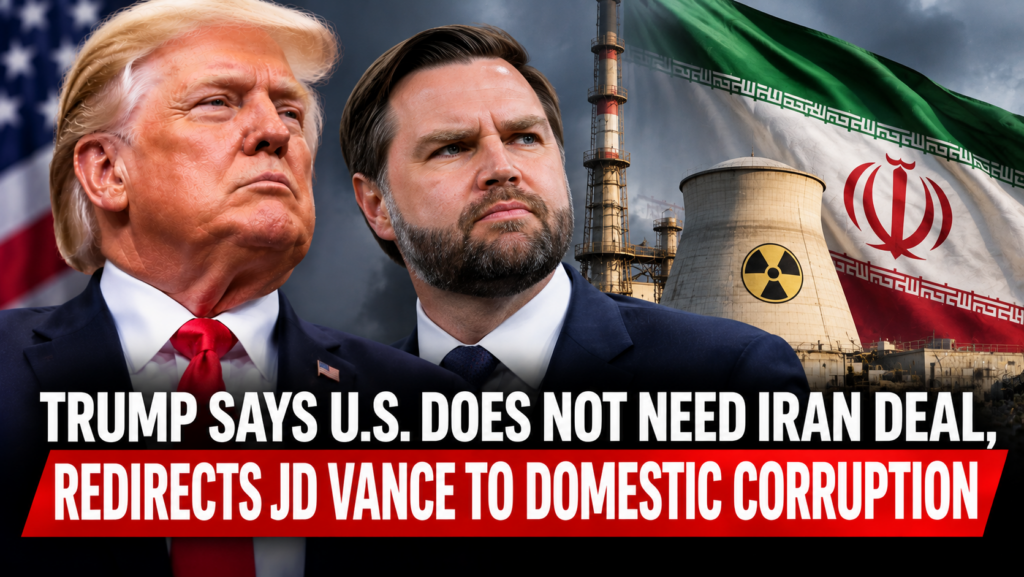
President Donald Trump has said the United States no longer needs a deal with Iran and directed Vice President JD Vance to shift his attention from diplomatic efforts to alleged crime and corruption in Democratic-led cities and states. The announcement marks a change in the administration’s approach to the eight-month conflict with Iran, as Washington continues its naval blockade and economic pressure on Tehran.
According to a report by Reuters, Trump’s announcement came amid reports that Vance was considering renewed diplomatic engagement with Iranian officials. It also followed Vance’s public criticism of the war’s financial and political costs after Republicans suffered major losses in the midterm elections.
Trump Says the U.S. Does Not Need an Agreement With Iran
Trump announced his position in a social media post on November 12, arguing that Washington holds sufficient leverage over Tehran through its control of Iranian funds and the strategic Strait of Hormuz. He wrote that the United States did not need an agreement with Iran, suggesting that the administration would continue relying on economic and military pressure.
The comments represent a shift in tone from Trump’s earlier suggestions that Iran might become more willing to negotiate after the U.S. midterm elections. His administration has indicated that the existing blockade and sanctions are putting pressure on Tehran, reducing the perceived need for either renewed military escalation or immediate diplomatic negotiations.
The U.S. military is maintaining a blockade on Iranian ports while working to secure international shipping through the Strait of Hormuz. Iranian military officials also reported that four oil tankers had been struck by explosions after ignoring warnings, adding to concerns about maritime security in the region.
JD Vance Redirected From Iran Diplomacy to Domestic Issues
Trump instructed Vance to devote his attention to alleged crime, fraud and corruption in Democratic-led cities and states. The president argued that addressing large-scale criminal activity could help balance the federal budget, while accusing Democratic leaders of enabling corruption.
The directive comes after Vance had played a significant role in diplomatic efforts to resolve the conflict. He led talks with Iranian officials in Pakistan in April, which resulted in a June memorandum of understanding that temporarily paused the war. However, the arrangement broke down within weeks.
Iranian state media reported in late October that Tehran had received a letter from Vance seeking renewed talks with Washington. The Wall Street Journal subsequently reported that Vance was considering a meeting with a senior Iranian security official, although Reuters said it had not independently confirmed the potential meeting.
Vance’s Position on the War Adds Political Tension
Vance’s reassignment follows his increasingly public criticism of the conflict. After Republicans suffered significant losses in the midterm elections, the vice president argued that the economic costs of the war had contributed to the party’s poor performance.
He also described his earlier recommendation to end the war as sound advice. Trump, however, defended the military campaign, arguing that it was necessary to prevent Iran from obtaining a nuclear weapon.
The disagreement highlights a difference in emphasis between the president and vice president over the war’s political and economic consequences. Vance is also viewed as a leading potential Republican contender for the 2028 presidential nomination, making his public position on the conflict politically significant.
What Trump’s Decision Means for Iran Negotiations
Trump’s announcement suggests that the administration is prioritizing economic pressure and the naval blockade over an immediate diplomatic agreement. Secretary of State Marco Rubio had already described Iran’s demands, including compensation for war-related damage, as unacceptable and said Trump would not sign a bad deal.
However, it remains unclear whether the president has completely abandoned diplomatic efforts. The Washington Post reported that Vance and other officials had been exploring possible negotiations, while Trump’s latest statement has created uncertainty among U.S. allies in the Persian Gulf.
The shift could leave regional governments facing greater uncertainty over the conflict’s future and the security of international shipping. It also raises questions about whether economic pressure alone can produce a lasting resolution or whether renewed diplomacy will eventually be necessary.
Trump’s decision therefore carries implications beyond Vance’s responsibilities. It places the future of Iran negotiations, regional stability and the administration’s domestic political priorities at the center of a broader debate over how Washington intends to manage the conflict.
Related Reading
- Richard Walters Leaves White House Deputy Chief of Staff Role Ahead of Stephen Miller’s Arrival
- US Treasury Sanctions Global Scam Networks and Prince Group Companies
Trump instructed Vance to focus on alleged crime and corruption in Democratic-led cities and states, arguing that addressing fraud could help balance the federal budget.
Trump’s comments suggest a reduced emphasis on an immediate deal, but it remains unclear whether the administration has completely abandoned diplomatic efforts.