The Electoral College decides who becomes president, not the national popular vote, and a candidate needs 270 of 538 electoral votes to win. This guide to the electoral college vs popular vote explained for 2026 covers how each system works, why they sometimes produce different winners, and where efforts to change the process stand today.
Voters in November are not choosing a president directly. They are choosing a slate of electors pledged to a candidate, and those electors cast the votes that count.
How the Electoral College Works
The Electoral College is a system of 538 electors, distributed among the states and the District of Columbia, who formally choose the president and vice president. According to the National Archives, a candidate needs 270 electoral votes to win.
Each state's total equals its number of U.S. representatives plus its two senators. Washington, D.C., is included in the system as well. That formula builds in a small-state advantage, since every state receives at least three electoral votes no matter how few people live there.
Electoral-vote allocations based on the 2020 Census apply to the 2024 and 2028 presidential elections, per the National Archives allocation page. That means the map for the next presidential race is already set.
For a plain-language walkthrough of the mechanics, see this explainer on how the Electoral College works in 2026.
The Steps From Ballot to Inauguration
The process runs on a fixed sequence:
- Voters cast ballots in their state on Election Day.
- States certify results and name their slate of electors.
- Electors meet in December and cast their votes.
- Congress counts the electoral votes in a joint session in early January.
- The president is inaugurated on January 20.
The Federal Election Commission compiles election results officially reported by state and territory election offices, but does not administer election results or Electoral College laws. States run the elections, and that decentralization is central to how the system functions.
What the Popular Vote Measures
The popular vote is the total number of individual ballots cast for each candidate across the entire country. It is a national tally with no legal effect on who wins the presidency under the current Constitution.
Every four years, news organizations report this figure on election night alongside the electoral count. Voters often treat it as the "real" result, which is where much of the debate begins. A national total captures how many Americans preferred each candidate, but it does not reflect how those preferences were distributed across states.
A candidate can win a state by one vote or by one million votes and receive the same electoral reward. In a direct national election, every additional vote in any state would matter equally. Under the Electoral College, votes beyond the winning margin in a given state add nothing to the electoral count.
Electoral College vs Popular Vote Explained for 2026: Key Differences
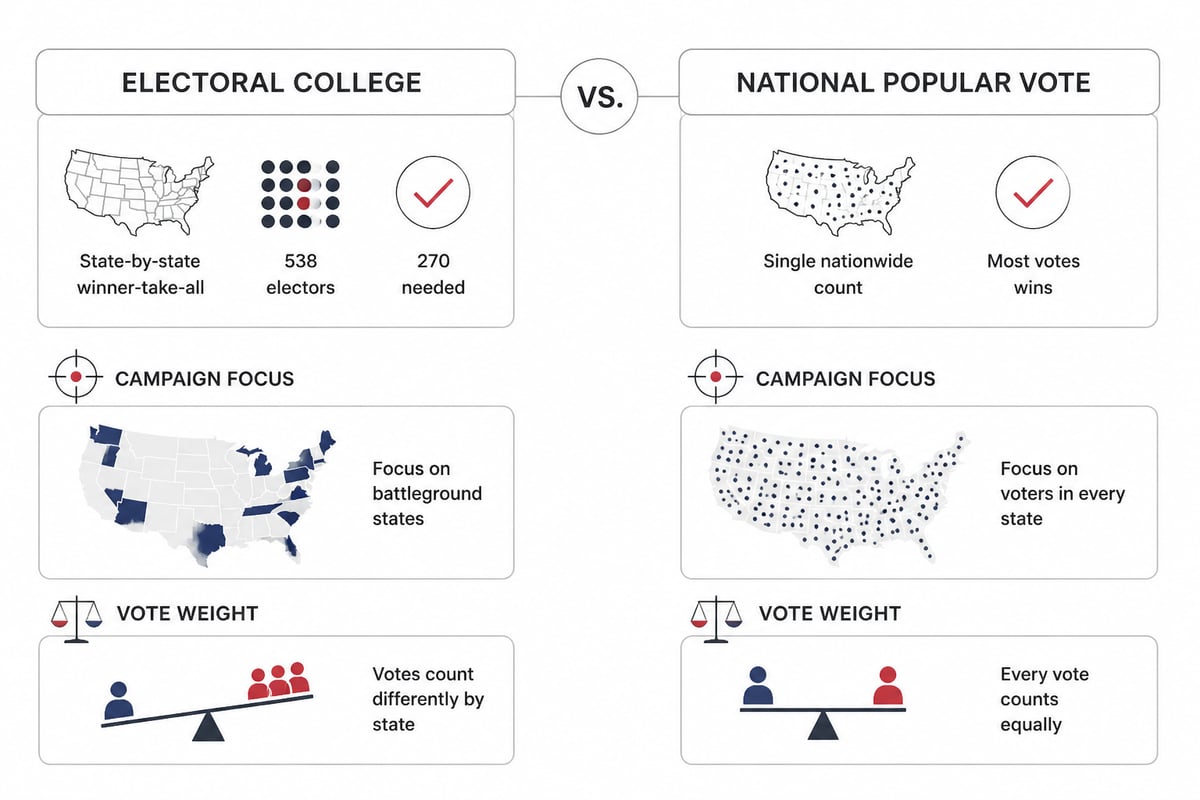
The two systems differ in what they count, where votes matter, and who benefits. This side-by-side comparison summarizes the main contrasts.
| Feature | Electoral College | National Popular Vote |
|---|---|---|
| What decides the winner | 270 of 538 electoral votes | Most votes nationwide |
| Unit of competition | States | Individual voters |
| Value of a surplus vote in a safe state | Zero additional electoral value | Counts the same as any other vote |
| Campaign focus | Competitive states | Population centers and media markets nationwide |
| Small-state influence | Boosted by the two-senator bonus | Proportional to population |
| Current legal status | Constitutional | Would require a constitutional amendment or state compact |
Supporters of the Electoral College argue it forces candidates to build coalitions across regions and protects the federal structure of the country. Critics argue it makes some votes count for more than others and concentrates campaigns in a few places.
Where Votes Carry the Most Weight
Because of the two-senator bonus, a voter in a low-population state has more influence per capita over the electoral count than a voter in a large state. At the same time, voters in large states that are not competitive often see little campaigning. Both effects shape how candidates spend time and money.
Readers tracking which states are in play can follow ongoing swing state polling analysis for 2026, which shows where campaign attention is likely to concentrate.
Winner-Take-All and the Maine and Nebraska Exceptions
Nearly every state awards all of its electors to whoever wins that state's popular vote. This winner-take-all rule is a state choice, not a constitutional requirement, and it is the main reason the national popular vote and the electoral outcome can diverge.
The National Archives reports that all states except Maine and Nebraska use winner-take-all allocation. Those two states award some electors by congressional district and two statewide, which means they can split their electoral votes between candidates.
Consider the practical effect. A candidate who wins California by five million votes receives the same 54 electoral votes as one who wins by 50,000 votes. Under winner-take-all, the margin of victory inside a state is irrelevant to the electoral total. Only the win itself matters.
When the Two Systems Disagree
The Electoral College and the national popular vote have produced different winners in several presidential elections, including 2000 and 2016. In those recent cases, the candidate who finished second in the national vote won the presidency.
Such splits are rare but consequential. They tend to occur when one candidate's support is concentrated in large states with lopsided margins while the other wins narrower victories in enough states to reach 270.
The 2024 result shows the more common pattern. Donald Trump received 312 electoral votes and Kamala Harris received 226, out of 538, according to the National Archives 2024 results. In most elections, the winner of the popular vote also wins the Electoral College, and the electoral margin often looks larger than the popular margin because of winner-take-all rules.
The Case for Keeping the Electoral College
Defenders of the current system make several arguments:
- Federalism. The presidency is chosen by a union of states, and the Electoral College reflects that design.
- Broad coalitions. Candidates must assemble support across multiple regions rather than running up totals in a handful of metro areas.
- Contained recounts. A close election can be contested in a few states rather than across the entire country at once.
- Clear outcomes. The system tends to convert narrow popular margins into decisive electoral results, which can reduce uncertainty about who won.
These points carry weight with many voters and lawmakers, particularly in smaller states that would lose relative influence under a direct national vote.
The Case for a National Popular Vote
Advocates of direct election argue from a different principle: every vote should count equally, regardless of where the voter lives.
- Equal weight. A ballot in Wyoming and a ballot in New York would carry the same value.
- Nationwide campaigns. Candidates would have reason to seek votes in every state, including those now considered safe for one party.
- No split outcomes. The candidate with the most votes would always win.
- Simplicity. Voters would no longer need to understand state-by-state allocation rules to interpret the result.
Opponents respond that a direct vote would shift campaign attention toward large cities and could raise the stakes of recounts and turnout disputes nationwide.
The National Popular Vote Interstate Compact
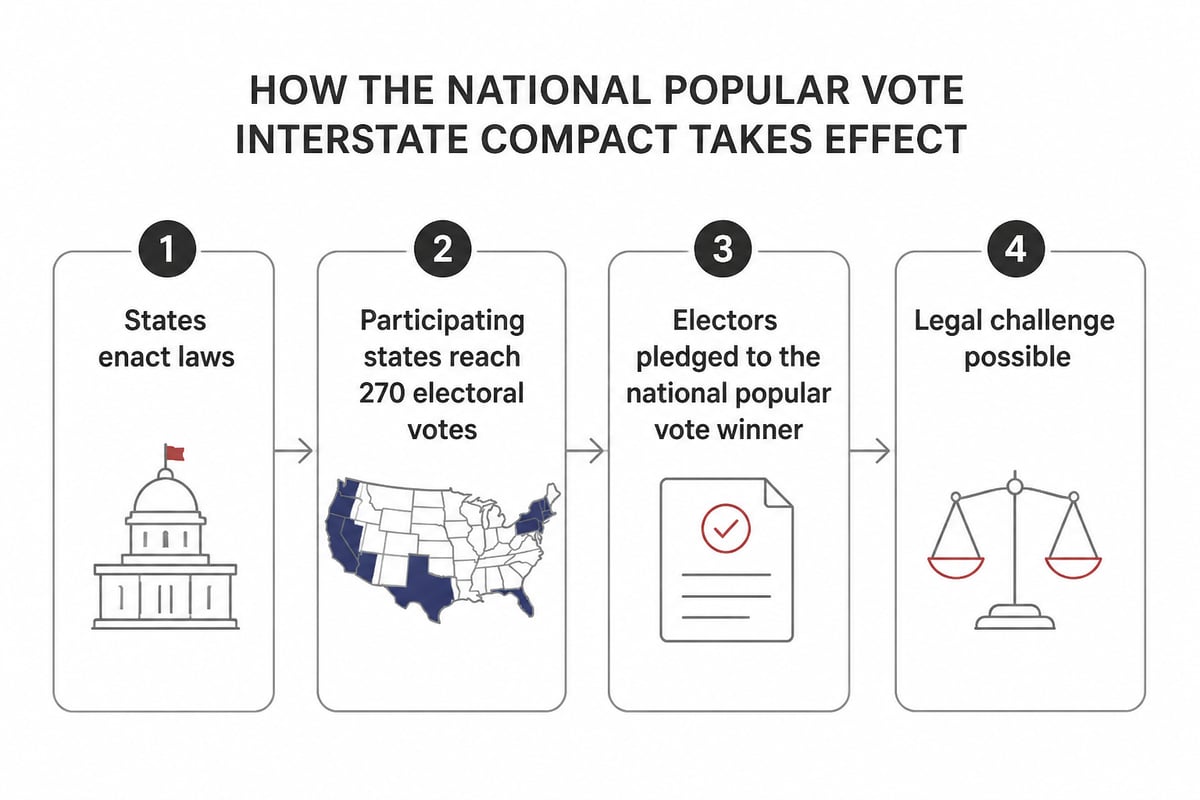
The most visible reform effort bypasses a constitutional amendment. The National Popular Vote Interstate Compact is an agreement among states to award all of their electors to whichever candidate wins the national popular vote, but it only takes effect once participating states collectively hold 270 electoral votes.
Because the Constitution lets each state decide how to appoint its electors, supporters argue the compact is legal without amending the Constitution. Critics contend it raises constitutional questions, including whether Congress must approve such an agreement, and the compact has not been tested in court at the presidential level.
Two practical hurdles remain. First, states participating so far have tended to be those favoring one party, so reaching 270 would require adding states from across the political spectrum. Second, a state in the compact could be required to award electors to a candidate who lost the vote among its own residents, a prospect that could prove politically difficult.
Why a Constitutional Amendment Is Harder
The alternative route, an amendment abolishing the Electoral College, requires two-thirds of both chambers of Congress and ratification by three-fourths of the states. Small states that benefit from the current formula would be asked to approve a change that reduces their relative influence. That structural obstacle is why compact supporters pursue the state-by-state approach.
Political reaction to the topic can be sharp. Coverage of how Tim Walz walked back an Electoral College comment after backlash illustrates how quickly the subject becomes a flashpoint for national figures.
What a Direct Vote Would Change for Campaigns and Voters
A direct national election would alter incentives in ways that are easier to describe than to predict. Under the current system, campaigns concentrate resources where outcomes are uncertain, and those places tend to be a short list of states. Turnout efforts in safe states often matter less to the final result.
If every vote counted equally nationwide, campaigns would likely spread effort differently, weighing the cost of reaching voters in expensive media markets against the benefit of each additional ballot. Analysts disagree on which regions would gain or lose attention. What is clear is that the behavior of campaigns, and therefore the experience of voters in many states, would shift.
Turnout patterns also matter for either system. Readers interested in who shows up and why can follow Democrats vs. Republicans voter turnout trends for 2026, and the growing role of unaffiliated voters is covered in this look at independent voters vs. party loyalists.
The Faithless Elector Question
An often-overlooked wrinkle in the Electoral College is that the electors themselves are people, and in rare cases an elector votes for someone other than the candidate they pledged to support. These "faithless electors" have never changed the outcome of a presidential election, but they raise a legitimate question about how binding the popular vote in a state really is.
The Supreme Court has ruled in Chiafalo v. Washington that states may require electors to vote for the candidate who won the state's popular vote and may penalize those who do not. Many states have since adopted such laws. The ruling strengthened the link between a state's voters and its electors, though it did not alter the winner-take-all structure itself.
This matters for the broader debate because it shows that the formal legal machinery of the Electoral College is more tightly controlled by states than many voters assume. It also means that any change to how electors are chosen would likely run through state legislatures.
What to Watch Through 2026 and Beyond
No change to the presidential election system is expected before the next presidential race. The 2020 Census allocations remain in force, the compact has not reached 270 electoral votes, and a constitutional amendment faces steep thresholds.
Several developments are worth tracking:
- State legislative action on joining or leaving the compact.
- Litigation over election rules, covered in the latest on election law challenge status for 2026.
- Midterm results, which shape which party controls state legislatures and governorships.
- Census-driven redistricting, which affects congressional representation and, after 2030, electoral-vote totals.
For a shorter primer, this guide to the Electoral College explained simply offers a quick reference. The National Archives Electoral College hub also maintains official records and historical results.
Understanding the electoral college vs popular vote explained for 2026 comes down to one fact: the winner is determined state by state, and the national tally, however large, is not what the Constitution counts.
Check your own state's rules for allocating electors and note whether it participates in the National Popular Vote Compact, then follow your state legislature's calendar for any related bills. For ongoing non-partisan coverage of presidential elections, Electoral College developments, and federal policy, visit U.S. Presidential Report and Start Your Own Political Club to discuss these questions with other readers who follow the presidency closely.