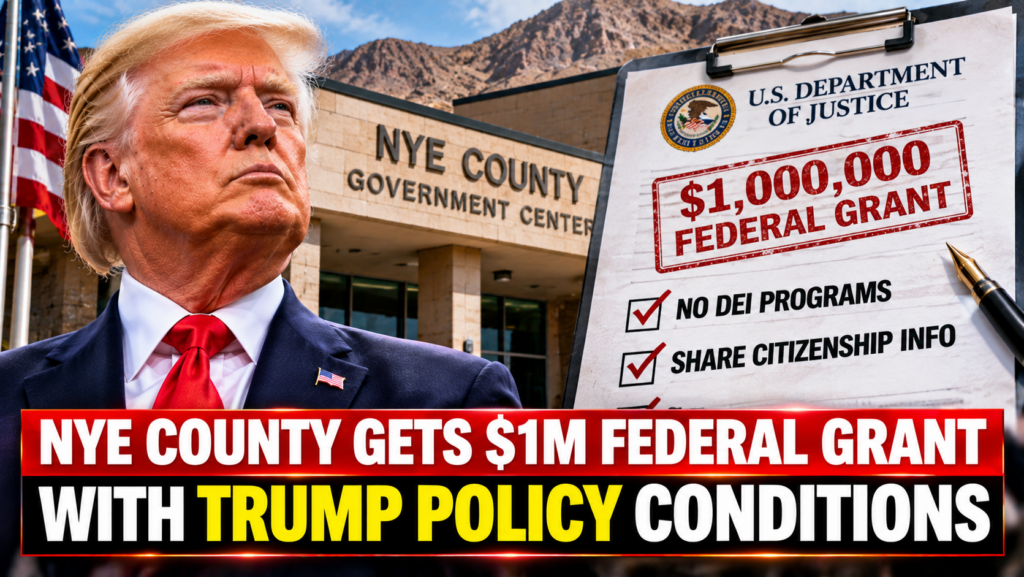
Nye County, Nevada, has accepted a $1 million federal public safety grant that comes with 44 conditions tied to President Donald Trump’s administration priorities, including restrictions on diversity, equity and inclusion (DEI) programs and requirements concerning the sharing of citizenship information with federal authorities.
The grant, awarded through the Department of Justice’s Community Oriented Policing Services (COPS) program, is intended to fund security improvements such as surveillance cameras in public parks and county buildings. However, its conditions have raised broader questions about how the Trump administration is using federal funding to advance its policy agenda.
According to a report by The Nevada Independent, the Nye County Board of Commissioners approved the grant unanimously through its consent agenda approximately two weeks before the November 2 report.
What the $1 Million Federal Grant Requires
The grant includes 44 conditions, several of which extend beyond the immediate purpose of improving local public safety.
One condition prohibits Nye County from operating programs associated with diversity, equity and inclusion. Another prevents the county from restricting communication about an individual’s citizenship status with the Department of Homeland Security (DHS) or other federal agencies.
The award also requires compliance with presidential executive orders and memoranda. This is a notable departure from earlier federal grants, which generally did not require local governments to follow such a broad range of presidential directives that typically apply to federal agencies.
The funding comes from the Justice Department’s COPS program, a longstanding source of financial support for local law enforcement agencies.
Under the Trump administration, however, the program has incorporated additional requirements reflecting the president’s priorities on immigration and DEI policies.
Why Nye County Accepted the Funding
Despite the conditions, local officials in the heavily Republican county have expressed little concern about accepting the grant.
The county is facing a multimillion-dollar budget shortfall and has experienced serious public safety incidents, including a fatal shooting during a movie night at a park in Pahrump last year.
Nevada Assemblyman Gregory Hafen, a Republican representing Pahrump, said the county urgently needs additional resources for its sheriff’s department and public safety operations.
Nye County Commissioner Ian Bayne also indicated that he had no concerns about the requirements. He suggested that the county or the sheriff’s office likely applied for the funding and noted that federal grants commonly come with conditions.
Neither the county nor the Nye County Sheriff’s Office responded to questions from The Nevada Independent about potential concerns regarding the grant’s requirements or the decision to apply.
Immigration Requirements and the DEI Debate
The immigration-related condition specifically references federal law 8 U.S.C. § 1373.
The statute generally prohibits state and local governments from restricting officials from sharing information about an individual’s citizenship or immigration status with federal immigration authorities.
However, the law does not require local governments to actively participate in federal immigration enforcement. It does not require them to detain individuals on behalf of federal authorities or proactively collect information about citizenship or immigration status.
President Trump has repeatedly cited the statute in disputes with so-called sanctuary jurisdictions, arguing that local governments violate federal law when they refuse to honor certain Immigration and Customs Enforcement (ICE) detainers or limit inquiries about immigration status.
The distinction between sharing information and actively enforcing immigration laws remains important as federal funding requirements become increasingly connected to immigration policy.
Democratic Lawmakers Criticize the Conditions
The grant has also drawn criticism from Nevada’s Democratic congressional delegation.
Sen. Catherine Cortez Masto, who requested the funding through a congressional appropriations bill, criticized the politicization of federal funding. However, she argued that the conditions should not prevent Nevada communities from receiving resources they need.
Her office had requested the funding before a 2025 executive order took effect that prohibited discretionary grants from supporting what the administration described as racial preferences or undocumented immigrants.
Rep. Steven Horsford, whose congressional district includes Nye County, also criticized the use of federal funding to advance partisan priorities. He argued that federal resources should not be used to promote one political party’s agenda.
The disagreement highlights a broader debate over whether the executive branch can attach policy requirements to federal funding beyond the purposes authorized by Congress.
Similar Federal Grant Conditions Face Legal Challenges
Nye County is not the only Nevada jurisdiction accepting federal funding with similar requirements.
Douglas County, another Republican-leaning area, approved a COPS grant with comparable conditions earlier in 2026. The county is also scheduled to consider another $400,000 award.
Elsewhere, several Democratic-led municipalities have challenged similar federal funding requirements in court.
Chicago, St. Paul in Minnesota, and Santa Monica in California sued the Department of Justice in November 2025. They argued that the conditions were unconstitutional because they allowed the executive branch to impose restrictions on federal spending that Congress had not authorized.
The dispute could have broader implications for how federal agencies structure grants to state and local governments.
Hans Menos, who works on public safety initiatives at the Vera Institute, warned that requiring municipalities to comply with broad executive orders could create a substantial administrative burden.
Although federal grants often reflect the priorities of the administration distributing the funds, Menos argued that the Trump administration’s approach has increasingly connected funding conditions to politically contested immigration policies.
What Happens Next for Federal Funding?
The practical impact of the conditions on Nye County remains unclear. Local officials have not publicly identified specific changes they intend to make to comply with the requirements.
However, the grant illustrates a growing tension between local governments’ need for federal financial assistance and the policy conditions attached to that support.
For counties facing budget shortages, rejecting federal funding may mean losing resources for essential public safety improvements. Accepting it, meanwhile, could require changes to local policies and administrative practices.
As legal challenges involving similar requirements continue, the central question is whether the federal government can use grant conditions to advance executive priorities beyond the specific spending purposes approved by Congress.
The outcome could influence how future federal grants are distributed and how much authority local governments retain over their own policies when accepting federal assistance.
Related Reading
- Trump Signs Executive Order Aimed at Lowering Mortgage Costs
- Trump Removes 50% Tariffs on Some Canadian Goods
The grant will support public safety improvements, including surveillance cameras and security enhancements at local parks and county buildings.
The 44 conditions include restrictions on DEI programs, requirements concerning the sharing of citizenship information with federal authorities, and compliance with presidential executive orders and memoranda.