The American electoral system operates through carefully structured processes designed to verify results and maintain public confidence. Understanding the distinction between election integrity investigations vs official election oversight is essential for citizens, journalists, and policymakers navigating discussions about how elections are verified and validated. These two mechanisms serve different purposes, operate under different authorities, and produce different outcomes. While official oversight represents the routine administrative processes built into every election cycle, investigations represent targeted inquiries triggered by specific allegations or concerns. The difference matters significantly in how we interpret post-election activities and assess their legitimacy.
The Foundation of Official Election Oversight
Official election oversight encompasses the systematic, pre-established procedures that election administrators execute after every election. These processes operate independently of election outcomes and follow standardized protocols developed through decades of electoral administration.
State and local election officials conduct canvassing, which involves verifying vote totals from each precinct, reconciling ballots cast with voter check-ins, and certifying results according to statutory deadlines. This administrative function occurs regardless of margin of victory or political controversy.
Statutory Audit Requirements
Most states mandate post-election audits that examine a sample of ballots or precincts to verify that voting equipment accurately captured voter intent. The U.S. Election Assistance Commission (EAC) Post‑Election Tabulation Audit Guide provides comprehensive federal guidance on these procedures, establishing best practices for audit methodology and implementation.
Key components of official audits include:
- Random selection of precincts or ballot batches
- Manual review of paper ballots against machine tabulations
- Statistical sampling methods that ensure representative coverage
- Public observation protocols that maintain transparency
- Documentation and reporting requirements
Risk-limiting audits represent the gold standard in this field, using statistical methods to provide high confidence that the reported winner actually won. MIT’s Election Data and Science Lab has extensively researched these methodologies, demonstrating their effectiveness in verifying election outcomes without requiring complete hand counts.
Transparency and Observer Access
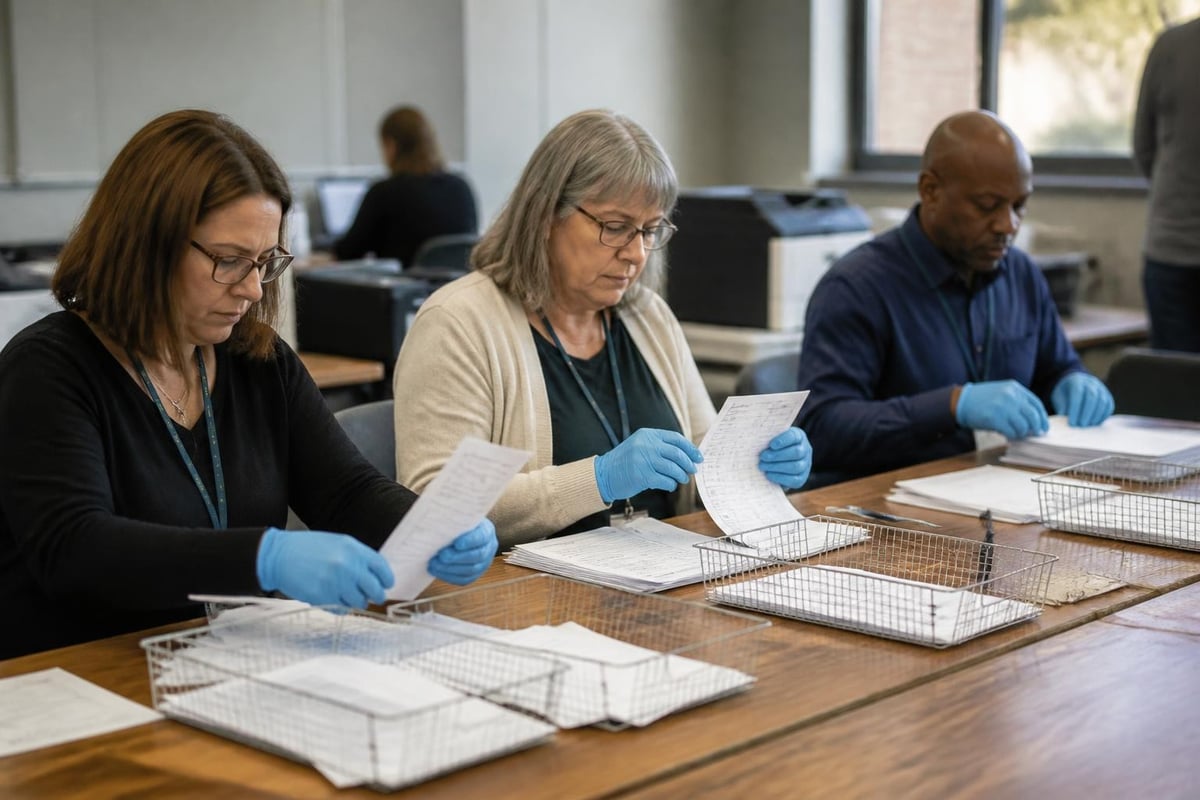
Official oversight includes structured public access mechanisms. Election offices implement observer programs that allow representatives from political parties, candidates, and the public to witness tabulation and canvassing processes. The EAC clearinghouse resources on observers and transparency outline how these programs balance openness with operational security.
Public access does not mean unlimited interference. Election officials maintain controlled environments where observers can meaningfully witness processes without disrupting the administrative functions required to complete certification on statutory deadlines.
The Nature of Election Integrity Investigations
Election integrity investigations represent a fundamentally different category of activity. These inquiries arise from allegations of irregularities, fraud, or systemic problems. Unlike routine oversight, investigations target specific claims and may involve law enforcement, legislative committees, or special counsel appointments.
The distinction between election integrity investigations vs official election oversight becomes particularly important when evaluating their authority and scope. Investigations do not replace routine administrative processes, but rather examine whether those processes were compromised or whether criminal activity occurred.
Criminal Investigations and Federal Authority
When allegations involve potential federal crimes, the Justice Department’s Election Crimes Branch may initiate investigations. These focus on prosecutable offenses such as voter intimidation, ballot fraud, or conspiracy to interfere with election administration.
| Investigation Type | Triggering Event | Authority | Typical Timeline |
|---|---|---|---|
| Criminal (Federal) | Alleged federal crimes | DOJ/FBI | Months to years |
| Criminal (State) | Alleged state crimes | State AG/local DA | Months to years |
| Legislative | Policy questions | State legislature | Weeks to months |
| Administrative | Process violations | Election boards | Days to weeks |
Federal investigations must navigate constitutional constraints. The DOJ Civil Rights Division’s voting rights policy and guidance establishes limits on federal intervention in state-run elections, balancing federal authority to prosecute crimes against state sovereignty in election administration.
Legislative and Partisan Investigations
State legislatures occasionally conduct investigations into election administration, particularly following close or controversial elections. These differ from official oversight in several ways:
Legislative investigations typically:
- Focus on policy changes rather than certification
- Operate with broader subpoena authority
- Generate political recommendations
- Extend beyond statutory certification deadlines
- May pursue partisan objectives
The challenge with legislative investigations involves distinguishing legitimate oversight from politically motivated efforts to undermine certified results. When state legislatures investigated the 2020 presidential election, debates centered on whether these constituted appropriate legislative inquiry or improper interference with completed administrative processes.
Comparing Methodologies and Standards
The methodologies employed in election integrity investigations vs official election oversight reveal their different purposes and constraints. Official oversight follows established protocols with predetermined sampling methods, audit procedures, and success criteria. Investigations follow evidence wherever it leads, adapting methods to specific allegations.
Evidence Standards and Burden of Proof
Official audits use statistical confidence levels, typically requiring 95% or greater confidence that the audit confirms the reported outcome. These mathematical standards provide objective benchmarks for determining whether voting systems performed accurately.
Investigations face higher evidentiary hurdles when allegations involve wrongdoing. Criminal prosecutions require proof beyond reasonable doubt. Civil enforcement actions require preponderance of evidence. Allegations that fail to meet these standards, regardless of public attention, do not justify overturning certified results.
The Brennan Center’s resources on post-election audits highlight how legitimate audits differ from deceptive tactics that manufacture doubt without producing credible evidence of outcome-altering irregularities.

Timeline and Public Communication
Official oversight operates on compressed timelines dictated by state certification deadlines and federal safe harbor provisions. Election officials must complete canvassing and audits within days or weeks following Election Day, ensuring timely resolution and peaceful transition of power.
Investigations may extend months or years beyond certification. This temporal disconnect creates public confusion when investigations continue long after winners take office. The investigation timeline does not invalidate certified results, but rather examines whether processes were compromised for future accountability and reform.
Institutional Roles and Separation of Functions
Understanding election integrity investigations vs official election oversight requires recognizing which institutions perform which functions. Blurring these lines undermines both processes and erodes public confidence.
Election Administrators and Their Mandate
County clerks, secretaries of state, and election boards have limited, defined responsibilities:
- Conduct elections according to statutory requirements
- Perform mandatory audits and canvassing
- Certify results by statutory deadlines
- Maintain chain of custody for election materials
- Provide transparency through observer programs
These officials lack authority to initiate criminal investigations, convene grand juries, or make prosecutorial decisions. Their role ends with certification, though they may assist subsequent investigations by preserving records and providing testimony.
Law Enforcement and Prosecutorial Discretion
Investigations fall to law enforcement agencies with criminal jurisdiction. State attorneys general, district attorneys, and federal prosecutors determine whether allegations merit investigation based on credible evidence of potential crimes.
Prosecutorial discretion means that not every allegation triggers an investigation. Prosecutors evaluate whether available evidence could support charges, whether violations affected outcomes, and whether prosecution serves public interest. This filtering function prevents frivolous investigations from consuming public resources.
The Role of Federal Oversight in State Elections
The federal structure of American elections creates tension between state sovereignty and federal interests in protecting constitutional rights. This tension affects both official oversight and investigations.
Federal agencies like the Election Assistance Commission provide guidance and support without operational control over state elections. The EAC develops voluntary guidelines, certifies voting equipment, and distributes election security grants, but cannot mandate specific procedures or overturn state certifications.
Federal investigations focus on violations of federal law: mail ballot fraud (federal crime), voting rights violations (constitutional protections), or conspiracies that cross state lines. These represent the limited circumstances where federal authority supersedes state control.
Recent presidential elections have highlighted these dynamics. When examining presidential election integrity, understanding federal versus state authority clarifies which officials have power to act on specific allegations and which do not.
Impact on Presidential Transitions and Governance
The distinction between election integrity investigations vs official election oversight has profound implications for presidential transitions. Official oversight must conclude with certification by the Electoral College safe harbor deadline, currently December 11, 2026 for this cycle. Investigations may continue indefinitely.
Constitutional Deadlines and Certainty
The Constitution and federal statutes establish firm deadlines for presidential selection:
- States certify results (varies by state, typically late November)
- Safe harbor deadline (December 11)
- Electoral College meets (December 17)
- Congress counts electoral votes (January 6)
- Inauguration (January 20)
These deadlines ensure governmental continuity regardless of ongoing investigations. Investigations cannot delay these constitutional processes, though they may inform future reforms or, in extreme cases, lead to impeachment proceedings after inauguration.
The 2020 presidential election demonstrated the consequences of conflating investigations with official oversight. Efforts to delay or prevent certification based on ongoing investigations failed because those investigations had not met evidentiary standards required to overturn certified results before constitutional deadlines.
Evaluating Claims and Evidence Quality
Citizens evaluating post-election controversies must distinguish between legitimate concerns warranting investigation and unfounded allegations that undermine confidence without factual basis. This evaluation requires understanding what constitutes credible evidence in election contexts.
Red Flags for Illegitimate Claims
Warning signs that allegations lack credible foundation:
- Claims rely on misunderstanding of normal procedures
- Evidence consists of anonymous affidavits without corroboration
- Statistical analysis ignores established voter behavior patterns
- Allegations change when initial claims are debunked
- Proponents refuse to present evidence in legal proceedings under oath
Legitimate investigations welcome scrutiny and present evidence through established legal channels. Illegitimate efforts often avoid venues where claims face cross-examination and evidentiary standards.
The Role of Courts in Resolving Disputes
Judicial review provides the ultimate mechanism for resolving election disputes in American democracy. Courts evaluate evidence under established rules, require testimony under oath, and impose sanctions for frivolous claims.
The volume of post-election litigation does not itself indicate problems with election integrity. Many lawsuits raise procedural questions about election rules rather than fraud allegations. Courts dismiss cases lacking evidence regardless of political pressure, protecting the integrity of both official oversight and legitimate investigations.
Media Responsibility and Public Understanding
News organizations covering presidential elections bear responsibility for accurately characterizing the difference between election integrity investigations vs official election oversight. Conflating these processes or presenting investigations as equivalent to official findings spreads misinformation.
Accurate reporting requires specifying which type of activity is occurring, who has authority to conduct it, what evidentiary standards apply, and how findings relate to certified results. When a legislative committee issues a report questioning election procedures, that differs fundamentally from election officials certifying results through mandatory audits.
U.S. Presidential Report maintains non-partisan coverage by distinguishing between these categories and providing context for post-election activities. Readers benefit from understanding whether reported developments represent routine administrative processes or exceptional investigative actions.
Reform Proposals and Future Directions
Ongoing debates about election integrity have generated numerous reform proposals affecting both official oversight and investigation mechanisms. These reforms aim to strengthen confidence while maintaining election security and efficiency.
Proposed reforms to official oversight include:
- Mandatory risk-limiting audits in all states
- Standardized observer access protocols
- Enhanced cybersecurity requirements for voting systems
- Improved voter roll maintenance procedures
- Expanded funding for election administration
Investigation reforms focus on establishing clear authority for examining allegations while preventing abuse of investigative powers for partisan advantage. Proposals include independent review boards, standardized procedures for evaluating fraud allegations, and penalties for officials who knowingly make false election fraud claims.
The Balance Between Security and Confidence
The relationship between election integrity investigations vs official election oversight reflects a fundamental tension in democratic governance. Systems must be secure enough to prevent fraud while transparent enough to maintain public confidence. Excessive investigation can undermine confidence as much as inadequate oversight. For a related look at how identity requirements are balanced against access, see our piece on voter ID enforcement vs voter access protections.
| Approach | Security Impact | Confidence Impact | Implementation Cost |
|---|---|---|---|
| Enhanced audits | High | High | Moderate |
| Unlimited investigations | Variable | Negative if frivolous | High |
| Reduced transparency | Uncertain | Negative | Low |
| Balanced framework | High | High | Moderate |
The optimal framework combines robust official oversight through mandatory audits and transparent processes with available mechanisms for investigating credible allegations of wrongdoing. This balance prevents both actual fraud and unfounded claims from undermining democratic legitimacy.
State election systems in 2026 reflect lessons learned from recent controversies. Many states have strengthened audit requirements, improved observer access, and established clearer procedures for addressing allegations. These improvements enhance both security and transparency, addressing legitimate concerns while maintaining efficiency.
Professional Standards and Accountability
Election officials, investigators, and oversight bodies must adhere to professional standards that prioritize accuracy over political expediency. These standards differ between official oversight and investigations but share common commitment to evidence-based conclusions.
Election administrators follow standards established by organizations like the National Association of State Election Directors and certification requirements for voting systems. These professional norms emphasize procedural consistency, documentation, and adherence to statutory requirements.
Investigators answer to different standards: legal requirements for evidence collection, constitutional protections for due process, and ethical obligations to pursue truth rather than predetermined conclusions. When investigations depart from these standards, they lose credibility and undermine rather than enhance election integrity.
Professional accountability mechanisms include civil service protections that prevent political interference with election administration, ethical rules governing prosecutors, and judicial review of both administrative actions and investigation outcomes. These safeguards help maintain the distinction between election integrity investigations vs official election oversight by ensuring each operates within appropriate boundaries.
Understanding the difference between routine election oversight and targeted integrity investigations enables citizens to better evaluate post-election controversies and assess claims about election security. Both mechanisms serve important functions, but conflating them undermines confidence in democratic processes. For comprehensive, non-partisan coverage of presidential elections, election integrity, and the governance processes that ensure democratic legitimacy, U.S. Presidential Report provides trusted analysis that helps readers navigate complex political developments with clarity and context.