The main difference in MAGA policy priorities vs mainstream GOP priorities is the order of emphasis: MAGA puts immigration enforcement, tariffs, and a skeptical approach to foreign commitments first, while the traditional Republican establishment centers tax cuts, deregulation, free trade, and a strong internationalist posture. The two camps share a large amount of common ground, which is why the 2024 party platform could hold both.
The distinction matters because it shapes primaries, congressional negotiations, and how the party governs. Treating the camps as identical misses real policy friction, and treating them as opposites overstates the gap.
What Separates the Two Camps at a Glance
MAGA and mainstream Republicans agree on a majority of goals but rank them differently and disagree on method, especially on trade, foreign alliances, and the role of the federal executive.
The table below summarizes the typical positions on the issues voters ask about most.
| Issue | MAGA-aligned position | Mainstream GOP position |
|---|---|---|
| Trade | Broad tariffs, protection for domestic industry | Free trade agreements, selective tariffs |
| Immigration | Mass deportation, sharply reduced legal immigration | Border security, enforcement, support for some legal pathways |
| Foreign policy | "America First," skepticism of alliances and aid | Strong NATO ties, active role in deterrence |
| Federal spending | Protect popular entitlements, cut perceived waste | Entitlement reform, deficit reduction |
| Executive power | Expansive presidential control of the bureaucracy | Greater deference to Congress and institutions |
| Cultural issues | Front-line priority | Important, but often secondary to economics |
Keep in mind that these are tendencies, not party-line certainties. Many officeholders hold a blend, and individual voters often mix positions across rows.
How the 2024 Platform Blended Both Movements
The 2024 Republican platform shows how much the party's formal agenda now reflects MAGA framing while retaining traditional conservative economic planks. The 2024 Republican platform lists 20 promises, including sealing the border, carrying out a large deportation operation, and eliminating taxes on tips.
Its economic agenda names five pillars: deregulation, tax cuts, fair trade deals, low-cost energy, and innovation. Those pillars read as classic Republican economics. The border and deportation language reads as the MAGA signature. The tax section combines both traditions, promising to make provisions of the Trump-era Tax Cuts and Jobs Act permanent, a longtime establishment goal, alongside the no-tax-on-tips pledge, a newer appeal aimed at service-sector workers.
The abortion plank shows the blend as well. It leaves abortion-law decisions to states and opposes late-term abortion, while also supporting prenatal care, birth control access, and IVF. That wording sits between the older movement demand for a national standard and the general-election caution of the mainstream wing.
NPR’s coverage of the platform describes how the document was shaped around Trump's campaign priorities, which helps explain why the shorter, more personality-driven format replaced the lengthy policy documents of earlier cycles.
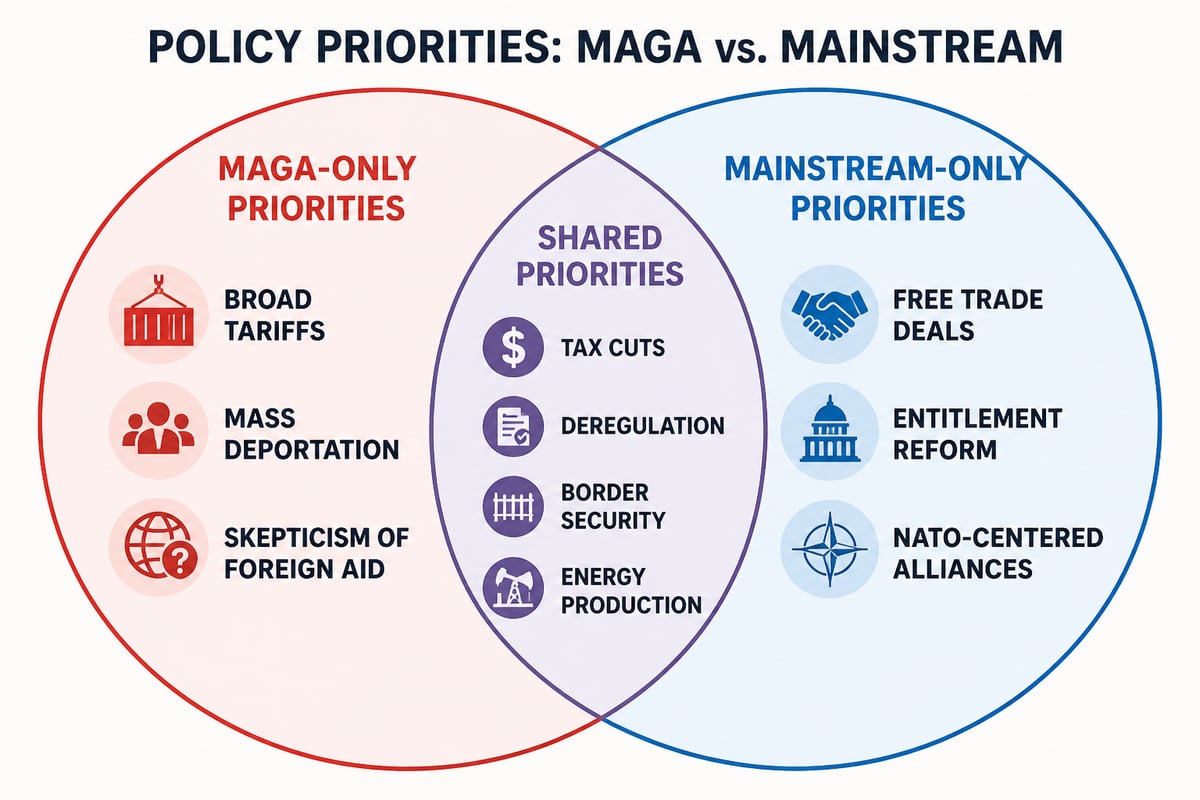
Trade and Tariffs: The Sharpest Economic Split
Trade is the clearest economic dividing line, because MAGA treats tariffs as a core instrument while mainstream Republicans have historically defended free trade.
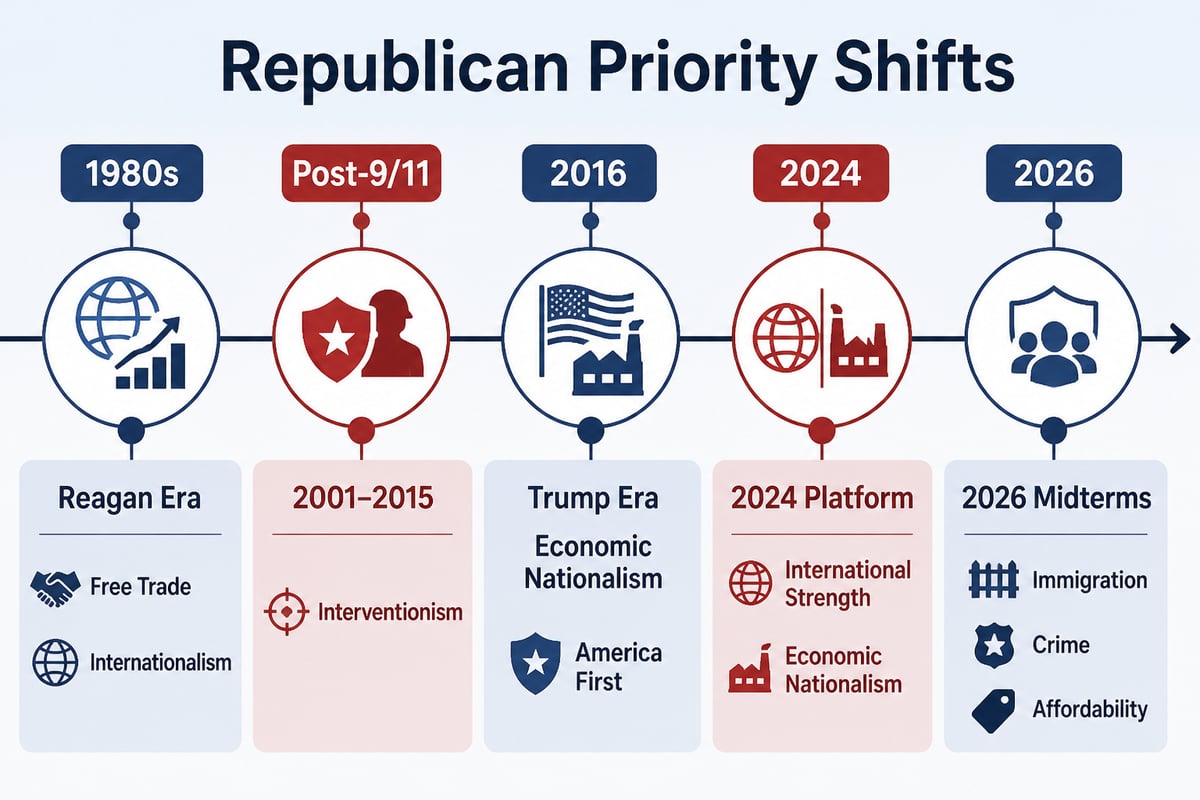
Traditional Republican doctrine, from Reagan through the Bush era, favored open markets, multilateral agreements, and low barriers. Business groups and many farm-state officials still hold that view. MAGA's economic nationalism holds that decades of trade liberalization hollowed out manufacturing towns and that tariffs restore leverage and domestic production.
The result is a party that agrees on tax cuts yet argues over the cost of imported goods, retaliation against exporters, and who absorbs the price. Farmers illustrate the tension well, since they often back Trump while worrying about export markets, a pattern covered in reporting on farmers who continue to back Trump despite policy concerns. For a fuller explanation of the underlying philosophy, see this breakdown of America First economic policy.
Immigration and Border Policy
Both camps want a secure border, but MAGA pushes toward mass deportation and deep cuts to legal immigration, while mainstream Republicans typically emphasize enforcement and orderly reform.
The practical gap shows up in scope. A mainstream approach often pairs border security with talk of work visas, skilled-immigration channels, or a path for certain long-term residents. The MAGA approach treats interior enforcement, detention, and tighter asylum rules as the central project.
Voter intensity helps explain why this issue carries so much weight. In an October 2026 Gallup survey, immigration ranked among the issues Republicans most often rated extremely important to their congressional vote, ahead of abortion, while crime also drew strong attention.
For more detail on how these policies are being carried out, see the latest on asylum policy enforcement and the comparison of immigration policy and border security policy.
MAGA Policy Priorities vs Mainstream GOP Priorities on Foreign Policy
On foreign affairs, MAGA favors transactional, "America First" diplomacy, while mainstream Republicans favor alliances, deterrence, and sustained overseas commitments.
The mainstream tradition, shaped by the Cold War and the post-9/11 era, treats NATO, security guarantees, and military aid as investments in American safety. MAGA reasons that allies should pay more, that foreign aid should face a domestic-benefit test, and that entanglements abroad carry costs at home.
This produces visible disagreements over Ukraine funding, burden-sharing with European partners, and how to handle China. It does not produce disagreement over every question: both camps generally support a strong military and a hard line on Iran. For current positions, review Trump’s foreign policy priorities in 2026 and the debate over foreign aid policies vs domestic spending priorities.
Spending, Taxes, and the Role of Government
Taxes unite the camps, but spending priorities and views of federal institutions divide them.
The platform says Republicans will make provisions of the Trump-era Tax Cuts and Jobs Act permanent and eliminate taxes on tips. Almost every Republican supports the first goal. The disagreement lies elsewhere:
- Entitlements: Fiscal conservatives have long sought reform of Social Security and Medicare. MAGA messaging has generally avoided benefit cuts to those programs.
- Deficits: Traditional budget hawks treat deficit reduction as a defining principle. MAGA-aligned officials tend to rank it below growth, tariffs, and enforcement.
- The federal workforce: MAGA favors tighter presidential control of agencies, including reclassifying career positions, an effort explained in coverage of Schedule Policy/Career federal positions. Mainstream Republicans are more likely to accept the civil service as it stands.
Together these differences show that MAGA is less a rejection of limited government than a redirection of federal power toward different ends.
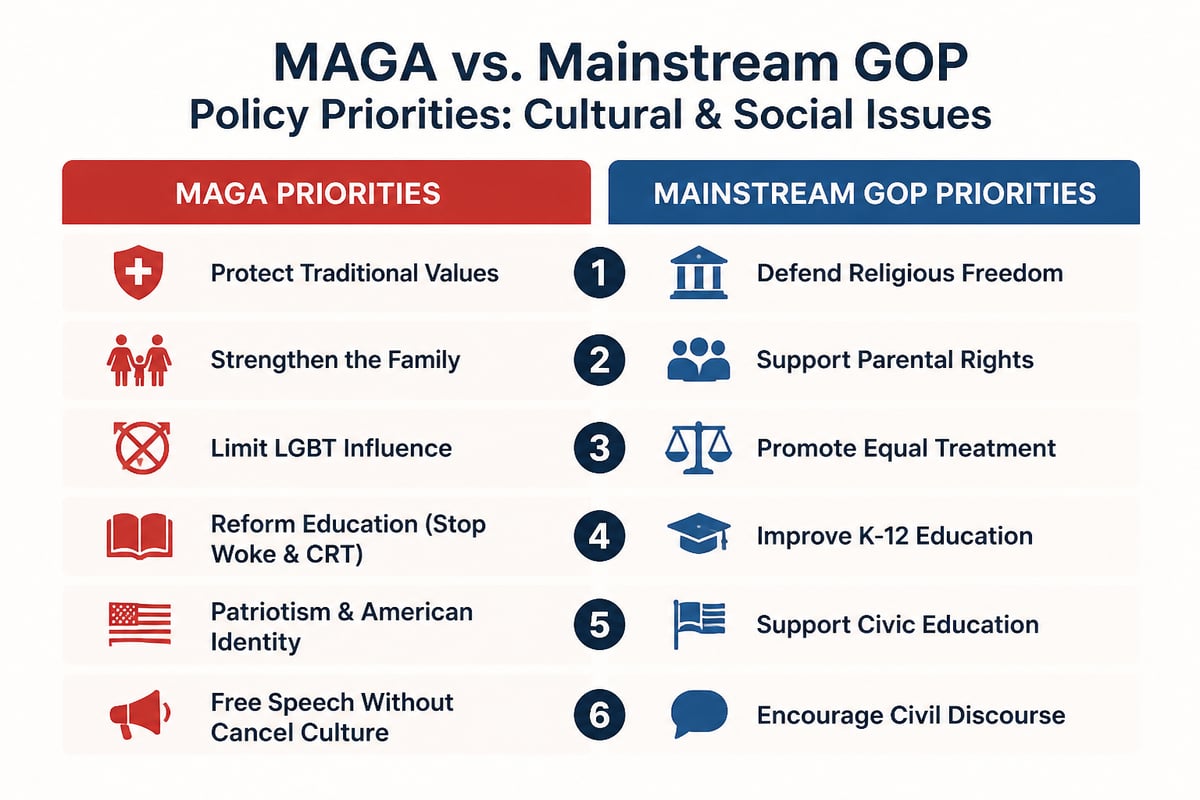
Cultural and Social Issues
Both camps oppose late-term abortion and defend traditional values, but the 2024 platform's handling of abortion reveals how MAGA's electoral instincts moderated a long-standing party plank.
The platform leaves abortion-law decisions to states and opposes late-term abortion; it also supports prenatal care, birth control access, and IVF. That position departs from earlier platforms that called for a national ban, and it reflects a calculation about general-election risk.
Cultural fights over crime, education, and gender policy tend to feature more prominently in MAGA messaging. CNN’s analysis of Republican campaign emphasis points to crime, immigration, and transgender issues as central themes heading into the midterms. Mainstream Republicans, by contrast, often prefer to steer campaigns back toward the economy and taxes.
Where the Two Camps Overlap
Most policy goals are shared, so the practical fight is usually over sequencing and style rather than basic direction. The 2024 platform's economic agenda, built on deregulation, tax cuts, fair trade deals, low-cost energy, and innovation, draws support from both wings, and the "fair trade deals" element carries real room for interpretation. A free-trade Republican and a tariff-minded Republican can each read it as their own.
Common ground includes:
- Lower taxes and extension of the 2017 tax law
- Deregulation and expanded domestic energy production
- Stricter border enforcement
- A strong national defense
- Conservative judicial appointments
- Skepticism toward expansive climate regulation
On energy, for example, both favor domestic production over aggressive emissions rules, a theme explored in climate regulation vs energy independence priorities. Border enforcement shows the same pattern: the disagreement is about scale and legal immigration, not about whether the border should be secured. On guns and health care, the camps also tend to align on principle, though specifics vary; readers can compare presidential approaches on gun policy and health care.
Why Method Matters as Much as Policy
A less-discussed divide is governing method: MAGA prizes speed, executive action, and personal loyalty, while mainstream Republicans prioritize process, legislation, and institutional norms.
Two Republicans can hold the same view on tax rates and still clash over how to achieve it. A mainstream legislator may prefer a negotiated bill that survives the next administration. A MAGA-aligned official may prefer an executive order that delivers immediate results, even if courts or a future president can reverse it. The same split appears in debates over federal authority vs state authority and in how each camp views the media, personnel decisions, and congressional oversight.
For analysts, this means a candidate's stated position on an issue predicts less than their stated approach to executing it. Appointment patterns offer one of the clearest signals, as shown in the reporting on how Trump's appointments hint at priorities for advancing Project 2025 goals.
What the 2026 Midterms Reveal About the Divide
The 2026 midterm cycle shows the tension in real time, with voters ranking affordability and border security highly while also wanting some check on presidential power.
CNBC’s survey on voter fears summarizes concerns about affordability, border security, taxes, and the consequences of congressional control.
Those findings explain why intraparty friction persists. Candidates in swing districts often favor a mainstream posture on trade and spending, while those in safe seats face primary pressure to align with MAGA positions. For related coverage, see the analysis of Trump and GOP tensions in 2026 and the effect of MAGA endorsements on the 2026 midterms.
Frequently Asked Questions
Is MAGA a separate party from the Republican Party?
No. MAGA describes a movement and voting bloc within the Republican Party, and the party's formal platform now incorporates many of its priorities. Its influence runs through primaries, endorsements, and the platform itself, not through a separate ballot line. A candidate can run as a Republican, win a primary on MAGA themes, and still vote with the mainstream wing on specific bills.
Do MAGA and mainstream Republicans disagree on taxes?
Rarely. Both support extending the 2017 tax cuts, and the 2024 platform pairs that goal with eliminating taxes on tips. The disagreements concern tariffs, which function as a tax on imports, along with deficits and entitlements. A mainstream Republican may accept the tax-cut agenda while objecting that broad tariffs raise costs for importers and consumers.
Which camp is larger?
Reliable measurement is difficult, since many Republican voters identify with both labels. Primary results and polling on candidate endorsements offer the best indicators, as tracked in coverage of MAGA movement growth in 2026. Issue polling also helps. The October 2026 Gallup survey found immigration ranked highest among Republican voters, a priority that aligns closely with the MAGA agenda.
To compare these camps on your own, pick one issue, such as tariffs or foreign aid, and track how a candidate's votes and public statements line up over the next few months. U.S. Presidential Report publishes non-partisan coverage of presidential policy, elections, and the internal dynamics of both parties, so you can follow each development with context. Visit the site for the latest reporting on how these priorities are shaping Washington in 2026.