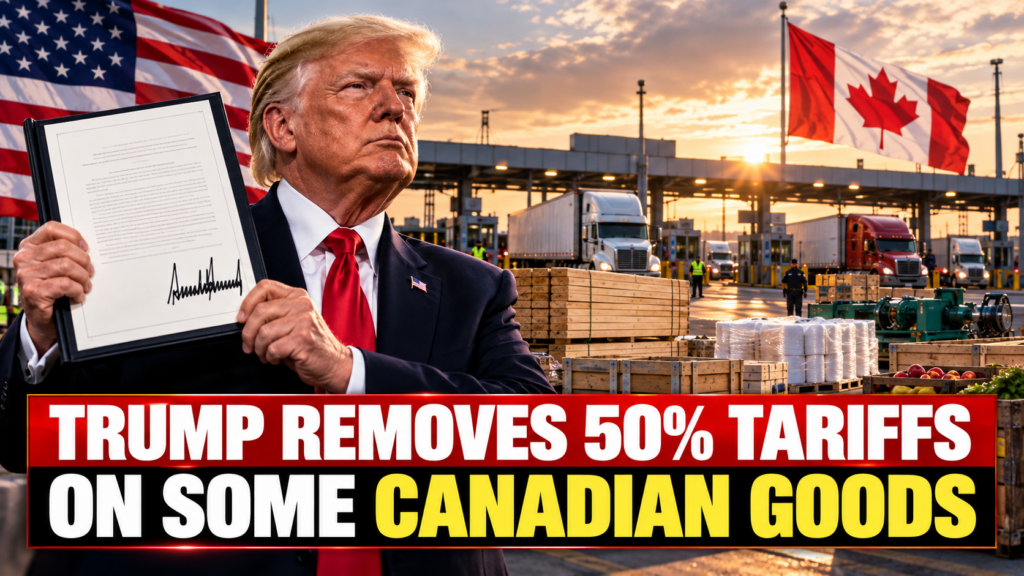
President Donald Trump has removed 50% tariffs on selected Canadian agricultural and forestry products, easing trade costs for certain businesses in a move that could benefit American producers and consumers. The October 23, 2026, decision comes as Republicans face competitive races ahead of the November midterm elections and businesses in northern states continue to raise concerns about the impact of tariffs on cross-border trade.
According to a report by Reuters, Trump signed an order exempting selected Canadian products from the tariffs. The affected categories include plywood sheets, certain paper products, machinery and refrigeration equipment, packing crates and boxes, and fresh and dried seaweed.
The exemptions follow lobbying by Republican Senator Susan Collins of Maine, who has argued that tariffs have increased costs for local businesses and agricultural producers. However, the administration’s broader trade dispute with Canada remains unresolved.
What Happened to the 50% Canadian Tariffs?
Trump Approves Exemptions for Selected Products
The Trump administration introduced 50% tariffs on approximately $20 billion worth of Canadian goods in late August 2026 after trade negotiations between the United States and Canada broke down.
The tariffs created additional costs for American businesses that depend on Canadian imports, particularly in states with close economic ties to Canada.
On October 23, Trump signed an order removing the tariffs from selected products. The White House said the exemptions covered plywood sheets, certain paper products, machinery, refrigeration equipment, packing crates and boxes, and fresh and dried seaweed.
The relief is targeted rather than comprehensive. Other Canadian products remain subject to the 50% tariffs, and the administration has previously offset exemptions by applying tariffs to additional goods.
Agricultural Producers Receive Targeted Relief
Senator Susan Collins said the exemptions would benefit Maine’s blueberry, potato, apple, and seaweed industries.
These businesses depend on cross-border supply chains, imported equipment, packaging, and other products used in agricultural production. Tariffs can increase operating costs and put pressure on businesses that already face competition and changing market conditions.
Collins welcomed the decision after repeatedly asking the administration to address the impact of tariffs on Maine businesses and families.
The exemptions could also help companies in other states that rely on Canadian agricultural and forestry products, although the scale of the benefit will depend on which goods businesses import and how much they previously paid in tariffs.
Why Trump Is Changing Tariff Policy Toward Canada
Pressure From Businesses and Republican Lawmakers
The tariff exemptions come amid growing political pressure from Republicans representing states whose economies are closely connected to Canada.
Maine and Michigan have significant cross-border trade relationships, including industries linked to agriculture, manufacturing, forestry, and automotive supply chains.
Senator Collins has sought tariff relief while campaigning for reelection in Maine. Her Democratic challenger, Troy Jackson, has made Trump’s trade policies toward Canada a central issue in the race.
The November 3 midterm elections are approaching, and Republicans are trying to retain control of Congress. The decision could help the party address concerns from voters and businesses affected by higher import costs.
According to reporting by The Wall Street Journal, the tariff changes were expected to help Collins and other Republicans in northern states. A White House official cautioned that preliminary reports about tariff announcements should not be treated as confirmation before the administration formally announces its decisions.
A Trade Dispute That Remains Unresolved
Despite the exemptions, the United States and Canada have not reached a broader agreement to resolve their trade dispute.
The Trump administration imposed the tariffs after negotiations broke down in August, prompting Canada to retaliate with tariffs of its own.
The administration has also threatened additional trade measures if the two countries fail to reach an agreement. These tensions have created uncertainty for companies that depend on predictable cross-border trade.
The latest exemptions offer targeted relief, but they do not signal a complete reversal of Trump’s tariff strategy. The administration continues to use tariffs as a negotiating tool while responding to pressure from industries affected by the policy.
How the Tariff Exemptions Could Affect the Economy
Potential Relief for American Businesses
Removing tariffs on selected Canadian goods could reduce costs for U.S. businesses that rely on imported materials, machinery, refrigeration equipment, and packaging products.
Companies may benefit from lower import expenses, potentially easing pressure on operating budgets and supply chains. Agricultural producers could also benefit when essential equipment and packaging become less expensive to obtain.
However, the extent to which savings reach consumers remains uncertain. Businesses may use the relief to improve margins, maintain prices, or reduce costs, depending on their individual circumstances.
The exemptions also do not eliminate uncertainty for companies importing other Canadian products that remain subject to tariffs.
Could Tariffs Shift to Other Canadian Goods?
The administration has previously balanced tariff exemptions by imposing additional duties on other Canadian products, keeping the overall value of goods affected by the 50% tariffs at approximately $20 billion.
Whether the latest changes will follow the same approach depends on the administration’s subsequent decisions. The precise treatment of other Canadian goods remains important for businesses assessing their supply chains and import costs.
For companies operating across the U.S.-Canada border, the possibility of further tariff adjustments makes trade planning more difficult. Businesses may need to monitor policy announcements and evaluate alternative suppliers or sourcing strategies.
What Happens Next?
The latest exemptions provide targeted relief for selected agricultural and forestry-related products, but the broader U.S.-Canada trade dispute remains unresolved.
Businesses will be watching for further tariff announcements, particularly whether the administration introduces new duties to offset the exemptions. Canadian officials and affected industries will also be assessing how the changes influence trade flows and negotiations.
For Trump, the decision illustrates the tension between maintaining a protectionist trade policy and responding to concerns from businesses and Republican lawmakers in states that rely heavily on Canadian trade.
The immediate impact may be lower costs for certain importers, but the wider economic consequences will depend on future trade decisions and whether Washington and Ottawa can reach a more durable agreement.
Related Reading
- Trump and Vance Launch $25 Million Fraud Whistleblower Program
- Trump Creates NIH Women’s Health Division and Task Force
The exemptions include plywood sheets, certain paper products, machinery, refrigeration equipment, packing crates and boxes, and fresh and dried seaweed.
The decision followed pressure from businesses and Republican lawmakers, including Senator Susan Collins, who argued that tariffs were increasing costs for Maine industries and families.