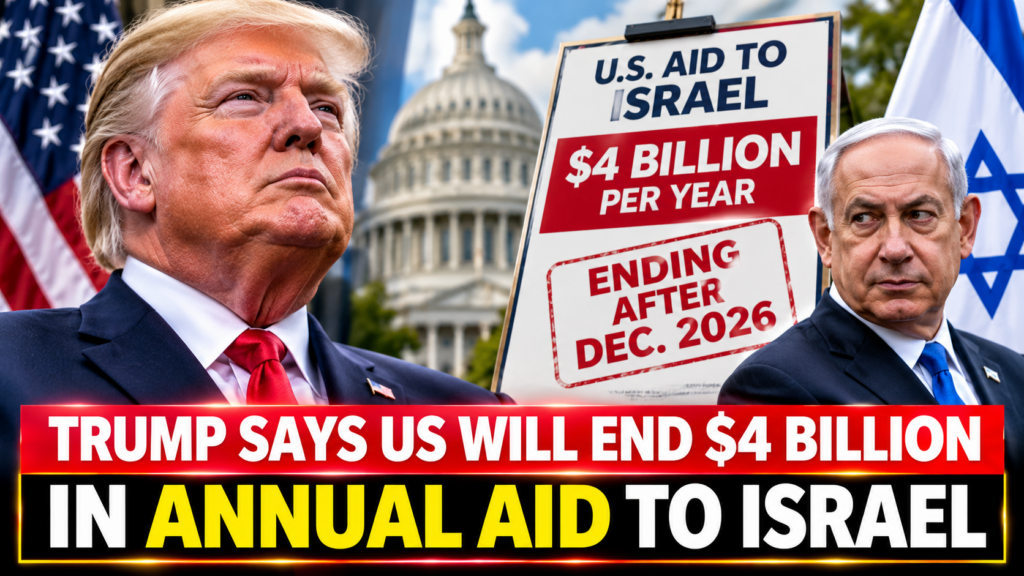
President Donald Trump says the United States will stop providing approximately $4 billion in annual financial assistance to Israel after December 2026, following an agreement with Israeli Prime Minister Benjamin Netanyahu. The announcement marks a potential shift in the long-standing US-Israel security relationship, although questions remain about how the funding would legally and practically end.
Trump made the statement during an interview with Fox News’ Fox & Friends on November 3, 2026. He said Israel no longer needed the financial support and suggested that ending the payments would also remove a political issue that Democrats have used to criticize Republicans.
According to a report by Reuters, Trump described the decision as an agreement reached with Netanyahu months earlier. He also said the United States would continue helping Israel if necessary and that Israel could still purchase American weapons.
What Trump Said About Ending US Aid to Israel
Trump said Washington and Jerusalem had agreed to end the annual payments by the end of 2026.
He argued that Israel had become a prosperous country capable of financing its own defense needs. He also connected the decision to domestic political criticism of American assistance to Israel.
During the interview, Trump specifically referred to Abdul El-Sayed, a Michigan Senate candidate who has criticized unconditional US military assistance to Israel.
Trump characterized the funding as a political vulnerability for Republicans, arguing that critics used the annual payments to question why the United States provides substantial financial support to Israel.
However, the president did not explain precisely which funding programs would be terminated or how the administration would implement the change.
The Existing US-Israel Military Aid Agreement Runs Through 2028
The announcement raises questions because the existing US-Israel military assistance agreement is scheduled to remain in place until September 2028.
The 10-year memorandum of understanding, signed in 2016, provides $38 billion in assistance over the agreement’s duration. This includes approximately $3.3 billion annually in Foreign Military Financing and $500 million for missile defense cooperation.
That arrangement amounts to approximately $3.8 billion per year, slightly below the $4 billion figure Trump cited.
It was therefore unclear how the administration intended to stop the payments more than a year before the agreement expires.
Congress also plays a central role in distributing the funding. Although legislation authorizes the assistance, the House and Senate must pass annual appropriations bills to release the money.
This means that implementing Trump’s announcement could require additional congressional action or a negotiated adjustment to the existing arrangement.
Netanyahu Had Previously Discussed Reducing Dependence on US Assistance
Trump’s announcement comes after Netanyahu publicly discussed reducing Israel’s reliance on American financial support.
In a May 2026 interview with CBS, Netanyahu said he hoped Israel could gradually move away from US military assistance within a decade.
He also wrote in a June letter to a US congressman that the relationship should evolve from one in which Israel receives assistance toward a partnership between the two countries.
In October, Netanyahu reportedly acknowledged that future American assistance could change, telling an Israeli television channel that the country should prepare for a different relationship with Washington.
However, Trump’s proposed timeline appears considerably faster than Netanyahu’s previously stated goal of gradually reducing dependence over several years.
The Associated Press also reported that discussions about future US-Israel defense cooperation include potential changes toward joint technology development and weapons-industry partnerships. Such arrangements could preserve strategic cooperation even if direct financial assistance declines.
Political Opposition and Security Concerns in Israel
Trump’s statement has prompted questions about whether Israeli political and security officials were adequately consulted.
Gadi Eisenkot, an Israeli opposition leader, criticized Netanyahu after the announcement. He argued that the country’s security establishment and citizens should not learn about a major change to the strategic relationship through media reports.
The criticism reflects concerns that ending financial assistance could affect Israel’s long-term defense planning.
The current arrangement supports purchases of American military equipment and contributes to Israel’s broader defense capabilities. A reduction in direct assistance would therefore require decisions about how to finance future procurement and maintain military cooperation.
The Trump administration has indicated that ending financial assistance would not necessarily prevent Israel from purchasing American weapons with its own funds.
US Public Opinion and the Changing Debate Over Israel
The announcement also reflects changing political attitudes toward American support for Israel.
US public support for Israel has declined since the Gaza war began in 2023, particularly among Democratic voters.
A June Quinnipiac University poll cited by Reuters found that 48% of voters and 66% of Democrats believed the United States was too supportive of Israel. When the question was first asked in 2017, the corresponding figures were 16% and 20%.
Criticism has also expanded beyond traditional Democratic opposition. Some conservative and Republican voters have questioned the extent of US involvement in overseas conflicts and the financial commitments associated with them.
Trump’s comments suggest that the administration is increasingly considering the domestic political implications of continued assistance to Israel.
At the same time, ending direct aid does not necessarily mean ending the broader military relationship. Continued weapons sales, joint defense projects and intelligence cooperation could remain important parts of the partnership.
What Happens Next?
The immediate question is whether the United States can end the existing assistance arrangement by the end of 2026, as Trump suggested.
The current memorandum extends through September 2028, and Congress has a role in authorizing and appropriating the funding. Neither the White House nor Netanyahu’s office immediately provided detailed explanations of how the proposed change would be implemented.
The announcement could also influence negotiations over the next phase of US-Israel defense cooperation, including weapons purchases, technology development and the future structure of military assistance.
Ultimately, the proposed end of direct US aid would represent a significant change in one of Washington’s most established foreign security relationships. Whether it becomes an immediate policy shift or a gradual transition will depend on congressional decisions, negotiations with Israel and the administration’s plans for future defense cooperation.
Related Reading
- Trump Invokes Defense Production Act to Boost Oil Production and Refining
- Russian Refiners Increase Diesel Output After Trump Deal
Trump said the United States would stop providing approximately $4 billion in annual assistance after the end of 2026. The implementation details remain unclear.
The 2016 memorandum of understanding provides $38 billion over 10 years, equivalent to approximately $3.8 billion annually through September 2028.