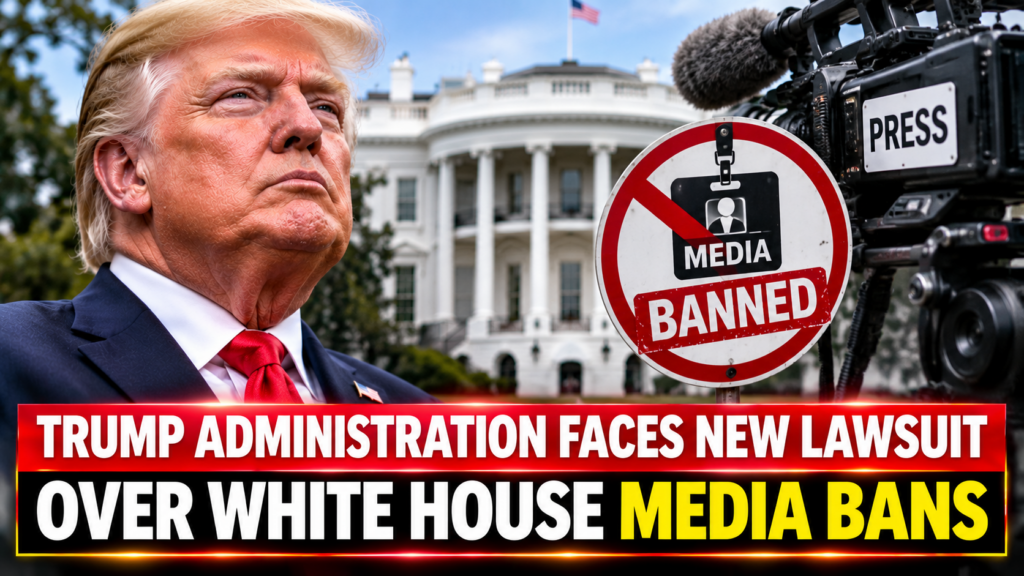
The Trump administration is facing another lawsuit over its restrictions on White House media access, this time from six American citizens who argue that barring certain news organizations from covering the president violates the public’s First Amendment rights. Filed in federal court in New York on October 26, 2026, the case seeks to challenge the broader impact of the administration’s media bans beyond the journalists and outlets directly affected.
Citizens Challenge White House Media Restrictions
The lawsuit was filed by the Knight First Amendment Institute at Columbia University and the Media Freedom and Information Access Clinic at Yale Law School. It represents six individuals who say they depend on independent White House reporting for their work in journalism, education, research, and public advocacy.
The plaintiffs include Yale law professor Kenneth Roth, Yale history professor Beverly Gage, Lawfare Editor in Chief Benjamin Wittes, journalist Daniel Froomkin, University of Pennsylvania student journalist Ethan Young, and New York City high school teacher Peter Schmidt-Nowara.
According to a report by The Washington Post, the lawsuit argues that restrictions imposed on news organizations such as CNN, MS NOW, and Politico also harm ordinary Americans by limiting their access to independent information about the federal government.
The plaintiffs contend that the White House cannot selectively exclude journalists because of their reporting or viewpoints. They argue that the public relies on journalists to observe government activities and communicate information from spaces that most citizens cannot access themselves.
Why the Lawsuit Targets the Public’s Right to Information
The case expands the legal challenge beyond the media organizations that initially faced restrictions. Rather than focusing exclusively on whether specific reporters should regain their credentials, the six citizens argue that government actions against journalists also affect the constitutional interests of the people who rely on their work.
The plaintiffs say that excluding news organizations from White House reporting opportunities reduces the public’s ability to receive independent accounts of presidential activities and government decisions.
The lawsuit also challenges the administration’s approach to spaces made available to the White House press corps. The legal argument is that when the government opens these spaces to journalists, it cannot exclude particular organizations based on disagreement with their reporting.
The case, identified as Roth v. Trump, was filed in the U.S. District Court for the Southern District of New York. The Knight Institute’s case information identifies the plaintiffs’ request for a preliminary injunction as part of the ongoing proceedings.
Earlier Court Ruling Already Blocked the Media Bans
The new lawsuit follows an earlier legal challenge filed by CNN, MS NOW, and Politico after President Donald Trump announced restrictions against the three news organizations in September.
Trump criticized their reporting and described it as fake news. The outlets subsequently challenged the administration’s decision, arguing that the restrictions violated their First Amendment press freedom protections and Fifth Amendment due process rights.
On October 14, U.S. District Judge Timothy Kelly issued a preliminary injunction preventing the administration from enforcing the bans against the three outlets while the litigation continued.
Kelly found that the organizations were likely to succeed in arguing that the restrictions violated their constitutional rights. The ruling also emphasized that the consequences extended beyond individual reporters because the restrictions affected their ability to observe events, report directly from the White House, and engage with government officials.
However, the earlier ruling did not resolve every dispute over media access. Questions remained about access to certain presidential reporting opportunities, including assignments involving Air Force One.
A separate report by Reuters on October 28 said CNN, MS NOW, and Politico had expanded their lawsuit, alleging that the administration continued to restrict their participation in certain reporting activities despite the court order.
White House Defends Its Position
The White House has rejected the criticism surrounding its media access decisions.
In response to the citizens’ lawsuit, a White House spokesperson argued that news organizations accused of misinformation or defamation could still report from outside the White House.
The administration has also previously argued in court that access to the White House is a privilege rather than an unrestricted constitutional right. Government lawyers have cited national security and concerns about misinformation in defending the president’s authority over media access.
The plaintiffs, however, argue that the government cannot use access restrictions to punish reporting it dislikes. Their case focuses on the potential consequences for public access to information when journalists are excluded from government spaces based on their editorial viewpoints.
The disagreement raises broader questions about the limits of presidential authority over press access and the constitutional protections available when government officials restrict journalists.
What Happens Next in the Legal Challenge
The new case is proceeding separately from the lawsuit brought by CNN, MS NOW, and Politico. Its central question is whether ordinary citizens can challenge restrictions on White House media access because those restrictions affect their ability to receive independent reporting.
The Knight First Amendment Institute and Yale’s Media Freedom and Information Access Clinic are seeking broader protection against policies that exclude journalists based on their reporting. The case’s preliminary injunction proceedings will determine whether the court grants the requested interim relief.
The outcome could have implications beyond the six plaintiffs and the three news organizations involved in the earlier case. A broader ruling could influence how future administrations manage press access and whether restrictions based on a journalist’s viewpoint can withstand constitutional scrutiny.
The dispute ultimately concerns more than media credentials. It raises a fundamental question about the relationship between government transparency, an independent press, and the public’s ability to receive information about those in power.
Related Reading
- Trump Directs Trade Negotiations on Wind Turbine Imports
- Trump Administration Moves to Expand Psychedelic Treatments for Veterans
Six Americans represented by the Knight First Amendment Institute at Columbia University and Yale Law School’s Media Freedom and Information Access Clinic filed the lawsuit.
They argue that excluding journalists based on their reporting restricts the public’s access to independent information about the president and federal government.