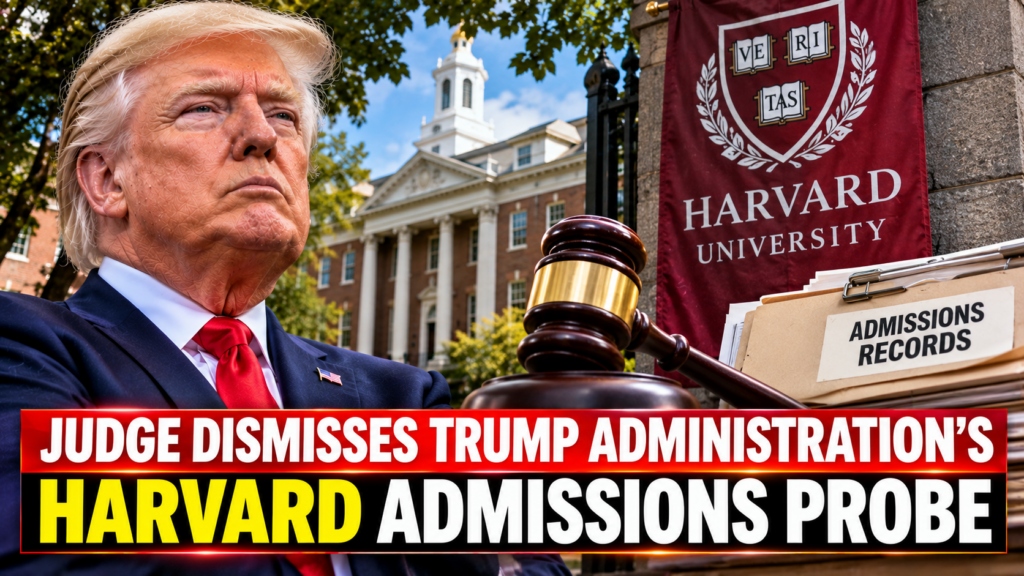
A federal judge in Boston has dismissed the Trump administration’s lawsuit seeking Harvard University admissions records as part of an investigation into whether the university continued considering race in its admissions process. The November 2, 2026, ruling represents a legal setback for President Donald Trump’s administration, but it does not resolve the underlying allegations against Harvard.
According to a report by CNN, U.S. District Judge Myong Joun ruled that the federal government had failed to follow the required procedures before asking the court to compel Harvard to provide applicant-level admissions data.
What Happened in the Harvard Admissions Case?
The lawsuit was filed by the U.S. Department of Justice (DOJ) in February 2026. The administration sought to obtain detailed admissions records from Harvard to investigate whether the university continued considering applicants’ race despite the Supreme Court’s 2023 decision prohibiting race-conscious admissions policies.
The government argued that Harvard had failed to provide information required for its civil rights investigation.
However, Harvard challenged the lawsuit, arguing that the federal agencies had not followed the proper legal procedures before seeking judicial enforcement.
Judge Myong Joun agreed with Harvard’s procedural argument and dismissed the case. The decision was limited to whether the government had adequately demonstrated that it had taken the necessary steps to secure the university’s voluntary compliance before filing the lawsuit.
Why Did the Judge Dismiss the Lawsuit?
The judge identified shortcomings in the government’s efforts to obtain Harvard’s cooperation before taking the dispute to court.
Under the applicable legal framework, federal agencies must take specific steps before seeking judicial enforcement of civil rights requirements. These include notifying the institution of the alleged failure to comply and establishing that voluntary compliance cannot be secured.
The court found that the DOJ’s complaint did not adequately demonstrate that Harvard had been informed that litigation would follow if it failed to comply with the government’s demands.
The complaint also did not sufficiently establish that the university had been notified of the specific compliance failure identified by the government.
The ruling therefore focused on the government’s legal process rather than the substance of its investigation.
What Admissions Records Did the Trump Administration Want?
The Justice Department sought years of applicant-level admissions information from Harvard’s undergraduate, medical, and law schools.
The requested records included information about applicants’ race and ethnicity, academic grades, standardized test scores, application essays, extracurricular activities, and admissions outcomes.
The administration argued that the information was necessary to determine whether Harvard had continued using race as a factor in admissions decisions.
The investigation was connected to Title VI of the Civil Rights Act of 1964, which prohibits racial discrimination in federally funded education programs.
Harvard maintained that it had cooperated with government inquiries and provided more than 2,000 pages of documents. However, the university objected to disclosing individual applicant records.
The university argued that the government’s demands were overly broad and that the administration had not followed the procedures required by law.
Harvard’s Legal Dispute With the Trump Administration
The admissions lawsuit is part of a broader conflict between Harvard and the Trump administration over federal oversight, university governance, and campus policies.
The administration has pursued several actions against the university, including efforts involving federal research funding and allegations of antisemitism.
Harvard has challenged these actions in court, arguing that the administration’s demands exceeded its legal authority and were intended to pressure the university into changing its policies.
The latest ruling adds another legal setback for the administration in its ongoing dispute with the institution.
However, the judge did not determine whether the government’s broader actions against Harvard were retaliatory or whether the university’s admissions practices violated federal law.
What Happens Next?
The dismissal was made without prejudice, meaning the federal government may bring the case again after addressing the procedural problems identified by the judge.
The ruling does not prevent the DOJ from continuing its investigation or seeking admissions records through a legally compliant process.
It also does not establish that Harvard has fully satisfied its obligations under Title VI or that its admissions policies comply with the Supreme Court’s 2023 ruling.
For now, the decision highlights the importance of procedural requirements when federal agencies seek to enforce civil rights laws against universities.
The dispute is likely to remain part of the broader legal debate over affirmative action, federal oversight of higher education, and the limits of presidential administration authority over universities.
Related Reading
- Supreme Court Blocks Trump Restrictions on Transgender Inmates
- Trump Administration Releases America First Seafood Strategy
A federal judge ruled that the Justice Department had not adequately followed the required procedures to secure Harvard’s voluntary compliance before filing the lawsuit.
Yes. The case was dismissed without prejudice, allowing the government to pursue the matter again after addressing the procedural deficiencies.