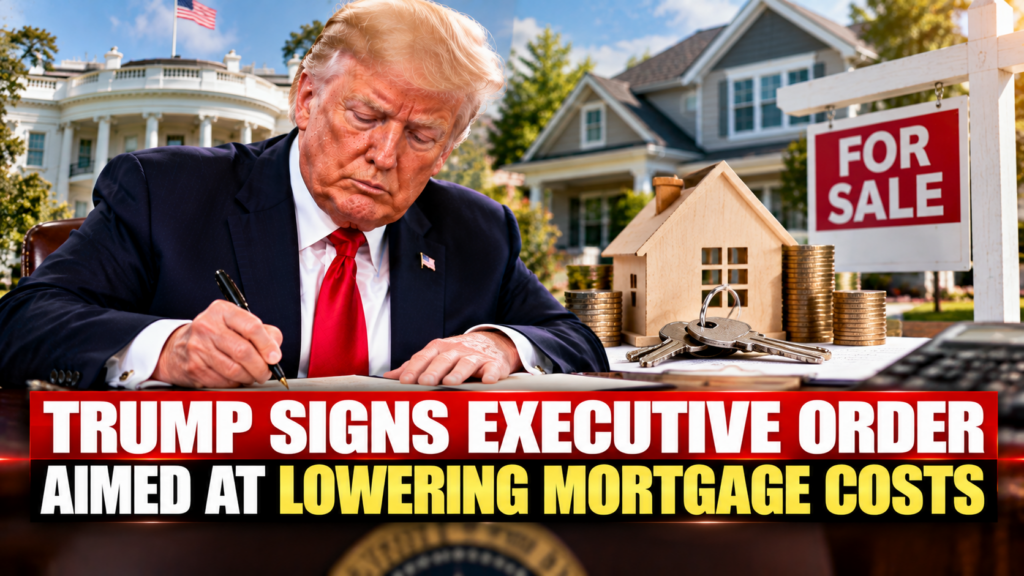
President Donald Trump signed an executive order aimed at lowering mortgage costs and improving housing affordability in the United States. Announced in October 2026, the initiative directs federal agencies to explore ways to reduce mortgage insurance expenses, lower refinancing costs, and encourage more affordable housing construction.
According to a report by CNBC, the order outlines several measures intended to ease the financial burden on homeowners and prospective buyers. The potential benefits will depend on how federal agencies implement the measures and which borrowers qualify.
What Happened?
The executive order, titled “Decreasing Housing Costs for the American People,” focuses on several areas of the housing market, including mortgage insurance, refinancing transactions, manufactured housing, and certain government-issued home loans.
The administration is directing federal agencies to develop programs and examine regulatory changes that could reduce some of the expenses associated with buying or refinancing a home.
However, the order does not mean that every homeowner will immediately receive lower mortgage payments. Several measures require additional implementation, and eligibility requirements will determine who can benefit.
Key Details of Trump’s Mortgage Costs Plan
Mortgage Insurance Cancellation
The order directs the Federal Housing Finance Agency (FHFA) to establish a pilot program that could proactively identify borrowers eligible to cancel mortgage insurance.
The program would periodically review eligible single-family mortgages backed by Fannie Mae and Freddie Mac, using automated property valuations and other available information to assess whether borrowers meet applicable requirements.
The proposed pilot would apply to qualifying loans made after the program is established. Eligibility would depend on relevant equity, payment-history, and financial requirements.
For qualifying homeowners, mortgage insurance cancellation could reduce recurring monthly housing expenses.
Lower Refinancing Costs
Another part of the order focuses on reducing expenses associated with refinancing a mortgage.
The FHFA is directed to expand an existing title insurance waiver pilot into an ongoing nationwide program through Fannie Mae and Freddie Mac. Eligible transactions could use approved automated title reviews or alternative title-risk assessments instead of a lender’s title insurance policy.
The agency is also directed to consider expanding eligibility, simplifying documentation requirements, and reducing certain refinancing fees.
These changes could make refinancing less expensive for eligible borrowers, although actual savings will depend on the final program requirements.
Support for Manufactured Housing
The order also establishes a Task Force on Manufactured Housing Innovation to examine ways to lower construction costs and expand access to factory-built homes eligible for federal housing programs.
The task force will consider regulatory barriers, permitting procedures, and modern manufacturing methods that could improve housing production.
The broader objective is to encourage housing innovation and competition while maintaining appropriate safety and quality standards.
Changes to Certain Government Home Loans
The order directs the secretaries of Agriculture and Veterans Affairs to reduce interest rates on eligible single-family home loans issued directly by their respective departments, subject to applicable laws and available funding.
This measure could offer additional support to qualifying borrowers who use these government lending programs.
Economic Impact on American Homeowners
The executive order addresses several costs associated with homeownership, including mortgage insurance premiums, refinancing fees, and housing construction expenses.
For eligible borrowers, lower recurring insurance costs or reduced refinancing fees could provide financial relief. Measures supporting manufactured housing could also help address construction costs and expand housing options.
However, the broader impact will depend on mortgage interest rates, home prices, implementation timelines, and the number of borrowers who qualify for the new programs.
The measures alone are unlikely to resolve every housing affordability challenge facing American households.
What Happens Next?
Federal agencies must develop the relevant programs and procedures in accordance with the executive order.
Homeowners should not assume that their existing mortgage insurance premiums or refinancing expenses will immediately decrease. The mortgage insurance pilot is intended for eligible loans made after the program is established, while refinancing benefits will depend on the expanded program’s terms.
The administration’s approach combines potential financing changes with regulatory adjustments and housing construction initiatives. Whether these measures deliver meaningful savings will become clearer as agencies implement the programs and eligible borrowers gain access to them.
Ultimately, the executive order represents an effort to address selected costs of homeownership. Its success will depend on whether the proposed changes translate into measurable savings for American families.
Related Reading
- Trump Announces $8 Billion Harvest Fuel Relief Program for Farmers
- Bessent Urges World Bank to Finance Oil and Gas Projects and Reform Lending Policies
It directs federal agencies to pursue measures involving mortgage insurance cancellation, refinancing costs, manufactured housing, and interest rates on certain government-issued home loans.
No. The measures require implementation, and potential savings will depend on program eligibility, loan requirements, and the rules established by federal agencies.