MAHA (Make America Healthy Again) is a health and food policy movement focused on childhood chronic disease, while MAGA (Make America Great Again) is the broader nationalist political movement built around Donald Trump. The maha vs maga differences 2026 debate matters because the two now overlap inside the Republican coalition yet pull in different directions on regulation, corporate influence and priorities after the midterms.
For readers who follow the presidency, the distinction is practical. One movement is attached to a specific executive order and a federal commission. The other is an identity-driven electoral force that shapes primaries, endorsements and the party's national message.
What MAHA and MAGA Each Stand For
MAHA is a policy-driven movement centered on diet, chemical exposure and chronic illness, and MAGA is a populist movement centered on national sovereignty, economic nationalism and loyalty to Trump.
MAGA became a campaign slogan during Donald Trump's political rise and grew into a lasting political identity. Its core themes include border enforcement, tariffs, "America First" foreign policy, skepticism of federal institutions and cultural conservatism. Readers tracking the movement's reach can review how MAGA grew in 2026 alongside its endorsement power in the midterms.
MAHA is newer and narrower. It gained national visibility through Robert F. Kennedy Jr.'s 2024 alliance with Trump and was then formalized in government. Its supporters focus on food additives, ultra-processed products, pesticides, medical overtreatment and what they describe as corporate capture of health agencies.
Both movements distrust established institutions. They differ on who the opponent is. MAGA tends to name immigrants, global trade arrangements and progressive cultural elites. MAHA tends to name food manufacturers, chemical producers and parts of the pharmaceutical and agricultural sectors.
How MAHA Became Official Policy
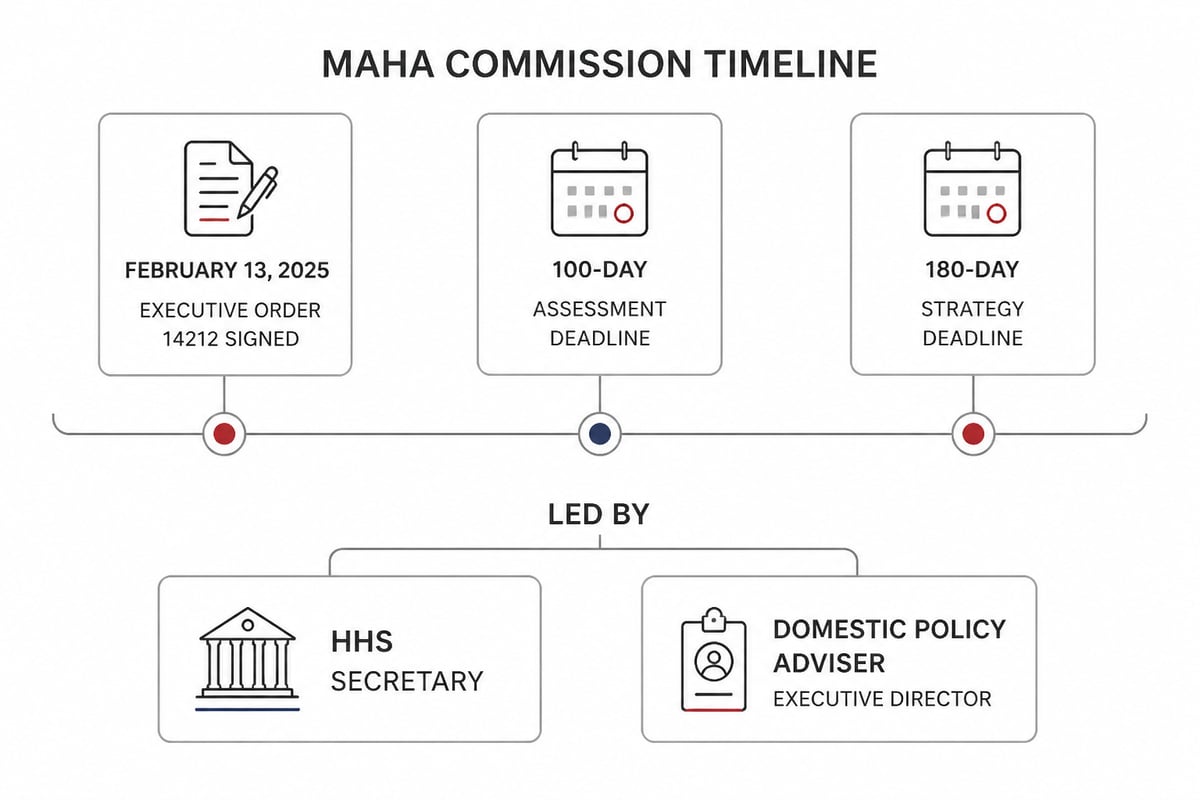
MAHA became official policy on February 13, 2025, when President Trump signed Executive Order 14212 establishing the President's Make America Healthy Again Commission, according to the Federal Register.
That order gives MAHA something MAGA does not have: a defined legal and administrative structure. Key features include:
- Mission: The commission's initial focus is advising the president on the childhood chronic disease crisis.
- Leadership: It is chaired by the secretary of Health and Human Services, with the assistant to the president for domestic policy serving as executive director.
- Deadlines: The order directed an assessment within 100 days and a strategy within 180 days, per GovInfo.
- Scope of study: Potential contributors to childhood illness include diet, toxic exposures, medical treatments, lifestyle, environmental factors, food production and corporate influence, as summarized by Covington & Burling.
The White House fact sheet lists four policy directives: transparency and open-source data, gold-standard research, working with farmers on healthy and affordable food, and expanding treatment and coverage for prevention and lifestyle changes. For a fuller walkthrough of the commission's agenda, see our MAHA agenda explainer.
Maha vs Maga Differences 2026: Side-by-Side Comparison
The clearest maha vs maga differences 2026 appear in origin, scope, leadership and the kinds of voters each movement attracts.
| Attribute | MAHA | MAGA |
|---|---|---|
| Origin | Formalized by executive order in 2025 | Campaign slogan from 2015-2016 |
| Primary focus | Childhood chronic disease, food, chemicals | Immigration, trade, sovereignty, culture |
| Government footprint | A named presidential commission | No single administrative body |
| Main adversary | Food, chemical and pharma industries | Political and cultural establishment |
| Typical stance on regulation | Open to tighter limits on additives and pesticides | Generally favors deregulation |
| Voter profile | Cross-partisan, wellness-minded, parents | Core Republican base, working-class populists |
| Central figure | Robert F. Kennedy Jr. | Donald Trump |
The regulation row is where the tension is sharpest. A movement that wants stricter rules on agricultural chemicals sits uneasily beside a coalition that has prioritized rolling back federal rules. Our coverage of federal agency restructuring shows how that tension plays out inside the executive branch.
Where the Two Movements Overlap
The movements overlap in leadership, rhetoric and voter loyalty, which is why many Americans treat them as one coalition.
Both rely on Trump as a political anchor. The commission that gives MAHA its administrative form was created by his executive order, so the movement's policy work runs through his presidency even though its most visible advocate is Robert F. Kennedy Jr. Both movements frame their cause as a rescue of ordinary Americans from entrenched institutions. MAGA aims that language at federal bureaucracy and political elites, while MAHA aims it at the "corporate influence" the executive order names as a possible contributor to childhood illness. Both attract voters who feel ignored by Washington. Many MAHA supporters also vote Republican, and many MAGA supporters are likely sympathetic to cleaner food and lower drug costs.
The overlap is strongest on messaging and weakest on policy detail. A voter can cheer "Make America Healthy Again" at a rally without supporting every proposed pesticide restriction, and a farm-state Republican can embrace MAGA while resisting limits on herbicides that growers depend on. The shared ground is real, but it is mostly attitudinal: distrust of institutions and loyalty to a leader, rather than agreement on specific rules.
Where MAHA and MAGA Split
The split shows up on regulation, agriculture and industry ties, and it has produced open friction within Republican politics in 2026.
Three fault lines stand out:
- Pesticides and herbicides. MAHA advocates want stronger scrutiny, and the polling supports them: 64% of adults in the KFF survey said the government does too little to regulate agricultural pesticides. Agricultural interests and many Republican officials worry about costs for farmers, who rely on these products to protect yields. The executive order's own language about working with farmers shows the administration trying to hold both positions at once.
- Food industry relationships. MAHA's critique of corporate influence collides with the party's traditionally pro-business instincts. The order lists food production and corporate influence as subjects for study, yet the same coalition depends on business-friendly donors and a deregulatory agenda. A call to restrict an additive is, in practice, a call to change a manufacturer's formulas and costs.
- Vaping and consumer products. Policy choices on nicotine and consumer goods have drawn criticism from MAHA voices who see them as inconsistent with a public health mission. Each such decision gives MAHA supporters a concrete test of whether the movement's stated goals survive contact with other administration priorities.
These disputes have spilled into public view through disagreements among advisers and allies of the administration. For background on the wider party strain, read our report on Trump and GOP tensions in 2026.
What the 2026 Midterms Revealed
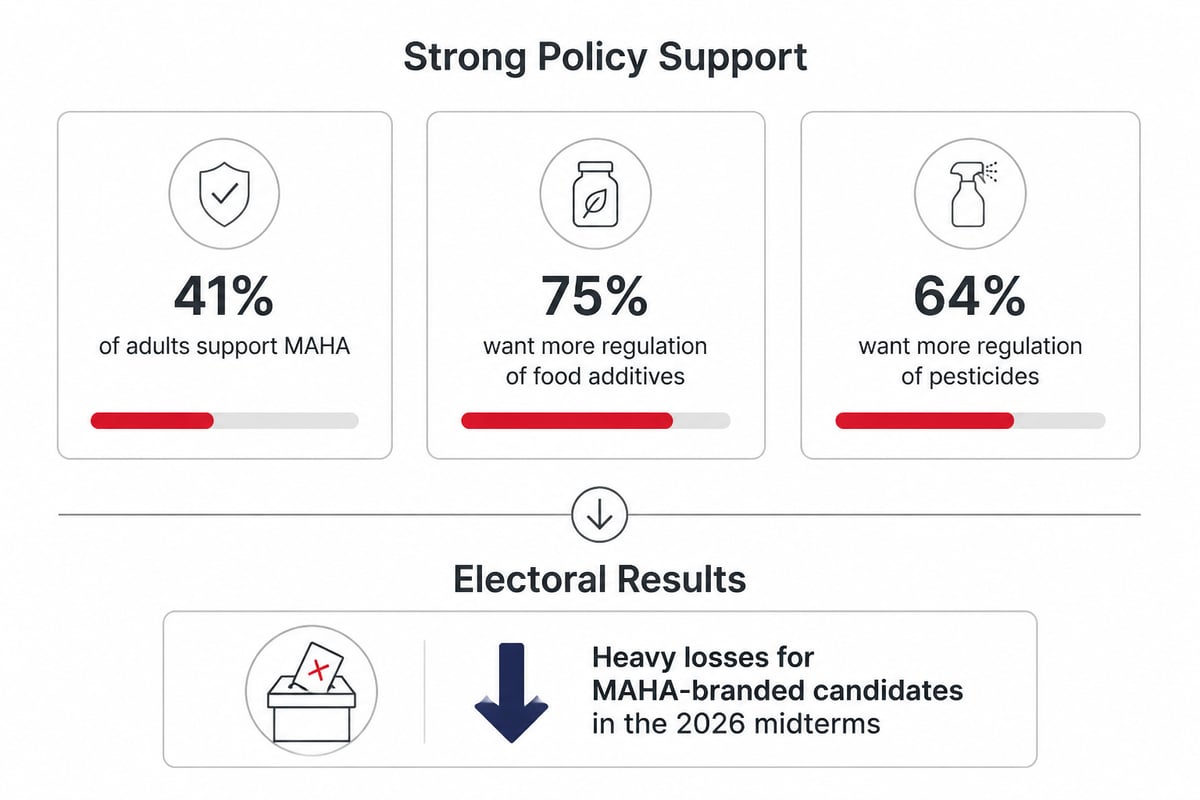
The 2026 midterms suggested that MAHA branding alone did not guarantee electoral success, even though public support for its goals remains substantial.
A May 2026 KFF poll cited by Fortune found that 41% of American adults supported MAHA. The same report says 75% thought the government did too little to regulate chemical food additives, and 64% said the same about agricultural pesticides. Those numbers suggest why the movement's ideas can poll well even when MAHA-branded candidates struggle.
The distinction is important for analysts. Voters can favor a policy goal, such as tighter additive rules, without choosing a candidate because of a movement label.
Voter Coalitions and Party Strategy
MAHA appears to draw a more politically mixed audience than MAGA, which makes it valuable to Republican strategists and harder for them to control.
MAGA voters are a reliable base. They turn out in primaries, respond to Trump endorsements and anchor Republican margins in rural and exurban areas. Analysis of Trump-backed primary victories shows how much weight that base carries in nominating contests.
MAHA voters are less predictable. Many are parents and wellness-oriented consumers, including some independents and former Democrats. That makes the movement a potential bridge to voters outside the core base. It also means those voters may not follow the party when policy decisions contradict MAHA priorities. Trends among independent voters and in swing-state polling help show how much this group could matter.
How Each Movement Approaches Policy and Government
MAGA governs through executive power and trade, border and tax policy, while MAHA works through agency science, data and rulemaking.
MAGA priorities tend to appear in large, visible actions: border funding, energy policy and tax proposals. These often rely on executive authority, which has drawn legal challenges. A tariff announcement or a border directive can change conditions within days, and its effects are easy to track in news coverage.
MAHA priorities move through slower institutional channels. The commission's mandate emphasizes research quality, open data and cooperation with farmers rather than single dramatic orders. Two of the four White House directives, transparency with open-source data and gold-standard research, are about how evidence is gathered and shared before any rule is written. The fourth, expanding treatment options and coverage for prevention and lifestyle changes, depends on coverage decisions and funding. Outcomes therefore rely on agency rulemaking, scientific review and congressional willingness to fund or authorize changes. That difference in tempo helps explain why MAGA often appears dominant in daily news while MAHA's results are measured over a longer period.
Why the Distinction Matters for Presidential Coverage
Separating the two movements helps readers interpret which policy fights are about ideology and which are about health and industry regulation.
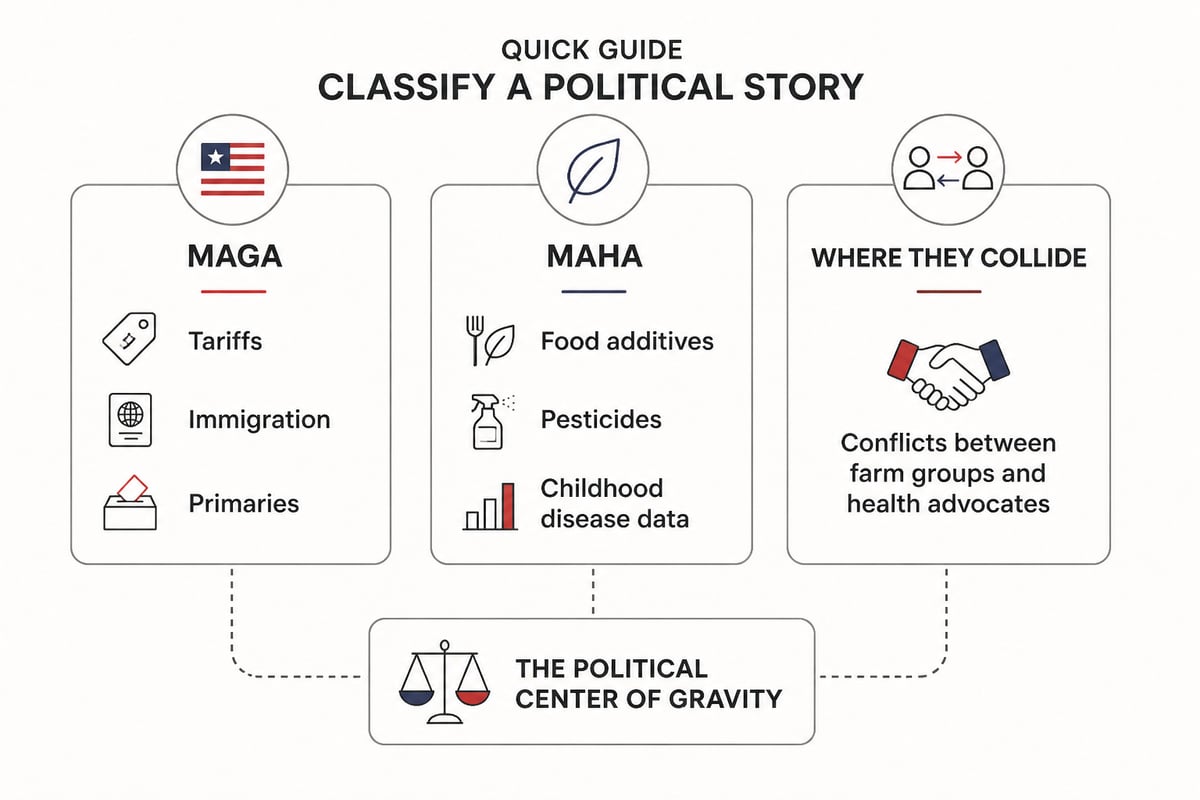
When a story concerns tariffs, immigration or a primary endorsement, MAGA is the relevant frame. When a story concerns food dyes, pesticide rules or childhood disease data, MAHA is the better lens. Many news events involve both, and the friction between them is often the most informative part of the story.
Practical tips for following the topic:
- Check whether a proposal comes from the HHS-led commission or from White House political staff.
- Note whether industry groups, farm organizations or public health advocates are weighing in.
- Compare polling on the policy itself with polling on the candidates who promote it.
- Watch for formal actions in the Federal Register rather than relying on public statements alone.
Readers who want a running view of the presidency can follow our top presidential news roundup for 2026 and the original MAHA vs MAGA explainer.
What to Watch After the Midterms
The next phase turns on whether MAHA's policy agenda survives its electoral setbacks and whether Republican leaders resolve the conflicts with agricultural and industry allies.
Key questions for the coming months include whether the commission's recommendations become binding rules, how Congress responds to calls for tighter chemical oversight, and whether MAHA-aligned voters stay in the Republican coalition. For many readers, the issue is also personal. Families weighing food choices, wellness habits and stress often look for support beyond politics, and local resources such as Crystal Energy’s psychic and spiritual healing center offer meditation instruction and stress-focused services that some readers pair with health-minded routines.
For the broader picture of voter priorities heading into the next cycle, our report on the top political issues Americans care about in 2026 shows where health, cost of living and border policy rank.
Start by reading the commission's executive order and the next set of agency actions yourself, then compare them with how each movement describes its goals. U.S. Presidential Report publishes non-partisan daily coverage of the presidency, Congress, courts and federal policy so you can follow these shifts as they happen, and if you want to turn that interest into community action, Start Your Own Political Club and bring informed discussion to your neighbors.