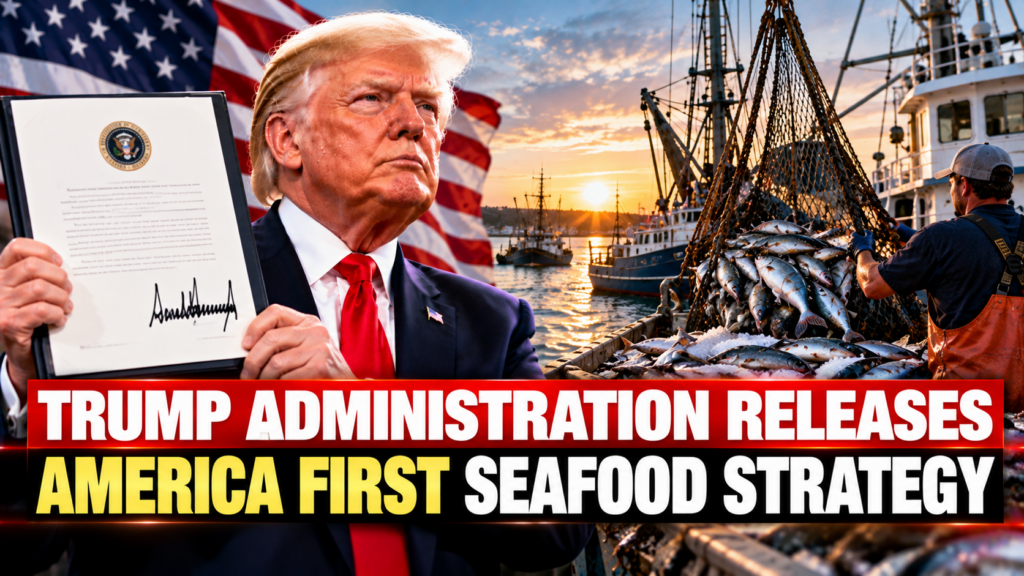
The Trump administration announced its America First Seafood Strategy on October 23, 2026, outlining a federal plan to expand domestic seafood production, modernize fishing infrastructure, strengthen market access, and address unfair foreign competition. The strategy aims to support American fishermen, seafood processors, coastal economies, and national food security.
According to a report by NOAA, the plan coordinates federal agencies around sustainable fisheries management, reduced regulatory costs, stronger domestic processing capacity, and improved competition in U.S. and international seafood markets.
What Happened?
President Donald Trump announced the America First Seafood Strategy as part of his administration’s broader effort to restore American seafood competitiveness.
The strategy builds on the executive order titled “Restoring American Seafood Competitiveness.” It brings together federal agencies, including the National Oceanic and Atmospheric Administration (NOAA), the U.S. Department of Agriculture (USDA), and the Food and Drug Administration (FDA), to strengthen the domestic seafood industry.
The administration says the plan will focus on increasing sustainable harvest opportunities, reducing unnecessary regulatory burdens, improving seafood processing infrastructure, and expanding markets for American products.
Rather than establishing a new spending initiative, the strategy relies on existing federal authorities and programs to coordinate policy changes and remove barriers facing the industry.
Key Details of the America First Seafood Strategy
Expanding Domestic Seafood Production and Market Access
One major priority is to increase opportunities for American fishermen while maintaining science-based fisheries management.
NOAA will work with regional fishery management councils and industry representatives to ensure catch limits reflect the best available scientific evidence. The agency will also examine opportunities to restore access to productive fishing grounds where supported by data.
The strategy introduces a voluntary “U.S.-Caught Seafood” designation, developed in coordination with the FDA and USDA. The label is intended to help consumers identify seafood harvested by American fishermen aboard U.S.-flagged vessels under U.S. fisheries management.
Federal agencies will also expand opportunities for American seafood in government procurement and launch a nationwide “Eat American Seafood” campaign to promote domestic products.
Rebuilding Fishing Infrastructure and Processing Capacity
The strategy identifies aging fishing fleets and limited domestic processing capacity as challenges facing the American seafood industry.
Federal agencies plan to streamline permitting and reduce barriers to private investment in cold storage, working waterfronts, docks, shipyards, and seafood processing facilities.
Existing financing programs operated by NOAA, USDA, and the Small Business Administration will be used to support modernization, vessel replacement, and equipment upgrades.
NOAA will also review its Fisheries Finance Program and Capital Construction Fund to identify obstacles that discourage fishermen from investing in safer and more efficient American-built vessels.
The administration plans to measure progress through changes in domestic production and processing, private investment, American jobs supported, and reliance on foreign supply chains.
Strengthening Import Enforcement and Fair Competition
Another priority is to address seafood fraud, mislabeling, and illegal, unreported, and unregulated fishing.
NOAA will continue implementing and improving the Seafood Import Monitoring Program, using advanced tools to identify high-risk imports and strengthen enforcement.
The strategy also calls for greater coordination with the Office of the U.S. Trade Representative and other federal agencies to improve market access for American seafood exports.
These measures are intended to help U.S. producers compete against imported products that may benefit from unfair trade practices or originate from illegal fishing operations.
Regulatory Reform and Marine Aquaculture
The administration plans to work with regional fishery management councils to pursue targeted regulatory reforms.
These efforts include reducing compliance costs that do not advance conservation objectives, reviewing fishing access where supported by scientific evidence, and improving the predictability of permitting for responsible marine aquaculture in federal waters.
The goal is to support commercial fishing and aquaculture investment while maintaining sustainable management of U.S. marine resources.
Promoting Seafood Through Public Health Initiatives
The strategy also connects domestic seafood production with public health and nutrition.
Federal health and nutrition agencies will align educational materials and public guidance with current scientific evidence on the benefits of seafood consumption.
NOAA will contribute fisheries and aquaculture information to support these efforts, while the nationwide “Eat American Seafood” campaign will promote domestic seafood as part of a healthy diet.
The administration expects stronger consumer awareness to support demand for American seafood and create additional opportunities for domestic producers.
Economic Impact on American Seafood Producers
The America First Seafood Strategy aims to strengthen the economic position of American fishermen, processors, and coastal communities by increasing domestic production and reducing dependence on foreign supply chains.
Improved processing facilities, expanded market access, and more efficient permitting could help businesses lower operating costs and reach more customers. The voluntary U.S.-Caught Seafood designation could also help domestic products stand out in the marketplace.
The administration has additionally announced more than $5 billion in guaranteed USDA loans to support modernization of meat and seafood processing facilities. This financing initiative complements the strategy’s broader focus on improving domestic processing capacity.
However, the economic impact will depend on implementation, private investment, market demand, and the ability of American producers to compete on price and quality.
What Happens Next?
Federal agencies will coordinate implementation through existing programs and regulatory authorities. NOAA will provide fisheries science, management expertise, and verification support, while other agencies will address labeling, financing, trade enforcement, and public education.
The administration has also launched Seafood.gov as a central resource for information about federal seafood initiatives and American seafood products.
Progress will be assessed through measures such as domestic production, processing capacity, private investment, employment, and reduced reliance on foreign supply chains.
The America First Seafood Strategy represents a broader effort to connect domestic manufacturing capacity, sustainable fisheries management, and national food security. Its long-term success will depend on whether the federal initiatives deliver measurable improvements for American seafood businesses and the coastal communities that depend on them.
Related Reading
- Court Backs EPA Decision Giving Oklahoma Environmental Authority Over Tribal Lands
- Trump Announces $8 Billion Harvest Fuel Relief Program for Farmers
It is a federal plan to expand domestic seafood production, modernize infrastructure, improve market access, and strengthen fair competition for American seafood producers.
The strategy aims to reduce unnecessary regulatory costs, improve access to markets and financing, modernize fishing fleets and processing facilities, and promote seafood harvested in the United States.