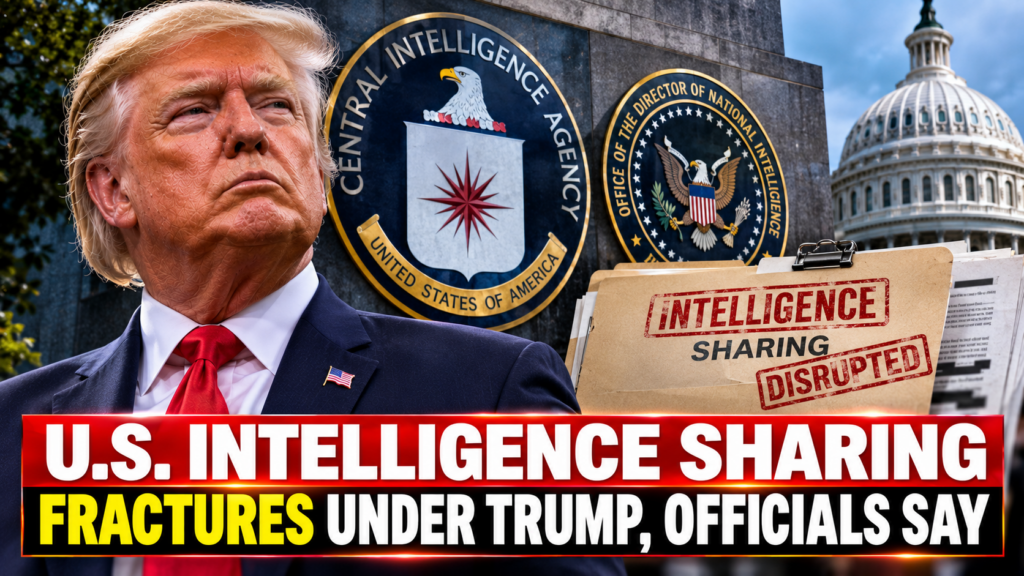
U.S. intelligence sharing across federal agencies and with Congress has slowed and, in some cases, temporarily stopped during President Donald Trump’s second term, according to current and former officials cited in a November 3, 2026, Reuters investigation. The disruptions have raised concerns that policymakers could receive an incomplete picture of national security threats, including developments involving Iran and other global security challenges.
According to a report by Reuters, eight current and former officials and people briefed on the matter described problems involving the Central Intelligence Agency (CIA), the Office of the Director of National Intelligence (ODNI), and congressional intelligence briefings.
What Happened to US Intelligence Sharing?
The reported disruptions developed during the tenure of former Director of National Intelligence Tulsi Gabbard, amid tensions between her office and the CIA.
Although those tensions have eased since Gabbard’s resignation in June 2026, officials told Reuters that some problems continued.
One significant change involved the CIA’s decision to stop co-authoring assessments with the National Intelligence Council (NIC), an analytical body within the ODNI. These assessments are designed to combine information and analysis from across the U.S. intelligence community to inform government decision-makers.
The CIA continued sharing intelligence with the council and participating in some reports. However, its analysts increasingly focused on producing their own assessments, reducing the number of joint reports.
The National Intelligence Council also experienced staffing cuts, contributing to slower production. Five current and former officials told Reuters that none of its assessments had focused on the war in Iran.
Tensions Between the CIA and ODNI Reduced Cooperation
The dispute between the CIA and ODNI was described by officials as one of the most significant internal conflicts between the agencies in approximately three decades.
The tensions intensified after Gabbard’s office revoked the security clearances of current and former intelligence officials in 2025.
According to three former officials cited by Reuters, White House Chief of Staff Susie Wiles intervened several times to ease the conflict.
The National Intelligence Council relies on contributions from intelligence agencies to produce assessments covering international security issues, including Iran and Russia. The CIA has historically played an important role in providing analysis for these reports.
The reduced cooperation therefore raised concerns about whether policymakers were receiving sufficiently integrated intelligence from across the government.
Congressional Intelligence Briefings Were Temporarily Interrupted
The problems also affected the flow of intelligence information to Congress.
According to Reuters, lawmakers and congressional staff temporarily stopped receiving intelligence reports from Gabbard’s office following two major U.S. operations.
The first interruption occurred after U.S. military intervention in Iran in June 2025. A second occurred following the capture of former Venezuelan President Nicolás Maduro in January 2026.
People familiar with the matter told Reuters that Gabbard’s team had accused lawmakers of leaking information to the press.
Her office also stopped briefing Congress on election threats in 2025, according to two people familiar with the matter and a former U.S. official.
However, the situation changed after Jay Clayton became director of national intelligence in August 2026. Officials told Reuters that Clayton had resumed congressional briefings on election threats.
An ODNI spokesperson said Clayton remained committed to ensuring that intelligence agencies had the resources needed to inform government decision-makers and protect Americans.
FBI and Counterterrorism Center Also Faced Disputes
The Reuters investigation identified another breakdown involving the FBI and the National Counterterrorism Center (NCTC).
The FBI reportedly stopped sharing some intelligence with the NCTC for several weeks in late 2025 after the center’s then-head, Joe Kent, and his staff attempted to investigate the shooting of Turning Point USA founder Charlie Kirk.
According to two former officials, FBI leaders believed the NCTC was exceeding its authority.
The disagreement created another barrier between federal agencies responsible for national security and counterterrorism operations.
The FBI did not respond to Reuters’ request for comment.
Officials Warn of National Security Risks
Former intelligence officials and outside experts warned that weakened coordination could leave policymakers without a comprehensive understanding of threats facing the United States.
Beth Sanner, a former deputy director of national intelligence during Trump’s first term, said government decision-makers need a more integrated assessment of international developments.
Former officials also raised concerns that intelligence analysts could become reluctant to produce assessments that conflict with the White House’s positions.
Two former officials and one current U.S. official told Reuters that some analysts were concerned about potential political retaliation if their findings contradicted administration views.
The White House did not respond to Reuters’ request for comment.
Meanwhile, some former intelligence officials are working on a bipartisan initiative at Stanford University’s Hoover Institution to develop proposals for rebuilding the intelligence community under a future administration.
What Happens Next?
The reported problems raise questions about how effectively U.S. intelligence agencies can coordinate information, assess emerging threats, and provide independent analysis to policymakers.
The appointment of Jay Clayton has reportedly restored some congressional briefings, while tensions between the CIA and ODNI have eased. However, concerns remain about the longer-term effects of reduced cooperation, staffing cuts, and political pressure.
As the United States faces international security challenges involving Iran and other regions, effective intelligence sharing remains essential. The ability of federal agencies to exchange information and provide independent assessments will be important to national security and informed government decision-making.
Related Reading
- Government Contractor Arrested in Classified Information Leak Case
- Two Former FBI Officials Charged Over Hunter Biden Laptop Probe
Reuters reported that tensions between the CIA and ODNI, agency staffing cuts, and disputes over congressional briefings contributed to reduced intelligence coordination.
The reported problems involve the CIA, ODNI, National Intelligence Council, FBI, and National Counterterrorism Center.