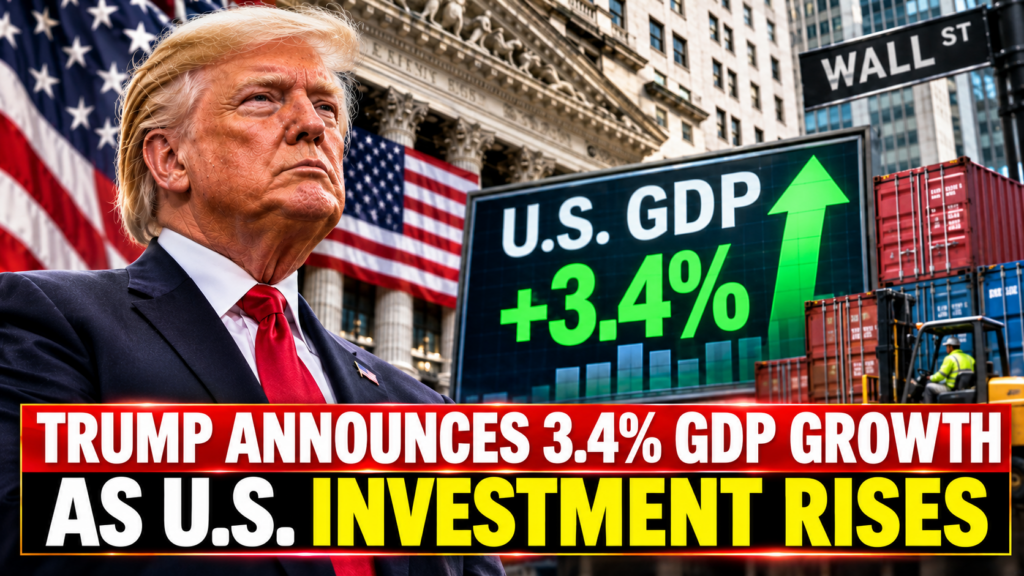
The U.S. economy grew at an annualized rate of 3.4% in the third quarter of 2026, accelerating from 2.2% in the previous quarter as consumer spending and business investment increased. President Donald Trump highlighted the figures on October 29, presenting the latest GDP growth as evidence of stronger economic performance under his administration.
According to a report by The White House, the latest figures show rising investment in American businesses, manufacturing, and equipment. However, independent economic data also point to persistent inflation and pressure on household finances.
What Happened: US GDP Growth Reached 3.4%
The Bureau of Economic Analysis (BEA) reported that real gross domestic product increased at a 3.4% annual rate between July and September 2026. This represented an acceleration from the 2.2% growth recorded in the second quarter.
The increase was driven by higher investment, consumer spending, and government spending. These gains were partly offset by a decline in exports, while imports increased.
The BEA’s advance estimate also showed that real final sales to private domestic purchasers, which combine consumer spending and gross private fixed investment, rose by 4.9% in the third quarter. This was slightly higher than the 4.6% increase recorded in the previous quarter.
The figures indicate stronger economic activity, although the advance estimate remains subject to revision as additional data become available.
Business Investment and Consumer Spending Drive Growth
Business investment was one of the main contributors to the stronger economic performance.
The White House reported that private investment in plants and equipment increased at a 9.4% annual rate during the third quarter. It also highlighted nearly 13% growth in business investment, describing the figures as a sign of increased confidence in American production and manufacturing.
Independent reporting provided further detail on the investment trend. Reuters reported that business investment in equipment increased significantly, supported in part by spending on artificial intelligence-related technology.
Consumer spending also remained strong, increasing at an annual rate of 3.8% during the quarter. According to the Associated Press, investment in artificial intelligence infrastructure contributed to the expansion, reflecting continued demand for advanced computing equipment and related technology.
However, the strength of consumer spending does not necessarily mean that all American households are experiencing improved financial conditions.
Inflation and Household Finances Remain Concerns
Despite stronger GDP growth, inflation and household purchasing power remain important economic challenges.
The Associated Press reported that consumer prices increased 3.6% year over year in September 2026, while core inflation reached 3.1%. These figures indicate that price pressures remained elevated even as the economy expanded.
Household savings also came under pressure. The AP reported that the personal savings rate fell to 3.8%, its lowest level in four years, as consumers continued spending despite weaker real after-tax income.
Reuters similarly highlighted concerns about the distribution of economic growth. Its reporting noted that spending was increasingly concentrated among wealthier households, while typical workers’ wages continued to lag behind prices.
These conditions create a more complicated picture than the headline GDP figure alone suggests. Stronger national output can coexist with affordability challenges for households facing higher living costs.
What the GDP Figures Mean for Trump’s Economic Agenda
The latest GDP growth figures provide the Trump administration with a positive economic indicator as it promotes its policies on investment, manufacturing, taxation, and trade.
The White House attributed the stronger performance to the administration’s approach, including lower taxes, reduced regulations, energy production, and America First trade policies.
However, the BEA’s report identifies the direct contributors to economic growth without establishing that any single administration policy caused the increase. Investment, consumer spending, government spending, exports, and imports all influence the overall GDP calculation.
The figures also present a challenge for policymakers. Sustaining economic growth while controlling inflation will remain important, particularly if higher prices continue to affect household budgets.
What Happens Next?
The BEA’s October 29 release was the advance estimate for third-quarter GDP. The agency scheduled its second estimate, alongside corporate profits data, for November 25, 2026.
That update will provide a revised assessment of economic performance as additional information becomes available.
For the Trump administration, the 3.4% growth figure offers a strong headline for its economic agenda. However, inflation, household savings, and the distribution of economic gains will remain important measures of whether that growth translates into broader financial improvements for Americans.
Related Reading
- Trump Directs Trade Negotiations on Wind Turbine Imports
- Trump Invokes Defense Production Act to Boost Oil Production and Refining
The US economy grew at an annualized rate of 3.4% in Q3 2026, according to the BEA’s advance estimate released on October 29.
Higher business investment, consumer spending, and government spending contributed to growth, while declining exports partly offset the increase.