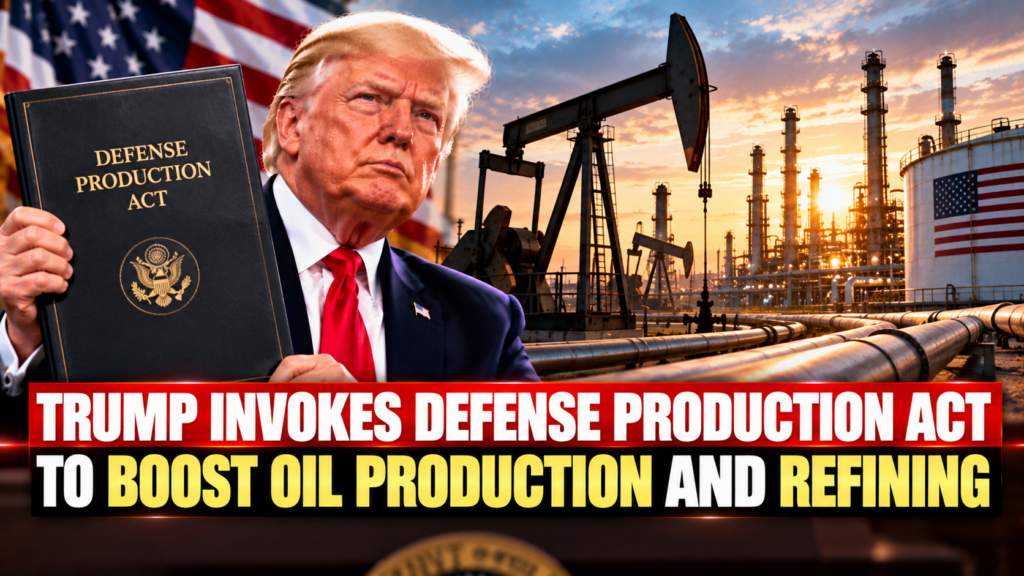
President Donald Trump has invoked the Cold War-era Defense Production Act to expand U.S. oil production, refining, and fuel infrastructure, declaring these activities essential to national defense. The move could unlock federal financial support for petroleum projects, pipelines, and liquid-fuel storage as rising energy costs put pressure on American households and businesses.
What Happened?
On October 22, 2026, Trump issued a presidential determination authorizing the use of Section 303 of the Defense Production Act of 1950 to strengthen domestic petroleum production and refining capacity.
According to a report by Reuters, the decision allows the administration to provide financial incentives and other forms of support for oil-related projects. The measure is intended to address barriers that could prevent the energy industry from expanding capacity quickly enough to meet national defense requirements.
The presidential memorandum identifies domestic petroleum production, refining, pipelines, storage facilities, and related logistics infrastructure as critical to national security.
How the Defense Production Act Could Support Oil Projects
Federal Funding and Financial Assistance
The Defense Production Act gives the federal government mechanisms to support industries considered essential to national defense. Under Trump’s determination, the administration can use purchases, purchase commitments, financial support, and other authorized measures to help expand petroleum-related capacity.
The memorandum identifies several obstacles facing the industry, including limited financing, lengthy project timelines, permitting delays, infrastructure bottlenecks, and supply-chain constraints.
The administration argues that these barriers could prevent the United States from developing the energy infrastructure needed to protect its defense capabilities.
Refinery Expansion and Fuel Infrastructure
The policy could support investments in oil production, refining, pipelines, and liquid-fuel storage. These facilities play a significant role in supplying gasoline, diesel, jet fuel, and other petroleum products used by transportation networks, businesses, industrial facilities, and the military.
Vice President JD Vance had previously indicated that the administration planned to use the Defense Production Act to expand capacity at a Texas refinery owned by Delek US Holdings.
However, Trump’s October 22 memorandum did not identify specific projects that would receive funding.
Why Trump Is Invoking the Defense Production Act Now
Rising Oil and Diesel Prices
The decision comes as crude oil and diesel prices have increased amid disruptions to global energy shipments. The conflict following U.S. and Israeli attacks on Iran in late February, alongside Ukrainian attacks on Russian refineries, has contributed to pressure on fuel supplies.
Higher energy costs can affect transportation, manufacturing, agriculture, and household budgets. The administration’s strategy is to strengthen domestic production and refining capacity to improve the availability of petroleum products.
The political implications are also significant. With congressional elections scheduled for November 3, higher fuel costs pose an economic challenge for Republicans seeking to maintain control of both chambers of Congress.
A Reuters/Ipsos poll that closed earlier in the week found that 36% of Americans approved of Trump’s handling of the economy.
What the Policy Means for U.S. Energy Security
The United States remains the world’s largest crude oil producer. The country averaged approximately 13.6 million barrels of crude oil production per day in 2025.
Nevertheless, high domestic production does not eliminate the effects of global supply disruptions. Refining capacity, transportation infrastructure, storage, and access to international markets also influence the availability and cost of fuel.
Trump’s determination seeks to address some of these vulnerabilities by treating petroleum infrastructure as a national defense priority. The administration is also operating under legislation enacted in 2025 that allocated $1 billion in Defense Production Act funding for energy projects considered critical to national security.
The broader strategy reflects the administration’s emphasis on domestic fossil fuel production and energy independence. Its effectiveness will depend on how quickly supported projects can expand capacity and whether additional supply helps ease pressure on fuel prices.
What Happens Next?
The next steps will involve implementing the presidential determination and identifying projects that could receive federal support. The memorandum authorizes the relevant federal department to make purchases, commitments, and financial arrangements to expand domestic petroleum production, refining, and logistics capacity.
The administration has not specified all projects that will benefit from the new determination. The impact on fuel prices will therefore depend on the projects selected, the time required to expand infrastructure, and broader conditions in global energy markets.
Trump’s use of the Defense Production Act places oil production and refining firmly within the administration’s national security strategy. Whether the policy delivers lower fuel costs for Americans remains an important question as the United States approaches the November midterm elections.
Related Reading
- Trump Administration Grants Deportation Reprieve to Ukrainians and Sudanese
- Trump Administration Imposes Fresh Iran-Related Sanctions on 16 Individuals and 10 Entities
Trump designated domestic petroleum production, refining, and logistics as essential to national defense, citing financing constraints, permitting delays, infrastructure bottlenecks, and supply-chain limitations.
The policy could support expanded production and refining capacity, but its effect on fuel prices will depend on project implementation and conditions in global energy markets.