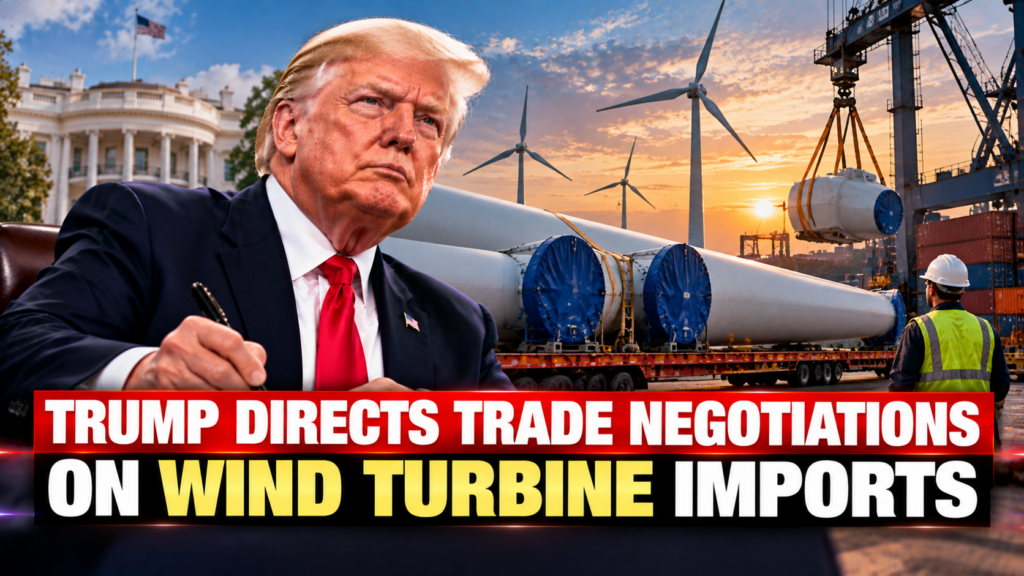
President Donald Trump has directed U.S. officials to negotiate with foreign trading partners over wind turbine imports, citing national security concerns involving cybersecurity, radar interference, and dependence on overseas suppliers. The October 22, 2026, proclamation does not impose new tariffs on wind turbines but leaves open the possibility of additional trade measures in the future.
According to a report by Reuters, Trump instructed Commerce Secretary Howard Lutnick and U.S. Trade Representative Jamieson Greer to pursue negotiations and report on their progress within 180 days.
What Happened?
The Trump administration has classified imports of wind turbines and their parts and components as a potential national security threat following an investigation by the U.S. Department of Commerce.
The investigation, launched in August 2025 under Section 232 of the Trade Expansion Act of 1962, examined the effects of imported wind energy equipment on national security and domestic manufacturing capacity.
In the October 22 proclamation, Trump directed the Commerce Department and the Office of the U.S. Trade Representative to negotiate agreements with foreign trading partners to address the identified concerns.
The administration has not introduced new tariffs specifically targeting wind turbines under this proclamation. Instead, it has chosen negotiations as the initial response while reserving the option to consider additional measures later.
Key Details of Trump’s Wind Turbine Import Policy
National Security and Cybersecurity Concerns
The Commerce Department investigation identified several risks associated with foreign-made wind turbines and their components.
According to the administration, cybersecurity vulnerabilities in imported equipment could potentially allow remote access to turbine systems and create risks of power disruptions. The proclamation also raises concerns about potential interference with radar systems, air traffic control, weather forecasting, homeland security, and national defense operations.
The administration argues that these risks warrant closer scrutiny as the United States continues to rely on imported wind turbine components.
The proclamation also highlights the potential consequences of supply chain vulnerabilities for critical infrastructure.
Trade Negotiations Instead of Immediate Tariffs
Trump has directed Lutnick and Greer to jointly pursue or continue negotiations with foreign trading partners they consider appropriate.
The officials must provide the president with at least one update on the negotiations within 180 days of October 22, 2026. They are also required to provide additional updates as the discussions progress.
The proclamation allows Trump to consider alternative remedies depending on the outcome of the negotiations.
If agreements are not reached or prove ineffective, further action could follow under the applicable provisions of Section 232. However, the administration has not announced a new wind turbine-specific tariff under this measure.
Dependence on Foreign Wind Turbine Components
The investigation found that U.S. dependence on imported wind turbine components has increased over the past decade.
Major suppliers of wind turbines and components to the American market include Mexico, France, India, Denmark, and Germany, according to trade data cited by the American Action Forum.
The administration argues that reliance on overseas manufacturing creates vulnerabilities when imported equipment is used in critical energy infrastructure.
The policy therefore links trade negotiations with a broader objective of reducing supply chain risks and strengthening domestic industrial capacity.
Trump’s Criticism of Wind Energy
The proclamation also reflects Trump’s longstanding criticism of wind power.
The administration argues that wind energy is intermittent and can create additional demands on electricity grid operators, who may need backup generation to maintain grid stability when wind output changes.
These arguments form part of the administration’s stated rationale for scrutinizing wind turbine imports and their effects on the U.S. electricity system.
However, the national security investigation and the trade negotiations concern imported equipment and components, rather than introducing an immediate blanket ban on wind energy or wind turbine imports.
Economic Impact on the U.S. Wind Energy Industry
The policy could affect wind energy developers, turbine manufacturers, equipment suppliers, and companies that rely on imported components.
Trade negotiations may create uncertainty for businesses planning equipment purchases or investments, particularly if the administration later introduces additional import restrictions. Manufacturers could also face pressure to strengthen domestic production capacity and reduce reliance on foreign suppliers.
However, no new wind turbine-specific tariffs were imposed by the October 22 proclamation. Existing tariffs on certain steel, aluminum, and copper products remain in place.
The ultimate economic impact will depend on the agreements reached with trading partners and any subsequent decisions by the administration.
What Happens Next?
The Commerce Department and the Office of the U.S. Trade Representative must continue negotiations and provide Trump with an update within 180 days of the proclamation.
The Commerce Department will also monitor wind turbine imports and assess whether developments indicate a need for further presidential action under Section 232.
If negotiations fail to address the administration’s concerns, Trump may consider additional trade measures, including tariffs. No decision on such measures has been announced under this proclamation.
The policy marks another step in the administration’s use of national security reviews to shape U.S. trade policy. For the wind energy industry, the next six months could be important in determining whether negotiations lead to new trade arrangements or further restrictions on imported equipment.
Related Reading
- Trump Administration Bans DeepSeek From Federal Government IT Systems
- Bessent Urges World Bank to Finance Oil and Gas Projects and Reform Lending Policies
No. The October 22, 2026, proclamation directs trade negotiations but does not impose new wind turbine-specific tariffs. Existing tariffs on certain metals remain unchanged.
The administration cites cybersecurity vulnerabilities, possible radar interference, risks to critical infrastructure, and increasing U.S. dependence on foreign-made components.