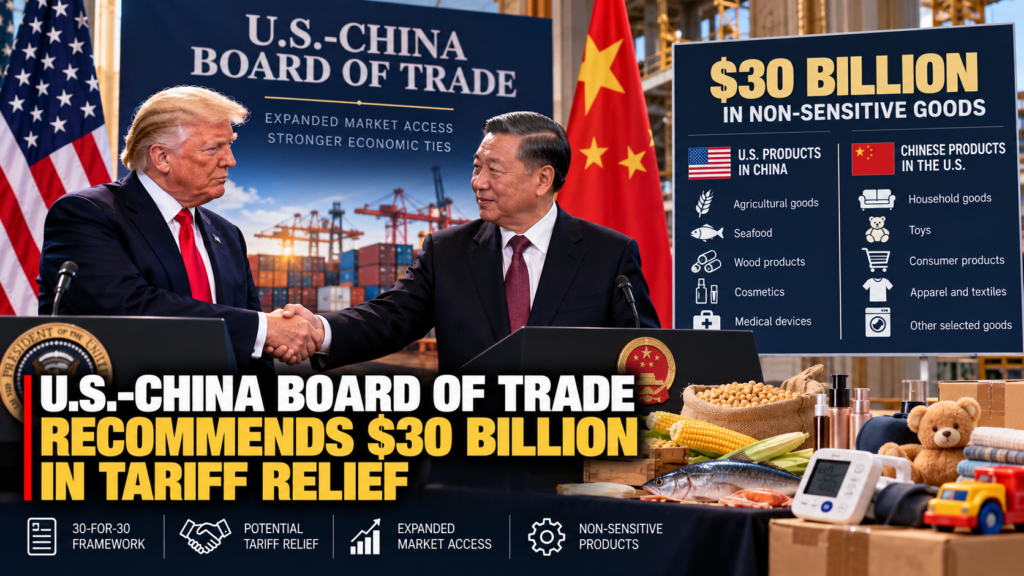
The United States and China have recommended about $30 billion in non-sensitive goods on each side for potentially more favorable tariff treatment under the new U.S.-China Board of Trade.
The framework could expand market access between the world’s two largest economies, although any tariff changes would still need to go through each country’s domestic legal and administrative processes.
According to a report by United States Trade Representative, Ambassador Jamieson Greer said the recommendations cover products ranging from agricultural goods and medical devices to household products and toys.
What Happened
The U.S.-China Board of Trade was established by President Donald Trump and Chinese President Xi Jinping to manage trade in non-sensitive products between the world’s two largest economies.
The two countries have now identified product groups that could potentially receive more favorable tariff treatment. The framework is known as the 30-for-30 arrangement, covering roughly $30 billion in trade in each direction.
The recommendations follow Xi’s September visit to Washington and come as both governments continue working on broader trade arrangements.
Products Covered by the Framework
The U.S. side identified Chinese products that could potentially receive more favorable tariff treatment, including household goods, toys and other consumer products.
The Chinese import list covers a broader range of U.S. products, including agricultural goods, seafood, wood products, cosmetics and medical devices.
Trade officials said the recommendations are intended to improve market access while keeping the products within the non-sensitive category.
The White House published the product lists alongside the Board of Trade’s working procedures and the terms of reference for the 30-for-30 framework.
Tariff Changes Are Not Yet Automatic
The recommendations do not mean that the listed products immediately receive lower tariffs.
The framework states that any future tariff reductions must be determined and implemented through the respective domestic legal processes of the United States and China. The product lists may also be reviewed over time.
The documents therefore establish a framework for potential tariff changes rather than announcing an immediate, across-the-board reduction.
Broader U.S.-China Trade Talks
The announcement comes shortly after Trump and Xi concluded a three-day summit in Washington.
Reuters reported that the two countries had also agreed to establish a trade council and continue earlier economic arrangements, while extending a trade truce that had been scheduled to expire in November.
The two sides also agreed to begin dialogue on artificial intelligence, including discussions about AI risks and benefits.
The U.S.-China Board of Trade is expected to provide a formal mechanism for continuing discussions over trade in selected products.
What Happens Next
The next stage will depend on how the United States and China implement the recommendations through their respective legal and administrative processes.
For American businesses, the framework could affect access to the Chinese market across agriculture, manufacturing and medical products if the proposed tariff treatment is implemented.
For U.S. consumers and importers, the Chinese product list could influence the cost and availability of selected household and consumer goods.
The recommendations mark another step in the ongoing U.S.-China trade process. However, the timing and scale of any actual tariff reductions remain subject to further decisions by both governments.
Related Reading
- US and Denmark Reach Greenland Security Deal as Trump Expands Arctic Military Role
- Bessent Proposes US-China AI Safety Notifications in Talks With Chinese Vice Premier
It is a framework identifying about $30 billion of goods on each side that could receive more favorable tariff treatment.
No. Any tariff reductions must still go through the domestic legal processes of the United States and China.