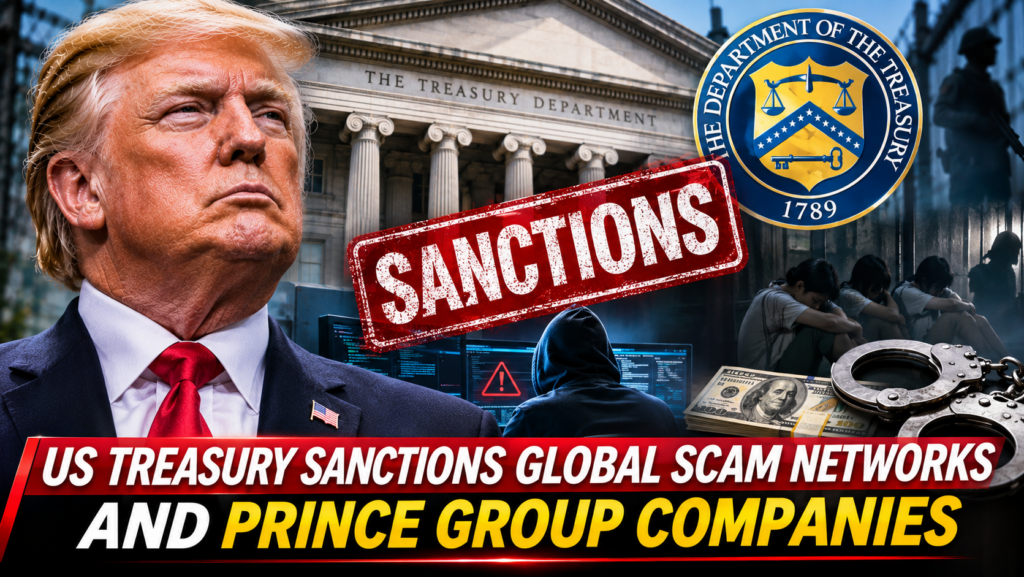
The U.S. Department of the Treasury has announced new sanctions targeting international scam networks and the companies allegedly helping them operate. On November 5, 2026, the Treasury’s Office of Foreign Assets Control (OFAC) designated four individuals and 41 entities linked to the Prince Group Transnational Criminal Organization, which has been accused of cyber-enabled fraud, money laundering and human trafficking.
The action also targets a Malaysian individual accused of managing a separate scam network operating from Madagascar. The measures aim to disrupt not only the people carrying out online fraud but also the corporate and financial structures allegedly supporting their activities.
Treasury Targets Prince Group’s Corporate Network
According to a report by EIN Presswire, the latest sanctions target companies and individuals accused of helping Prince Group executives conceal assets, manage offshore businesses and continue financial activities despite earlier restrictions.
The designated entities operate across several jurisdictions, including Cambodia, Singapore, Mauritius and Malaysia. They include businesses involved in insurance, property development, technology, aviation and other commercial activities.
Treasury said some of these companies were owned or controlled by previously sanctioned Prince Group figures, including Chen Bo, Dai An and Thet Li.
The latest action builds on earlier sanctions announced in October 2025 and June 2026. Treasury said its investigation identified additional companies and intermediaries allegedly helping the organization maintain its business operations and move assets internationally.
Prince Group Accused of Cyber Fraud and Human Trafficking
Treasury has linked Prince Group-affiliated operations to billions of dollars in alleged illicit proceeds generated through online scams targeting victims in the United States and other countries.
The schemes include cryptocurrency investment fraud, romance scams and other forms of digital financial deception. Criminal networks reportedly use social engineering to gain victims’ trust before persuading them to transfer money or digital assets.
Some operations are connected to scam compounds in Southeast Asia, where trafficked and coerced workers are allegedly forced to conduct online fraud.
The money generated through these activities can then move through offshore companies, shell corporations and financial intermediaries, making it difficult for authorities to identify the people ultimately controlling the proceeds.
By targeting these corporate structures, Treasury aims to restrict the financial networks that allegedly allow criminal organizations to continue operating.
Malaysian Individual Targeted Over Madagascar Scam Operations
In a separate action, OFAC sanctioned Malaysian national Chui Kok Wa for allegedly managing a network of scammers operating from Madagascar.
Treasury accused the network of targeting American victims through cyber-enabled fraud, including digital asset scams. The department identified more than $400,000 in equivalent losses suffered by Americans.
Chui was designated under Executive Order 13694, as amended, which targets certain significant malicious cyber-enabled activities.
This measure is separate from the sanctions against Prince Group. Together, however, the actions demonstrate Treasury’s efforts to target both large transnational criminal organizations and individuals managing specific online fraud operations.
Financial Restrictions and International Enforcement
The sanctions block property and financial interests belonging to designated individuals and entities that are within the United States or under the control of U.S. persons.
U.S. persons are generally prohibited from conducting transactions involving blocked parties unless an exemption or authorization applies. Companies owned at least 50% by one or more blocked persons can also be subject to blocking restrictions, even if they are not separately named.
The enforcement action involved cooperation between several U.S. agencies, including the Federal Bureau of Investigation, the Department of Justice’s Scam Center Strike Force and the U.S. Attorney’s Office for the District of Alaska. Authorities in the British Virgin Islands and the United Kingdom also provided assistance.
This international coordination reflects the difficulty of investigating criminal networks that use companies, financial accounts and intermediaries across multiple countries.
What Happens Next?
The November 5 sanctions expand the U.S. government’s efforts to disrupt international scam operations by targeting the businesses and financial structures allegedly supporting them.
The restrictions will limit designated parties’ access to assets and transactions subject to U.S. jurisdiction. However, enforcement will also depend on identifying additional intermediaries, tracing illicit funds and preventing criminal networks from rebuilding their corporate structures.
The action highlights the growing connection between online fraud, cryptocurrency scams, human trafficking and international money laundering. As these networks become more complex, cooperation between financial authorities and law enforcement agencies will remain essential.
Related Reading
- Melania Trump to Host Russian and Ukrainian Representatives at the White House
- Trump Moves to Remove South Africa and Rwanda From AGOA Trade Program
Treasury accused the companies of helping Prince Group conceal ownership, manage offshore businesses and support its alleged criminal activities.
Chui is a Malaysian individual sanctioned for allegedly managing a Madagascar-based scam network that caused more than $400,000 in equivalent losses to Americans.