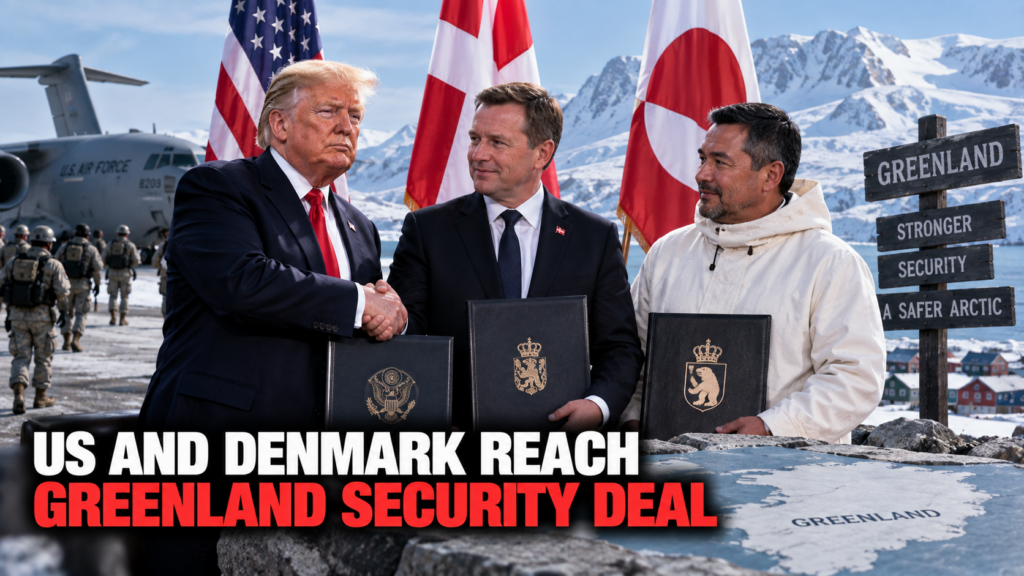
The United States, Denmark and Greenland have reached a Greenland security deal that would allow the U.S. to expand its military presence on the Arctic island while restricting rival countries from establishing military bases there. The agreement stops short of President Donald Trump’s previous goal of acquiring Greenland and leaves several details of the arrangement unclear.
According to a report by Reuters, Trump announced the agreement on September 18, 2026, saying it would give the United States permanent access to Greenland for security purposes.
What Happened
The agreement involves the United States, Denmark and Greenland, an autonomous territory of Denmark. Under the arrangement, Washington would be able to develop a significant military presence on the island, while non-NATO countries would be prevented from establishing military bases there.
Trump said the agreement would also restrict sensitive investments by U.S. adversaries without American approval. He described the arrangement as having no expiration date and said the United States would have the ability to take measures necessary to protect Greenland and U.S. security interests.
The announcement represents a shift from Trump’s earlier efforts to acquire Greenland. Reuters reported that the agreement falls well short of his previous goal of bringing the territory under U.S. control.
Key Details of the Greenland Security Deal
Expanded U.S. Military Presence
The United States already has extensive military rights in Greenland under a 1951 treaty, including broad overflight and basing rights. The island currently hosts a U.S. Space Force installation in its remote northwest.
The new agreement would provide permanent U.S. access, basing and overflight rights, according to a State Department official cited by Reuters. The official also said the arrangement would remain in effect even if Greenland eventually becomes independent.
However, it remained unclear when the new military presence would be established or whether additional U.S. bases would actually be constructed.
Restrictions on Non-NATO Countries
The agreement is designed to prevent countries outside NATO from establishing military bases in Greenland. It also places restrictions on sensitive investments, with the State Department saying only the United States and its allies would be permitted to make certain investments.
The provisions reflect Greenland’s growing strategic importance in the Arctic, particularly because of its location between North America and Europe.
Greenland’s Sovereignty Remains
The agreement does not transfer Greenlandic territory to the United States. Greenland remains an autonomous territory within the Kingdom of Denmark.
Greenland Prime Minister Jens-Frederik Nielsen said the agreement recognized Greenland’s interests and its place in international cooperation. Denmark’s government also said the arrangement would strengthen security in the North Atlantic and Arctic regions.
Political and Security Impact
The Greenland security deal could reshape the security framework surrounding the Arctic and North Atlantic. Washington would gain a more formalized long-term military role while Denmark and Greenland would retain their existing sovereignty arrangements.
The agreement also has implications for NATO. Denmark has described the arrangement as strengthening regional security, while the United States has emphasized preventing adversarial military or economic activity in Greenland.
Greenland’s strategic position makes it particularly important for Arctic defense and North American security. Its location also places it near emerging geopolitical competition involving the United States, Russia and China.
Trump’s Greenland Policy Takes a Different Direction
Trump has repeatedly argued that Greenland is important to U.S. national security and previously expressed a desire for the United States to acquire the territory.
The new Greenland security deal instead focuses on military access and strategic cooperation without transferring sovereignty. Reuters reported that Trump’s announcement suggested he may not revive his territorial acquisition push in the near term.
The arrangement therefore represents a move from discussions about territorial acquisition toward a framework centered on defense, military access and restrictions on potential adversaries.
What Happens Next
Several important details remain unresolved. Reuters reported that it was not immediately clear whether new U.S. bases would be built or precisely how the agreement would operate.
The full scope of the agreement will also determine how Denmark, Greenland and the United States divide responsibilities for Arctic security. Greenland’s aspirations for eventual independence add another layer to the long-term implications of the arrangement.
For now, the Greenland security deal establishes a framework for deeper U.S. military involvement while maintaining Greenland’s status within the Kingdom of Denmark. Its implementation and the eventual details of U.S. military expansion will determine how significantly it changes the Arctic security landscape.
Related Reading
Air Pollution Spiked After Trump Ended Embassy Monitoring
Trump Escalates Canada Trade War With New Tariffs and Import Bans
FAQs
The deal between the U.S., Denmark and Greenland allows an expanded U.S. military presence while restricting non-NATO military bases and certain sensitive investments.
No. Greenland remains an autonomous territory of Denmark. The agreement concerns security, military access and strategic restrictions rather than transferring sovereignty.