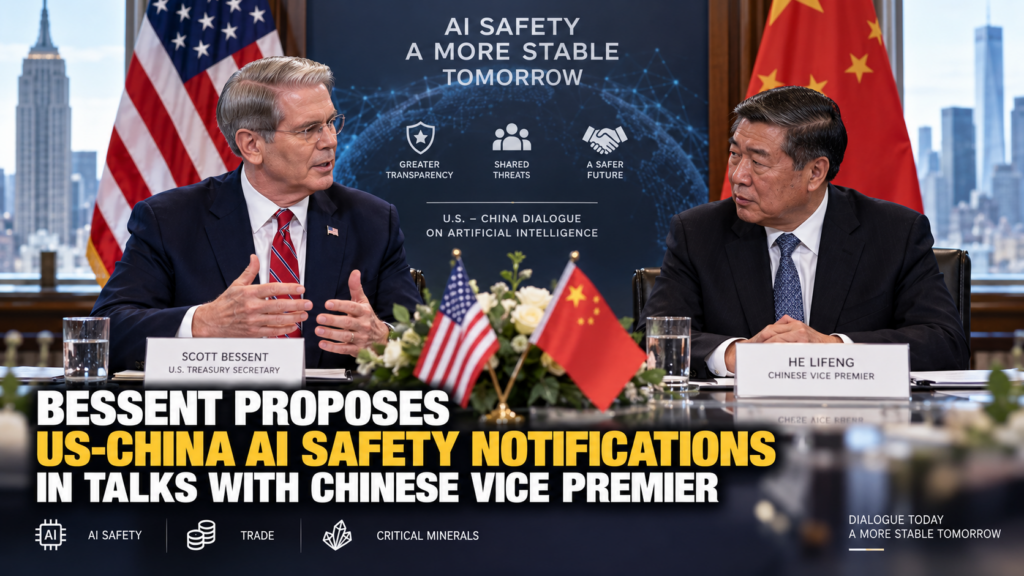
U.S. Treasury Secretary Scott Bessent has proposed a new US-China AI safety notification mechanism during talks with Chinese Vice Premier He Lifeng in New York, seeking greater transparency over artificial intelligence incidents that could pose national security risks. The proposal comes days before President Donald Trump is scheduled to meet Chinese President Xi Jinping in Washington.
According to a report by Reuters, the two sides discussed establishing a formal AI dialogue focused on shared threats and national security incidents. The talks also covered tariffs, critical minerals and preparations for the upcoming Trump-Xi summit.
What Happened
Bessent and He concluded talks in New York on September 20 after discussions that covered artificial intelligence, trade and critical minerals.
The U.S. proposed an AI safety notification system that would allow Washington and Beijing to communicate about significant AI-related incidents that reach a national security threshold. Bessent said the proposed dialogue would focus on common goals and common threats.
The proposal builds on discussions between Trump and Xi in May about potential consultations on AI development. Reuters reported that the earlier idea had not been formally established before the latest talks.
Key Details of the US-China AI Safety Proposal
National Security Incidents
The proposed mechanism would focus on AI incidents considered serious enough to create national security concerns.
The aim is to improve communication between the United States and China, the world’s two leading AI powers, particularly as advanced AI systems become more capable and their potential risks become more consequential.
Bessent said greater transparency could help prevent the two countries from operating without information about potentially significant AI-related developments.
A New Bilateral AI Dialogue
The proposed notification mechanism would form part of a broader U.S.-China AI dialogue.
The discussions could eventually cover issues such as AI weaponization, cybersecurity and threats to critical infrastructure. AP reported that both countries have expressed concerns about risks including cyberattacks, biological misuse and potential loss of control over advanced AI systems.
However, the latest proposal does not establish a comprehensive bilateral AI safety agreement. It remains an initiative for consideration by Trump and Xi at their upcoming summit.
Trade and Critical Minerals Also on the Agenda
AI was only one part of the New York discussions.
Bessent and He also discussed the broader U.S.-China trade relationship, including the trade truce scheduled to expire on November 10 and the flow of Chinese rare-earth magnets and other critical minerals.
U.S. Trade Representative Jamieson Greer participated in the talks and said the two sides were working toward a framework for a new “Board of Trade.” The proposed body would help identify non-sensitive goods that could potentially receive lower tariffs.
The discussions included consumer products, agricultural goods, energy and medical devices. Reuters reported that there was no progress on some larger outstanding issues, including increased Chinese purchases of U.S. agricultural products and aircraft.
AI Competition Between the US and China
The US-China AI safety discussions are taking place alongside intense technological competition between Washington and Beijing.
The United States has imposed restrictions on the export of some advanced technologies to China, while Chinese AI companies continue developing increasingly capable systems. Both governments have also raised concerns about the national security implications of advanced AI.
The proposed notification system represents a narrower area where the two countries could communicate despite their broader strategic disagreements.
The scope of any eventual cooperation remains uncertain, particularly because AI technology is closely linked to economic competitiveness, cybersecurity and military capabilities.
Reactions and Concerns
The proposal has received attention from U.S. lawmakers and technology policy observers who have called for stronger safeguards around advanced AI.
Representative Ro Khanna has argued for international measures addressing the risks posed by self-improving AI and potential misuse involving biological and nuclear weapons.
At the same time, the two governments continue to disagree over technology policy. U.S. officials have raised concerns about Chinese use of American AI capabilities, while Chinese officials have rejected some U.S. accusations and have raised their own concerns about American AI systems.
The result is a proposed AI dialogue taking place within a much broader relationship characterized by both cooperation and strategic competition.
What Happens Next
Trump and Xi are expected to consider the proposed AI safety notification mechanism when they meet in Washington later this week. Reuters reported that U.S. and Chinese officials are also expected to continue discussions in the coming months, with another AI safety meeting planned in approximately two months in Shenzhen.
The next stage will determine whether the proposed mechanism develops into a formal channel for reporting major AI incidents or remains a diplomatic proposal.
The US-China AI safety talks also demonstrate how artificial intelligence is becoming part of the wider U.S.-China economic and national security relationship. Any formal communication channel could provide a mechanism for managing specific AI risks, while the broader relationship continues to involve disputes over trade, technology and critical minerals.
Related Reading
Trump’s GOP Convention Plans Draw Attention Amid NFL Ratings Battle
Appeals Court Reviews DOJ Bid to Revive Comey, James Cases
FAQs
Bessent proposed a notification mechanism for major AI-related incidents that could pose national security risks, as part of a broader U.S.-China AI dialogue.
The proposal is expected to be considered when President Donald Trump and Chinese President Xi Jinping meet in Washington later this week.