Independent voter priorities vs partisan voter priorities differ less in the issues they name than in how they weigh them: nearly everyone ranks the economy first, but independents tend to judge candidates on results and competence, while partisans filter issues through party loyalty. Independents are also a large share of the electorate, which makes understanding what they want a practical necessity for anyone following the presidency, Congress and federal policy.
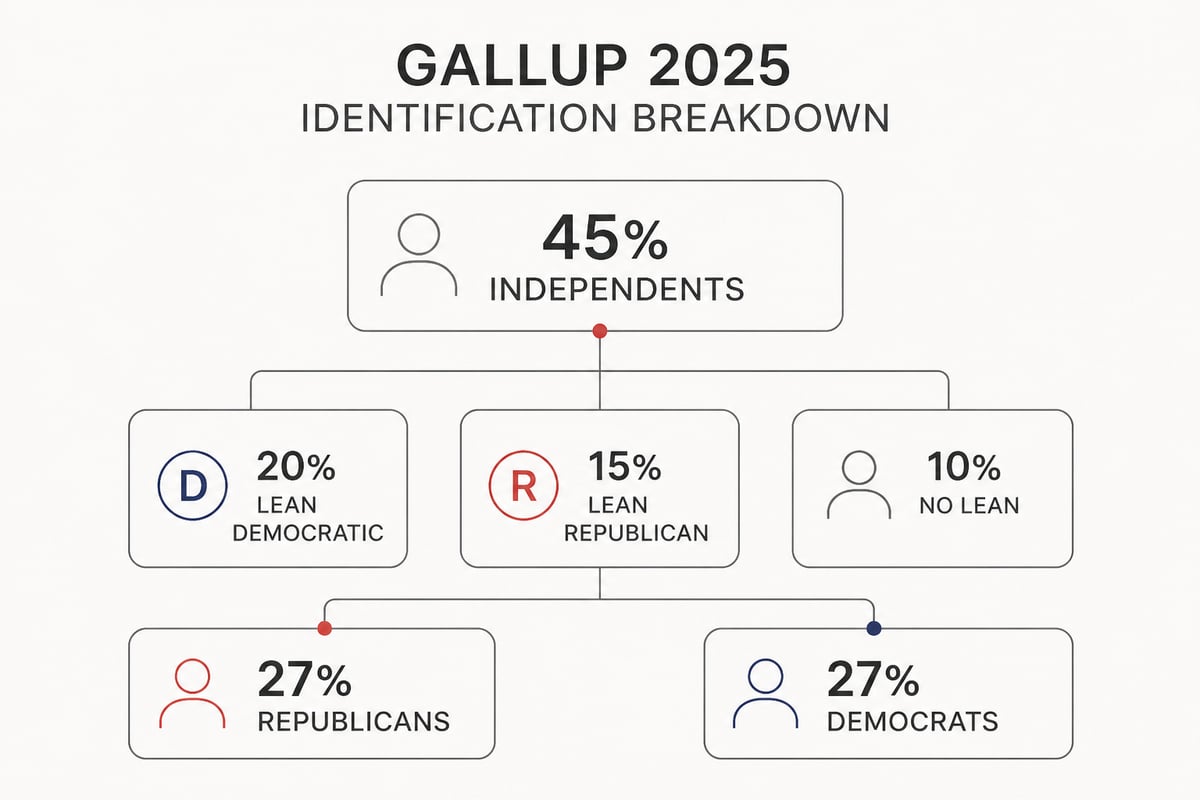
A Gallup survey conducted throughout 2025 found that 45% of U.S. adults identified as political independents, compared with 27% who identified as Republicans and 27% as Democrats. This article breaks down who independents are, where their priorities overlap with partisans, where they diverge, and why the gap matters for presidential politics.
Who Counts as an Independent Voter?
An independent voter is someone who does not identify with either major party, though most independents still lean toward one side in practice. Gallup's 2025 data shows the split clearly: of the 45% who call themselves independents, 20% lean Democratic, 15% lean Republican, and 10% do not lean either way.
That breakdown explains a common source of confusion. "Independent" describes an identity, not a single ideology. A leaning independent may vote for one party in nearly every election while refusing the label, whereas a true independent may split tickets or skip races altogether.
Three groups are worth separating when reading any poll:
- Partisans: Voters who identify with a party and vote for it consistently.
- Leaners: Independents who say they lean toward a party and usually behave like soft partisans.
- Pure independents: Voters with no lean, who are the hardest to predict and often the least engaged.
Registration rules add another layer. Some states register voters by party and others do not, so a voter's registration status and self-description can differ. For a closer look at how these blocs have moved, see our analysis of independent voter shift trends in 2026.
Where Independent and Partisan Priorities Overlap
Independents and partisans agree most on the economy, which tops every group's list of concerns. In a September 2024 AP-NORC survey, about 8 in 10 registered voters said the economy was one of their top issues, more than half named health care, and about half named crime, immigration, abortion policy or gun policy.
The poll interviewed 2,028 adults, including 1,771 registered voters, with a margin of sampling error of ±3.5 percentage points for registered voters. Those numbers are a snapshot from the 2024 campaign, and pocketbook concerns dominated that survey.
Shared concerns tend to cluster in a few areas:
- Cost of living. Grocery prices, housing and everyday expenses cut across party lines. Our coverage of why voters care about grocery prices shows how a single household cost can shape views of the White House.
- Health care costs. Premiums, prescription prices and coverage worry voters of every affiliation.
- Government competence. Voters in all groups want policies that work, not just policies that sound good.
The overlap is real, but it is also where the comparison gets interesting. When two voters both say "the economy," they may mean different things: one thinks of inflation, another of job security, a third of taxes.
Independent Voter Priorities vs Partisan Voter Priorities on Key Issues
The sharpest differences show up on issues that carry strong party identity. The same AP-NORC survey found that Democrats were more likely than Republicans to name gun policy, climate change, crime, abortion policy and health care as top issues, while Republicans were more likely to name the economy and immigration.
Independents generally land between those poles, and their exact position depends on which way they lean. The table below summarizes the general pattern.
| Issue | Democratic partisans | Republican partisans | Independents |
|---|---|---|---|
| Economy | High priority | Very high priority | Top priority, framed around cost of living |
| Immigration | Moderate priority | Very high priority | Mixed, often focused on border management and orderly process |
| Health care | High priority | Moderate priority | High priority, centered on costs |
| Abortion policy | High priority | Moderate priority | Varies widely by lean |
| Climate change | High priority | Low priority | Moderate, often tied to energy costs |
| Gun policy | High priority | Lower priority | Mixed |
| Crime | High priority | High priority | Moderate to high |
This table reflects general tendencies from the AP-NORC findings, not exact figures for independents, who were not separately broken out in the data cited here. The takeaway is that independents often differ from either party's base in their issue priorities.
Foreign policy and federal spending offer further contrasts. Our reporting on foreign aid policies vs domestic spending priorities and climate regulation vs energy independence priorities shows how these debates split partisans cleanly while leaving independents divided.
How Independents Decide: Results Over Loyalty
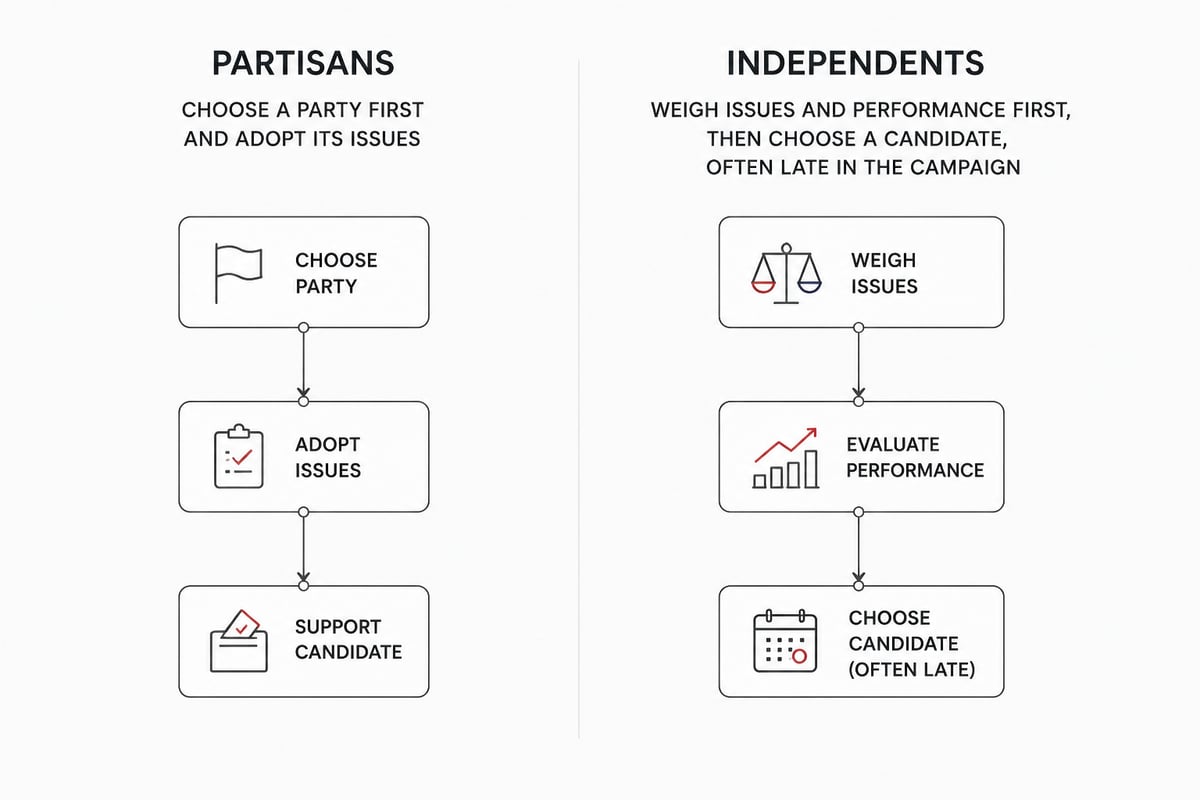
Independents differ from partisans less in what they care about than in how they choose. A partisan voter usually picks the party first and adopts the party's issue positions second. An independent voter often works in the opposite order: issues and performance first, candidate second.
That has several practical effects:
- Weaker party attachment. Independents are more willing to vote across party lines from one election to the next.
- Performance-based judgments. An incumbent's handling of prices, security or crises weighs heavily, which is why a president's approval among independents often moves faster than among partisans.
- Later decisions. Many independents settle on a candidate late in a campaign, after debates and closing messages.
- Lower turnout. Pure independents tend to participate less, so their influence depends on whether campaigns can motivate them to vote.
Gallup’s analysis of party favorability and trust is a useful companion on this point, since it examines what independents say appeals to them about each party. The finding that neither party dominates trust helps explain why independents stay unattached.
Our piece on why independent voters decide elections explains the arithmetic: in close states, a modest swing among independents can outweigh the entire effect of base turnout.
Why Partisan Voters Prioritize Differently
Partisan priorities are shaped by party messaging, media habits and group identity as much as by personal circumstances. When party leaders elevate an issue, partisans tend to follow, which is why issue rankings can shift quickly after a high-profile event or a change in who holds the White House. The AP-NORC pattern shows the result: Democrats were more likely to name gun policy, climate change, crime, abortion policy and health care as top issues, while Republicans were more likely to name the economy and immigration. Those gaps track the themes each party's leaders and allied media stress most often.
Several forces drive this:
- Cue-taking. Voters adopt the issue emphasis of leaders they trust, so immigration rises on the Republican list when party leaders spotlight it, and abortion or climate rise on the Democratic list for the same reason. A voter who has never studied a policy in detail can still rank it highly because trusted figures keep raising it.
- Coalition needs. Each party courts specific groups. Our analysis of why Democrats are losing working-class voters and why Republicans are winning Hispanic voters shows how shifting coalitions change a party's priorities.
- Intra-party divides. Partisans are not uniform. The split between populist and traditional wings is covered in our look at MAGA policy priorities vs mainstream GOP priorities.
The consequence is that partisan priorities are sticky but not fixed. They respond to leadership and events, while independents respond more to conditions on the ground.
Age, Income and Region Shape the Gap
Independent voter priorities vs partisan voter priorities also vary by demographic group, and the independent bloc is not evenly distributed. Younger voters are more likely to reject party labels, and their issue ranking differs from older voters.
Tufts CIRCLE’s analysis of young voters in 2024 examined young voters' candidate support in 2024. The results show that even within one age group, support varied across voters. Our own reporting on why young voters are leaving Democrats adds context on the economic frustrations behind that shift.
Other demographic patterns worth tracking:
- Working-class and non-college voters put cost of living and job security ahead of social issues.
- Suburban independents often weigh education, public safety and taxes heavily.
- Black and Hispanic voters show growing diversity of views, which our coverage of Black voter trends in 2026 explores.
Geography matters too. A voter's state shapes which issues feel urgent, from border communities to energy-producing regions to high-cost coastal metros.
What This Means for Presidential Politics
Understanding independent voter priorities vs partisan voter priorities helps explain why presidents and candidates talk the way they do. Campaigns that need to motivate their base emphasize identity-driven issues, while campaigns that need to win a general election pivot toward cost of living, competence and security.
The same logic applies to governing. A president whose approval depends on independents has an incentive to show results on prices and services, since those are the issues independents judge most directly. A three-year low in inflation is exactly the kind of data point that can move a performance-minded voter.
A few signals are worth watching as 2026 unfolds:
- Approval among independents, which often leads changes in overall approval.
- Turnout gaps between parties, tracked in our report on Democrats vs Republicans voter turnout trends in 2026.
- Cost-of-living data, since affordability concerns and inflation concerns are not identical in voters' minds.
- Candidate strategy, especially how campaigns balance base mobilization against persuasion.
Independents also face structural hurdles when they try to run for office themselves, a subject we cover in why independent candidates struggle.

How to Read Polls About Independents Carefully
Polling on independents requires attention to definitions, because the label covers very different people. A poll that groups leaners with pure independents will show a very different picture from one that separates them. Gallup's 2025 figures illustrate the stakes: 10% of adults are independents with no lean, while 35% are independents who lean toward a party (20% Democratic, 15% Republican). A headline about "independents" could describe either population, and the two behave differently at the ballot box.
Keep these checks in mind:
- Check how independents are defined. Self-identified independents, registered independents and leaners are not the same group. If a poll does not say which one it surveyed, treat its conclusions about independents with caution.
- Look at sample size and margin of error. Subgroups carry larger margins than the full sample. The AP-NORC survey above reported ±3.5 points for registered voters overall, based on 1,771 registered voters, and any slice of that sample, such as independents alone, rests on far fewer interviews and would be wider.
- Note the date. Priorities shift with events, so a 2024 snapshot should not be treated as a 2026 reading.
- Compare question wording. "Top issue" and "most important issue" can yield different rankings. A question that lets respondents name several issues, as the AP-NORC survey did, will show the economy near 8 in 10, while a single-choice question will spread answers more thinly.
For additional context on how voters weigh policy against personality, our coverage of voters demanding policy over drama illustrates how debate-season preferences surface in polling.
Start by tracking one independent-voter indicator, such as presidential approval among independents, for the next few weeks so you can see how it moves against partisan numbers. U.S. Presidential Report publishes daily, non-partisan coverage of presidential elections, federal policy and the voter blocs that shape them, which makes it a practical place to follow those shifts as they happen. If you want to bring that conversation to your own community, U.S. Presidential Report can help you Start Your Own Political Club and discuss these issues with neighbors who share your interest.