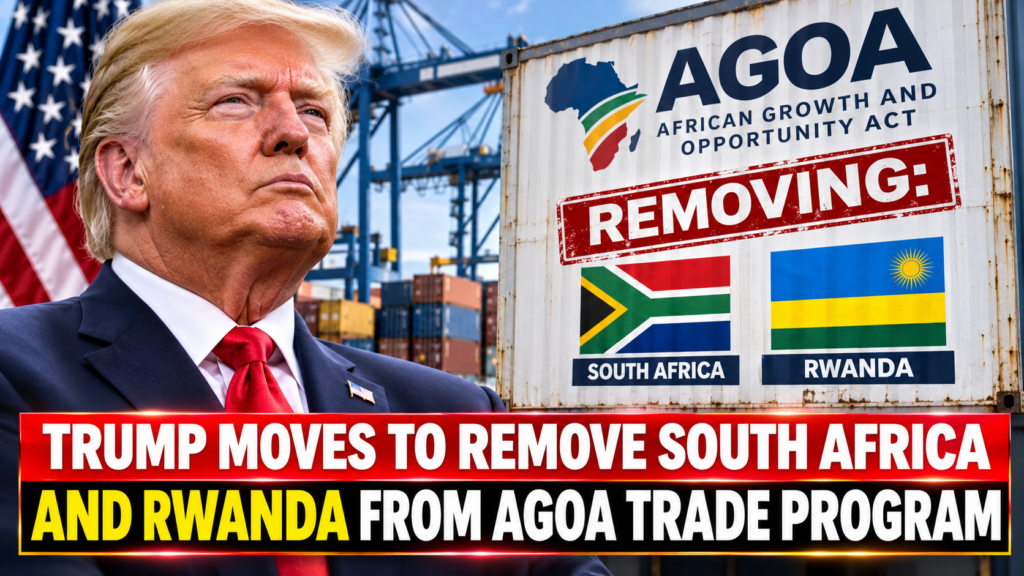
President Donald Trump has notified Congress of plans to remove South Africa and Rwanda from the African Growth and Opportunity Act (AGOA), a preferential trade program that allows eligible African countries to export thousands of products to the United States duty-free. The proposed removals are scheduled to take effect on January 1, 2027, potentially affecting trade relations and export opportunities for both countries.
The Trump administration says the two countries have failed to meet AGOA’s eligibility requirements, citing concerns involving trade barriers, national security, foreign policy and governance.
According to a report by BBC News, US Trade Representative Jamieson Greer said an annual review found that South Africa and Rwanda were engaging in practices inconsistent with the program’s requirements. Washington has also formally notified both governments of its decision.
Why Trump Is Removing South Africa and Rwanda From AGOA
The African Growth and Opportunity Act provides eligible African countries with preferential access to the American market. Its benefits allow qualifying exports to enter the United States without certain import tariffs.
However, eligibility depends on meeting requirements related to economic policy, governance, workers’ rights and US national security interests.
The Trump administration has identified different concerns involving South Africa and Rwanda.
US Concerns About South Africa
For South Africa, Washington has raised concerns about corruption, trade restrictions and the country’s international relationships.
In a letter to South African President Cyril Ramaphosa, Trump argued that Pretoria’s actions on international security and its cooperation with governments considered concerning by Washington could undermine American national security and foreign policy interests.
The administration also cited barriers affecting US businesses, including:
- Restrictions on agricultural market access.
- Regulatory requirements affecting American companies.
- Concerns about investment protections.
- Intellectual property restrictions.
US Trade Representative Jamieson Greer said the administration expects African partners to take the necessary steps to satisfy AGOA’s eligibility requirements.
US Concerns About Rwanda
The administration has also raised concerns about human rights, political pluralism, the rule of law and workers’ rights in Rwanda.
The announcement follows US sanctions against Rwanda’s defense ministry, imposed barely a week earlier.
According to the US Treasury Department, Rwanda’s defense ministry directed thousands of troops to fight alongside M23 rebels in eastern Democratic Republic of Congo. Washington accused the ministry of providing weapons, equipment, logistics and training.
Rwanda has denied supporting the M23 movement.
The trade decision therefore comes amid broader tensions between Washington and Kigali over the conflict in eastern Congo and Rwanda’s regional role.
South Africa Warns of Economic and Employment Consequences
South Africa’s Trade Minister Parks Tau described the decision as unfortunate, arguing that Washington was introducing new concerns that had not featured in trade negotiations between the two countries, which began in 2025.
Tau said the government would continue diversifying South Africa’s export markets to protect employment.
However, the potential economic impact may be limited by the country’s existing trade structure.
Government figures show that approximately 89% of South African exports to the United States entered under ordinary World Trade Organization most-favoured-nation terms in 2025. Around 10% benefited from AGOA preferences, down from 28% in 2024.
Tau said the value of South African exports under AGOA fell to approximately $1.7 billion in 2025, compared with $4 billion in 2024.
Despite the decline, the broader economic relationship remains substantial.
Bilateral trade between the United States and South Africa reached $28.8 billion in 2025. More than 600 American companies operate in South Africa, supporting approximately 134,600 jobs.
Critical Minerals and American Business Interests at Stake
South Africa’s economic importance to the United States extends beyond preferential trade arrangements.
Pretoria says the two economies have complementary trade interests. South Africa supplies 12 of the 50 minerals classified as critical by the United States, as well as approximately 70% of the American isotopes used for purposes including cancer treatment.
South African manufacturers also rely on American inputs to produce goods exported back to the United States under AGOA, including vehicles and boats.
This interconnected supply chain means changes to trade preferences could affect businesses in both countries.
Jee-A van der Linde, a senior economist at Oxford Economics, warned that the decision would put additional pressure on South Africa’s manufacturing sector. He said affected exports could be difficult to redirect to alternative markets.
The challenge comes as global trade flows remain disrupted and South African manufacturers face growing competition from lower-cost Chinese imports, particularly in the automotive industry.
However, South Africa has previously redirected some exports affected by tariffs toward markets such as Europe and China.
Rwanda’s Exposure to the US Trade Decision
Rwanda’s direct exposure to the loss of AGOA benefits appears smaller than South Africa’s.
US import data show that Rwanda’s exports to the American market increased to $43.3 million in 2025, up from $13.1 million in 2024.
However, Alexander Venter, an economist at Oxford Economics, said the United States accounted for approximately 2% of Rwanda’s merchandise exports in 2025. Only around 4% of Rwanda’s exports to the US benefited from AGOA preferences.
Neighboring African countries and Asian markets continued to dominate Rwanda’s trade relationships.
This suggests that the direct impact on Rwanda’s overall export economy may be more limited, although the decision adds pressure to its already strained relationship with Washington.
US-South Africa Relations Face Further Strain
The proposed removal comes amid increasingly difficult relations between Washington and Pretoria.
In 2025, Trump accused South Africa of persecuting its white minority and launched a program allowing white Afrikaners to seek asylum in the United States. He also repeated widely discredited claims of a genocide targeting South Africa’s white population.
South African officials have rejected those allegations.
The latest trade decision adds another source of tension to the relationship, particularly because South Africa views AGOA as part of a broader economic partnership with the United States.
US Ambassador to South Africa Leo Brent Bozell III described the country’s removal from the program as a predictable and preventable outcome. He argued that the South African government had rejected concerns raised by Washington.
South Africa’s government, meanwhile, maintains that the decision introduces issues that were not central to previous trade negotiations.
What Happens Next for AGOA Trade Relations?
The proposed removals are scheduled to take effect on January 1, 2027. Until then, the announcement is likely to shape negotiations between the affected governments and Washington.
South Africa has indicated that it will accelerate efforts to diversify its export markets, while Rwanda may seek to strengthen trade relationships with regional and Asian partners.
The decision also raises questions about the future direction of US-Africa economic relations. AGOA has historically been an important instrument for expanding African access to American markets. Using eligibility reviews to address trade, security and foreign policy concerns could make continued access more dependent on diplomatic relationships with Washington.
For businesses operating across the affected markets, the next few months will be important. The final outcome could influence export costs, investment decisions, supply chains and the broader economic relationship between the United States and African countries.
Related Reading
- Trump Administration Releases America First Seafood Strategy
- Trump Removes 50% Tariffs on Some Canadian Goods
The administration cited trade barriers, national security and foreign policy concerns, alongside governance and workers’ rights issues.
The proposed removal is scheduled to take effect on January 1, 2027, following Trump’s notification to Congress.