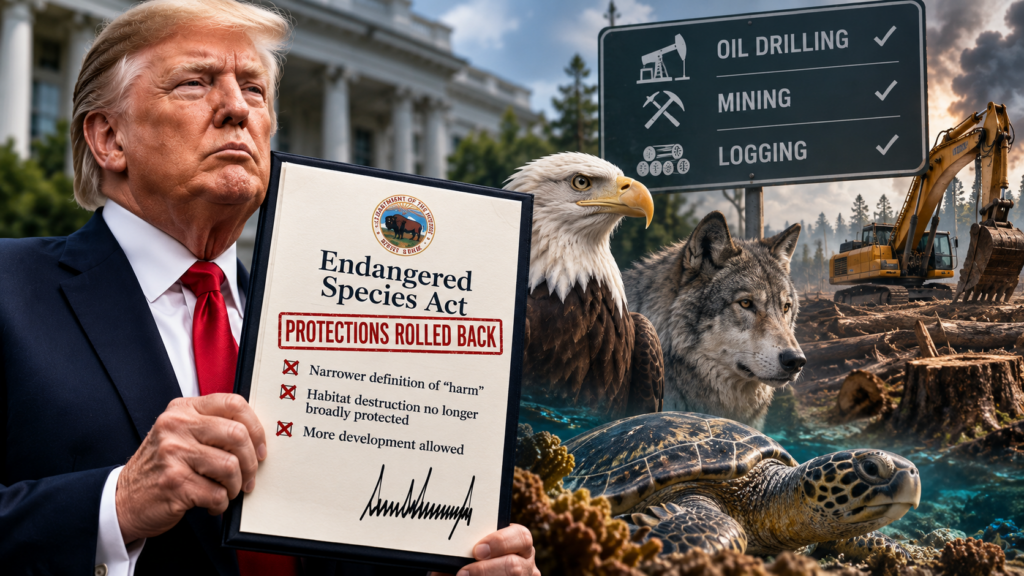
The Trump administration has finalized a major change to the Endangered Species Act (ESA), narrowing a long-standing definition of “harm” that protected threatened and endangered wildlife from habitat destruction. The new rule is expected to expand opportunities for activities such as oil drilling, mining, and logging, while drawing sharp criticism from environmental groups that warn it could accelerate species extinction.
According to a report by NPR, citing reporting from The Associated Press, the administration says the rule restores the original intent of the Endangered Species Act and better protects private property rights. Environmental advocates argue the change removes one of the law’s most effective safeguards for vulnerable wildlife.
What Happened?
The Department of the Interior finalized a rule on July 11 that changes how federal agencies interpret the Endangered Species Act’s prohibition against harming endangered and threatened species.
For decades, federal regulators interpreted “harm” to include significant destruction or degradation of wildlife habitat that could injure protected species indirectly.
Under the new rule, habitat destruction alone generally will not qualify as prohibited harm unless it directly kills or injures protected animals.
The administration argues the revision aligns federal policy with statutory language and recent Supreme Court rulings that limit federal agencies’ authority to broadly interpret congressional statutes.
Key Changes to the Endangered Species Act
Narrower Definition of “Harm”
The most significant change involves redefining what constitutes harm under the ESA.
Previously, activities such as extensive logging, mining, road construction, or oil and gas development could be restricted if they substantially damaged critical habitats supporting endangered species.
Under the revised rule, many development projects may proceed provided they do not directly kill or physically injure protected wildlife.
Administration officials contend the previous interpretation expanded the law beyond what Congress intended when it passed the Endangered Species Act in 1973.
Why the Administration Supports the Rule
Interior Secretary Doug Burgum said the change restores a more balanced interpretation of the law.
According to the administration, federal agencies had increasingly used the ESA to block lawful land use and impose unnecessary burdens on businesses, landowners, and energy producers.
Officials also cited the Supreme Court’s 2024 decision limiting agency discretion in interpreting federal statutes as a legal basis for revising the regulation.
The rule is consistent with other recent administration efforts affecting federal regulatory authority, including changes to energy development policies under the Trump administration.
Environmental Groups Warn of Serious Consequences
Habitat Loss Remains the Biggest Threat
Conservation organizations strongly oppose the new regulation, arguing that habitat destruction is the leading cause of species extinction worldwide.
Environmental advocates say allowing development projects to proceed in critical habitats—even if animals are not immediately harmed—could permanently eliminate breeding, feeding, and migration areas necessary for species survival.
Aaron Weiss, executive director of the Center for Western Priorities, described the rule as one of the most significant reductions in wildlife protections in recent history.
Several environmental organizations unsuccessfully challenged the proposal after it was first introduced in April 2025.
Endangered Species Act Has Protected Iconic Wildlife
Since becoming law in 1973, the Endangered Species Act has played a major role in recovering numerous species once facing extinction.
Among its most widely recognized conservation successes are:
- Bald eagle
- American alligator
- California condor
Supporters of the existing law argue these recoveries demonstrate the importance of protecting both endangered animals and the habitats they depend upon.
Political and Economic Impact
The debate reflects the long-running divide between environmental conservation and economic development.
Business organizations and many Republican lawmakers have argued for years that the ESA has been interpreted too broadly, delaying infrastructure projects, energy production, mining operations, and other land development.
Environmental groups counter that weakening habitat protections may produce long-term ecological and economic costs that outweigh short-term development benefits.
The latest regulatory rollback follows several other domestic policy initiatives pursued by the administration, including broader executive actions affecting federal policy and regulatory oversight.
What Happens Next?
The final rule is expected to face renewed legal challenges from environmental organizations seeking to overturn the regulation in federal court.
Future litigation will likely determine how broadly agencies may interpret the Endangered Species Act under current Supreme Court precedent.
Meanwhile, developers, landowners, conservation groups, and federal agencies will begin operating under the revised definition of “harm,” making this one of the most consequential wildlife policy changes in recent years.
The outcome could shape endangered species conservation and federal environmental regulation for years to come, influencing both habitat protection and economic development across the United States.
The administration narrowed the definition of “harm” under the Endangered Species Act, reducing protections for wildlife habitats while maintaining protections against direct injury or killing of endangered species.
They argue habitat destruction is the leading cause of species extinction and warn the revised rule could allow more development in critical habitats.