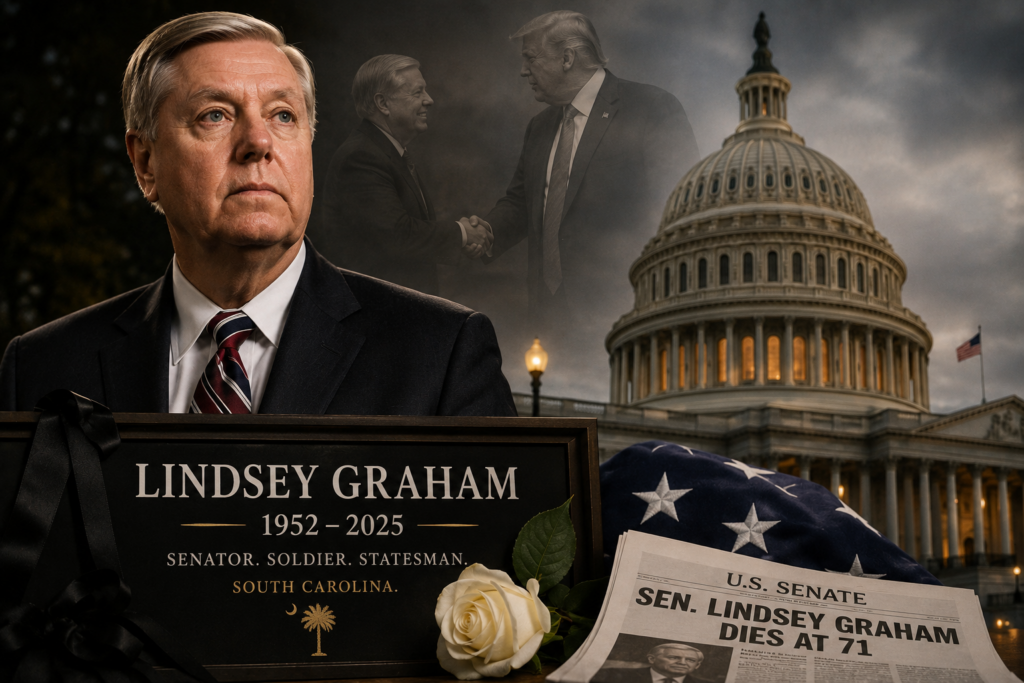
Republican Sen. Lindsey Graham, one of President Donald Trump’s closest allies in Congress and a leading voice on national security and foreign policy, has died at the age of 71 following a brief and sudden illness. Graham’s death marks the end of more than three decades of public service and creates an unexpected vacancy in the U.S. Senate just months before the 2026 midterm elections.
According to a report by CNBC, Graham died on the evening of July 11 after returning from a diplomatic trip to Ukraine. Reuters also confirmed the senator’s death and reported that preliminary findings from the District of Columbia medical examiner identified the cause as an aortic dissection related to arteriosclerotic cardiovascular disease.
What Happened?
Lindsey Graham’s office announced that the South Carolina senator passed away after a “brief and sudden illness.”
A subsequent statement cited preliminary findings from the District of Columbia medical examiner, indicating that Graham died from an aortic dissection caused by arteriosclerotic cardiovascular disease. The final death certificate remains pending additional toxicological and microscopic testing.
Graham had recently returned from Kyiv, where he met with Ukrainian President Volodymyr Zelenskyy and discussed continued U.S. support for Ukraine, sanctions on Russia, and strengthening Ukraine’s air defenses.
Lindsey Graham’s Political Career
More Than Two Decades in the Senate
Graham was first elected to the U.S. Senate in 2002 after serving four terms in the House of Representatives.
Throughout his Senate career, he became one of the Republican Party’s most influential lawmakers, serving on several key committees, including:
- Senate Budget Committee (Chairman)
- Senate Judiciary Committee
- Senate Appropriations Committee
- Senate Environment and Public Works Committee
He was widely recognized for his hawkish foreign policy views and strong advocacy for U.S. military alliances.
Before entering Congress, Graham served more than three decades in the U.S. Air Force and Air Force Reserve as a military lawyer, retiring with the rank of Colonel.
From Trump Critic to Trusted Ally
One of the defining aspects of Graham’s political career was the evolution of his relationship with Donald Trump.
During the 2016 Republican presidential primary, Graham sharply criticized Trump, calling him “unfit for office.”
Following Trump’s election, however, the two developed a close political partnership that endured through both Trump administrations.
Graham became one of Trump’s strongest allies on Capitol Hill, supporting many of the administration’s legislative priorities and judicial nominations.
His close involvement in Republican foreign policy debates often aligned with broader initiatives such as President Trump’s approach to NATO defense spending and allied commitments.
Impact on the Senate
Graham’s death leaves Republicans without one of their most experienced senators at a critical time.
Prior to his death, Republicans held a narrow Senate majority. His absence temporarily reduces the party’s voting strength until South Carolina appoints an interim replacement.
Under South Carolina law:
- Gov. Henry McMaster will appoint a temporary senator to serve the remainder of Graham’s current term.
- A special election process will determine the Republican nominee for the November ballot after Graham had already secured renomination.
Several Republican figures are reportedly considering entering the race for the open Senate seat.
Tributes Pour In
President Donald Trump led tributes to Graham, describing him as “one of the greatest people and Senators I have ever known” and calling him “a true American Patriot.”
Ukrainian President Volodymyr Zelenskyy praised Graham’s longstanding support for Ukraine, noting that the senator had visited the country numerous times during Russia’s full-scale invasion.
Israeli Prime Minister Benjamin Netanyahu also honored Graham’s commitment to the U.S.-Israel alliance.
Senate Majority Leader John Thune, South Carolina Gov. Henry McMaster, and Sen. Tim Scott joined bipartisan leaders in recognizing Graham’s decades of public service and influence on American foreign policy.
Legislative Legacy
Throughout his career, Graham played a central role in shaping U.S. defense, judicial, immigration, and budget policy.
In recent months, he remained actively involved in legislation concerning sanctions on Russia, election security, and national defense.
His final overseas trip to Ukraine underscored his long-standing commitment to American engagement abroad, complementing broader discussions surrounding the Trump administration’s policies toward Russia, Ukraine, and NATO allies.
What Happens Next?
South Carolina officials are expected to begin the process of appointing an interim senator while organizing a special election to fill Graham’s seat permanently.
His passing also reshapes the Senate’s political landscape as Republicans work to advance President Trump’s legislative agenda ahead of the 2026 midterm elections.
Lindsey Graham leaves behind a legacy defined by decades of public service, influential foreign policy leadership, and a political career that evolved from outspoken Trump critic to one of the president’s closest congressional allies. His absence is expected to have lasting consequences for both South Carolina and national politics.
Preliminary findings from the District of Columbia medical examiner state that Graham died from an aortic dissection caused by arteriosclerotic cardiovascular disease.
South Carolina Gov. Henry McMaster is expected to appoint an interim senator until a replacement is chosen through the state’s election process.