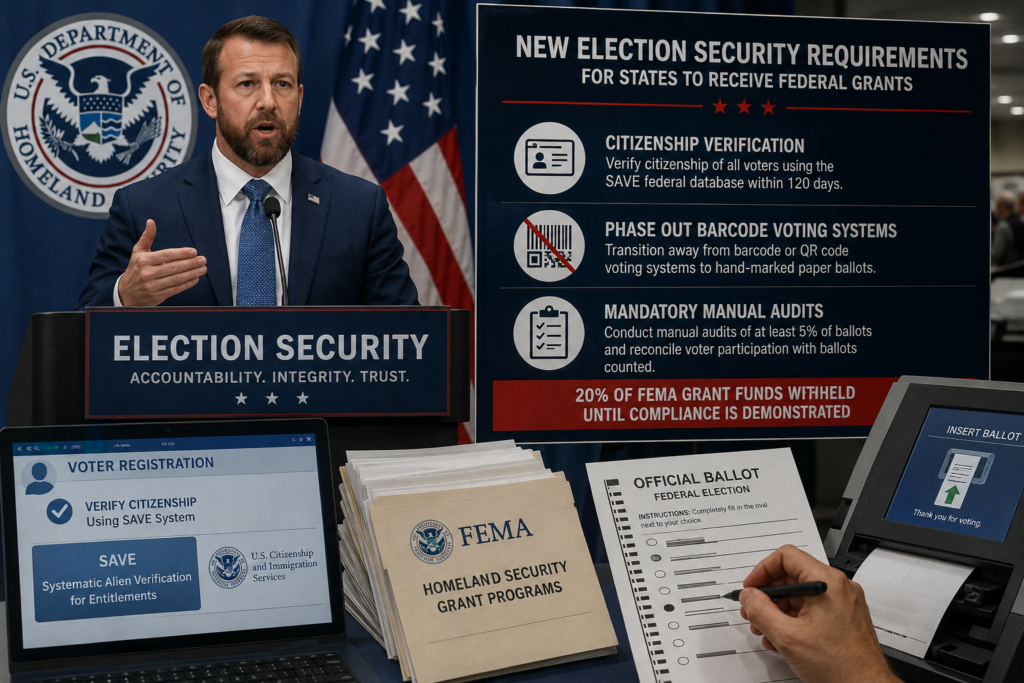
The Trump administration has announced new election security requirements that states must meet to receive certain federal homeland security grants. Under the new policy, states will be required to verify voter citizenship using a federal database, strengthen post-election audits, and begin transitioning away from barcode-based voting systems or risk losing a portion of their federal funding.
According to a report by Reuters, the Department of Homeland Security (DHS) will tie compliance with the new election security standards to approximately $1.1 billion in Federal Emergency Management Agency (FEMA) grant programs.
What Happened?
The Department of Homeland Security announced that states accepting three existing FEMA homeland security grant programs must implement a series of election security measures.
The requirements apply to grants traditionally used to help states prepare for terrorism and other public safety threats.
Under the policy, FEMA will withhold 20% of a state’s grant funding until officials demonstrate compliance with the new election security standards.
Homeland Security Secretary Markwayne Mullin said the changes are intended to strengthen confidence in U.S. elections and improve election integrity.
New Election Security Requirements
Citizenship Verification
States will be required to verify the citizenship status of every individual listed in their voter registration databases.
To accomplish this, election officials must use the U.S. Citizenship and Immigration Services’ Systematic Alien Verification for Entitlements (SAVE) database within 120 days after accepting the federal grant.
The administration says this requirement is intended to prevent noncitizens from remaining on voter rolls.
Transition Away From Barcode Voting Systems
The new policy also directs states to begin moving away from electronic voting systems that rely on barcodes or QR codes to tabulate votes.
Instead, DHS requires states to develop plans to use voting equipment that accepts hand-marked paper ballots.
Administration officials argue that paper ballots improve transparency and allow for more reliable post-election audits.
Mandatory Manual Audits
States must also:
- Conduct manual audits of at least 5% of ballots cast in federal elections.
- Reconcile the total number of participating voters with the total number of ballots counted.
- Demonstrate compliance before receiving the final portion of FEMA grant funding.
Why the Administration Says the Changes Are Needed
The announcement comes less than four months before the 2026 midterm elections.
Secretary Mullin said the measures represent “common-sense election security” designed to improve public confidence in election results.
The administration has consistently argued that stronger voter verification procedures and enhanced auditing standards are necessary safeguards for federal elections.
The policy follows several other administration actions involving election administration, including Department of Justice efforts related to voter eligibility and citizenship verification.
Broader Election Policy Context
President Donald Trump has continued to prioritize election security throughout his second term.
In recent days, the administration:
- Removed the remaining members of the U.S. Election Assistance Commission.
- Directed the Department of Justice to warn states that election officials could face criminal liability if noncitizens remain on voter rolls.
- Expanded federal involvement in state election administration through grant conditions.
Supporters argue the measures will improve election integrity and strengthen public trust.
Critics have questioned whether homeland security grants should be tied to election administration requirements, noting that the grant programs were originally created for emergency preparedness and anti-terrorism efforts.
The latest announcement comes amid broader administration efforts affecting federal policy and other domestic initiatives involving executive authority.
Political and Legal Implications
Election administration has traditionally been handled primarily by individual states.
Legal experts say conditioning federal funding on compliance with election policies could generate constitutional and administrative law challenges if states contest the new requirements.
The policy is also expected to become a significant issue during the 2026 midterm election campaign, particularly in closely contested battleground states.
What Happens Next?
States seeking FEMA homeland security grants will now need to determine whether they can meet the new election security requirements within the required timeline.
Those failing to demonstrate compliance risk losing 20% of their grant awards until the required measures are implemented.
As implementation begins, election officials, state governments, and federal agencies are expected to closely monitor the practical and legal impact of the new policy ahead of November’s elections.
States must verify voter citizenship using the federal SAVE database, conduct manual audits of at least 5% of ballots, reconcile voter participation records, and develop plans to transition away from barcode-based voting systems.
FEMA will withhold 20% of certain homeland security grant funding until states demonstrate compliance with the election security standards.