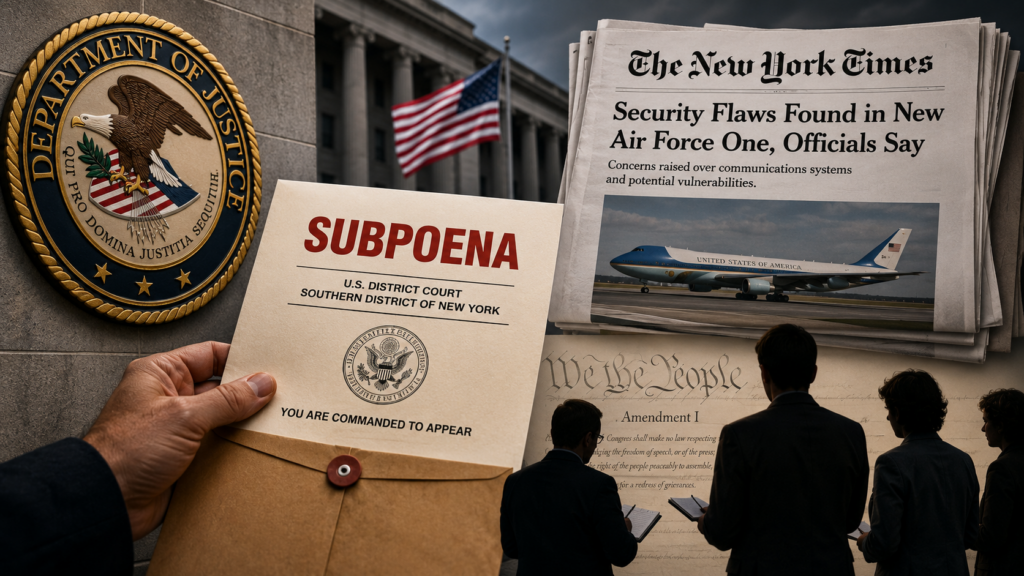
The Trump administration is facing mounting criticism after the U.S. Department of Justice issued subpoenas to several New York Times journalists who reported on security concerns involving President Donald Trump’s new Air Force One. The move has sparked widespread debate over press freedom, government transparency, and the balance between protecting classified information and safeguarding the First Amendment.
According to a report by Politico, journalism organizations and press freedom advocates condemned the subpoenas, calling them an unprecedented escalation against members of the media. Reuters and the Associated Press also confirmed the subpoenas and the Justice Department’s explanation that the investigation targets alleged leaks of classified information rather than journalists themselves.
What Happened?
The Department of Justice issued subpoenas to four New York Times reporters who covered alleged security vulnerabilities involving the new Air Force One aircraft donated by Qatar.
The journalists — Julian E. Barnes, Eric Lipton, Tyler Pager, and Eric Schmitt — were ordered to testify before a federal grand jury in Manhattan. According to reports, federal agents personally delivered some of the subpoenas to the reporters’ homes.
The subpoenas are part of a federal investigation into the possible unauthorized disclosure of classified national security information related to the aircraft.
Why the Report Became Controversial
Air Force One Security Questions
The reporting focused on security concerns surrounding the newly retrofitted Air Force One aircraft, which entered service after being donated by Qatar.
The New York Times reported that certain security capabilities typically found on presidential aircraft were either incomplete or raised concerns among officials familiar with the project.
Following publication, the Justice Department began investigating how the information became public.
Administration officials stated that the investigation is aimed at identifying government officials responsible for leaking classified information, not prosecuting journalists.
Press Freedom Groups Condemn the Move
Several journalism organizations sharply criticized the subpoenas.
The National Press Club, the Reporters Committee for Freedom of the Press, and legal representatives for The New York Times argued that compelling reporters to testify before a grand jury could discourage confidential sources from speaking with journalists in future investigations.
David McCraw, the newspaper’s lead newsroom attorney, described the delivery of subpoenas to journalists’ homes as a serious challenge to constitutional protections for a free press.
Critics argue that requiring reporters to reveal information gathered during newsgathering could undermine investigative journalism involving national security and government accountability.
Justice Department Defends the Investigation
Justice Department officials did not confirm the specific subpoenas but emphasized that the investigation concerns the unlawful disclosure of classified information.
A DOJ spokesperson said the department is focused on individuals responsible for leaking sensitive national security material and is not treating journalists as the targets of the criminal investigation.
The White House referred questions about the matter to the Justice Department.
Political and Legal Implications
The dispute comes as the Trump administration continues to expand executive authority across several policy areas.
Recent actions involving federal personnel, national security, and executive power have generated renewed legal scrutiny, including changes to federal employee discipline and executive workforce policies and broader debates surrounding President Trump’s national security agenda during recent NATO discussions.
Legal experts say the subpoena dispute could become another significant test of the relationship between national security investigations and constitutional protections for a free press.
What Happens Next?
The subpoenaed journalists are expected to appear before a federal grand jury unless legal challenges delay or block the proceedings.
Media organizations have indicated they intend to contest the subpoenas, arguing that compelling reporters to testify threatens longstanding protections for confidential sources and investigative journalism.
The outcome may influence future Justice Department policies on leak investigations and could shape how courts balance national security concerns with First Amendment protections.
As litigation unfolds, the controversy is expected to remain a closely watched issue for journalists, government officials, and constitutional scholars, with implications extending well beyond this single investigation.
The DOJ is investigating alleged leaks of classified information related to reporting on security concerns involving the new Air Force One aircraft.
According to the Justice Department, the investigation targets the source of the alleged leak rather than the reporters themselves.