Independent candidates have long promised voters an alternative to traditional party politics, yet their electoral success remains remarkably rare in American democracy. Despite growing voter dissatisfaction with major parties and an increasing number of Americans identifying as independents, these candidates face formidable obstacles that make meaningful electoral victories exceptionally difficult. Understanding why independent candidates struggle requires examining the interconnected structural, financial, and political barriers embedded within the U.S. electoral system.
Structural Barriers Within the Electoral System
The American electoral framework creates inherent disadvantages for candidates running outside the two-party structure. The Electoral College system, designed in the 18th century, fundamentally favors candidates with broad party infrastructure across multiple states. Winner-take-all allocation in most states means independent candidates must achieve outright majorities or pluralities in individual states rather than accumulating support nationally.
Beyond the Electoral College, ballot access requirements present significant hurdles that major party candidates automatically bypass. Independent candidates must navigate a complex patchwork of state-specific regulations, each with unique signature requirements, filing deadlines, and procedural technicalities.
State-by-State Ballot Access Challenges
The decentralized nature of American elections means independent candidates face 50 different sets of rules to achieve nationwide ballot access. This fragmentation consumes enormous resources that major party candidates can instead allocate to campaigning and voter outreach.
Consider these typical requirements across various states:
- Petition signatures ranging from 5,000 to over 100,000 voters
- Strict notarization and witness requirements for signature gathering
- Filing fees reaching tens of thousands of dollars
- Early submission deadlines occurring months before general elections
- Prohibitions against signing petitions for multiple candidates
Texas, for example, requires independent presidential candidates to gather signatures equal to one percent of the total votes cast in the previous presidential election, typically exceeding 80,000 signatures. These signatures must be collected within a narrow 75-day window, creating logistical challenges that demand significant organizational capacity.

| State Category | Signature Requirement | Timeline | Additional Obstacles |
|---|---|---|---|
| High Barrier States | 50,000+ signatures | 60-90 days | Notarization required |
| Moderate Barrier States | 10,000-50,000 signatures | 90-120 days | Filing fees $5,000-$15,000 |
| Lower Barrier States | Under 10,000 signatures | 120+ days | Minimal additional requirements |
Financial Disadvantages and Campaign Funding
Campaign finance realities represent another critical explanation for why independent candidates struggle in modern elections. The dominance of major parties within campaign finance structures creates insurmountable funding gaps that limit independent candidate viability.
Major party candidates benefit from established fundraising networks built over decades. National party committees, state party organizations, and affiliated political action committees provide coordinated financial support that independent candidates cannot replicate. The Democratic and Republican parties collectively raise billions of dollars each election cycle through institutional donors, small-dollar online contributions, and corporate-affiliated PACs.
Public Financing Exclusion
Federal election law theoretically provides public financing for presidential candidates, yet the criteria effectively exclude independent challengers. To qualify for primary matching funds, candidates must raise $5,000 in individual contributions of $250 or less in at least 20 states. For general election grants, candidates must have received at least five percent of the popular vote in the previous presidential election.
This five percent threshold creates a catch-22 situation. Independent candidates need significant resources to reach five percent, yet cannot access public funds without having previously achieved that threshold. Ross Perot in 1992 represents one of the few exceptions, but his personal wealth enabled a self-funded campaign that few independent candidates can emulate.
The practical impact of these funding disparities affects every aspect of campaign operations:
- Limited television advertising in key media markets
- Reduced field operations for voter contact and mobilization
- Smaller professional campaign staff with less expertise
- Inadequate opposition research and message development
- Minimal digital marketing presence across social platforms
Independent candidates typically spend 60-70 percent of available resources simply achieving ballot access, leaving minimal funds for persuasion and mobilization. Major party candidates, by contrast, allocate nearly all resources toward voter contact and advertising.
Media Coverage and Visibility Challenges
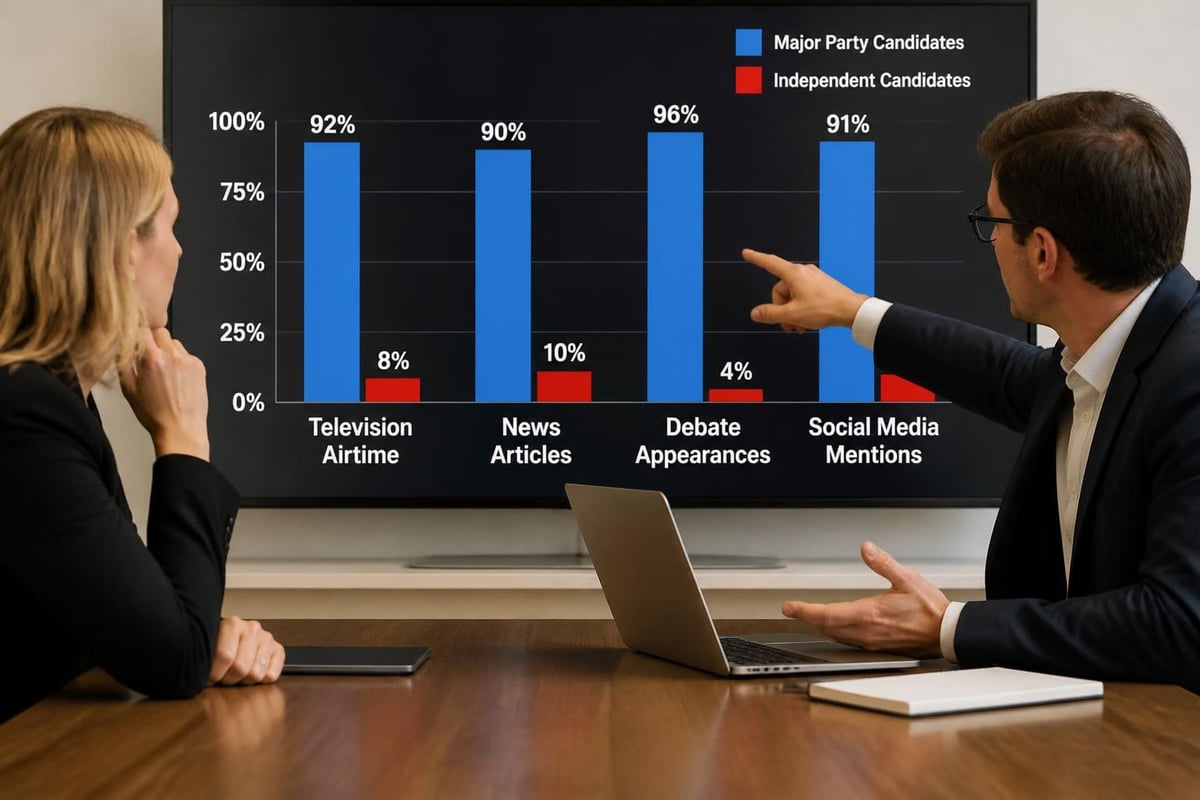
The American media landscape compounds the structural obstacles that explain why independent candidates struggle to build competitive campaigns. News organizations structure political coverage around the two-party framework, treating independent candidates as novelties rather than serious contenders.
Horse race journalism focuses on polling averages that often exclude independent candidates from early surveys. This creates a self-fulfilling prophecy where media outlets justify limited coverage by citing low poll numbers, while those poll numbers remain low partly due to inadequate media exposure.
Presidential Debate Exclusion
Perhaps no barrier illustrates media-driven challenges more clearly than presidential debate access controlled by the Commission on Presidential Debates. The Commission, formed jointly by Democratic and Republican parties in 1987, establishes polling thresholds that independent candidates rarely achieve.
Current rules require candidates to poll at 15 percent in five national polls conducted near debate dates. This standard appears neutral but systematically disadvantages independent candidates who lack the name recognition, media coverage, and campaign infrastructure to reach 15 percent before debates occur.
Debate exclusion creates cascading disadvantages. Voters making decisions during the fall campaign season never see independent candidates alongside major party nominees in the year's most-watched political events. This reinforces perceptions that independent candidates represent wasted votes rather than viable alternatives.
The Spoiler Effect and Strategic Voting
Voter psychology and strategic considerations provide additional context for why independent candidates struggle even when they overcome structural barriers. The "spoiler effect" describes situations where independent candidates allegedly draw votes from major party candidates with similar ideological positions, potentially causing the voter's least-preferred candidate to win.
This dynamic creates strategic voting pressure where supporters of independent candidates feel compelled to vote for major party alternatives. A voter might prefer an independent candidate's positions but vote for a major party candidate to prevent an undesirable outcome. This reasoning becomes particularly acute in closely contested swing states where every vote carries amplified importance.
Historical Examples and Electoral Mathematics
The 2000 presidential election illustrates these dynamics. Ralph Nader received 97,488 votes in Florida while George W. Bush defeated Al Gore by just 537 votes statewide. Post-election analysis suggested many Nader voters would have chosen Gore as their second preference, leading to accusations that Nader "spoiled" the election.
Whether or not such analysis proves causation, the perception shapes future voter behavior. Potential independent voters in subsequent elections remembered 2000 and felt pressure to vote strategically rather than support preferred independent candidates.
This strategic voting pressure explains why independent candidates often poll stronger in early surveys than they ultimately perform on Election Day. As elections approach and stakes become clearer, voters abandon independent candidates to support major party alternatives.
Party Infrastructure and Organizational Capacity
The organizational advantages major parties possess explain much about why independent candidates struggle to translate initial enthusiasm into sustained campaigns. Political parties represent permanent institutions with professional staff, established vendor relationships, and refined operational procedures developed over decades.
Voter data represents one crucial infrastructure advantage. The Democratic and Republican parties maintain sophisticated voter files tracking millions of Americans' voting history, consumer behavior, and demographic characteristics. These databases enable targeted advertising, efficient volunteer deployment, and strategic resource allocation.
Independent candidates must build similar capabilities from scratch, often purchasing inferior data from commercial vendors. This information gap affects crucial tactical decisions about where to campaign, which voters to contact, and how to allocate limited advertising budgets.
Ground Game and Volunteer Networks
Party infrastructure extends beyond data to include physical organizing capacity. Major parties operate permanent offices in key states staffed by experienced political operatives. These offices maintain relationships with local activists, recruit and train volunteers, and coordinate with affiliated organizations.
Independent candidates cannot replicate this infrastructure within a single election cycle. Building trusted relationships with local leaders, recruiting committed volunteers, and establishing operational procedures requires time that campaign calendars do not allow.
The volunteer advantage particularly matters for crucial campaign activities:
- Door-to-door canvassing in targeted neighborhoods
- Phone banking to identified persuadable voters
- Poll monitoring and legal compliance on Election Day
- Absentee ballot collection and processing assistance
- Rapid response to opponent attacks or breaking news
Legal and Regulatory Frameworks
American election law evolved within a two-party context, creating regulatory frameworks that reinforce major party advantages while complicating independent campaigns. Federal Election Commission regulations, state election codes, and judicial precedents collectively favor established party structures.
Complex regulatory requirements including FEC reporting rules, state filing deadlines, contribution limits, and disclosure obligations that create additional compliance burdens for independent campaigns
Campaign finance disclosure requirements exemplify these regulatory challenges. While transparency serves legitimate public interests, compliance demands sophisticated legal and accounting expertise. Major parties maintain permanent compliance staff, while independent candidates must hire consultants at significant expense.
Consider the reporting burden for a competitive independent presidential campaign:
| Report Type | Filing Frequency | Required Detail | Penalties for Errors |
|---|---|---|---|
| FEC Form 3P | Monthly/Quarterly | Itemized contributions over $200 | Fines up to $25,000 |
| State Financial Reports | Varies by state | State-specific formats | Ballot removal possible |
| Independent Expenditure Reports | 24-48 hour windows | Real-time transaction reporting | Criminal prosecution possible |
Missing a single filing deadline or making reporting errors can result in fines, negative media coverage, and legal complications that derail campaigns. Major party candidates benefit from institutional knowledge preventing such mistakes.
Voter Perceptions and Psychological Barriers
Beyond structural obstacles, psychological factors contribute to why independent candidates struggle to convert dissatisfaction with major parties into electoral success. Decades of two-party dominance have conditioned voters to view politics through partisan lenses, making independent candidates seem unfamiliar or risky.
Name recognition poses an immediate challenge. Major party nominees typically enter general elections with near-universal voter awareness built through primary campaigns. Independent candidates often remain unknown to large voter segments even after achieving ballot access.
This recognition gap affects voter decision-making in crucial ways. Political science research demonstrates that voters use party affiliation as an information shortcut when evaluating candidates. Without party labels, voters struggle to place independent candidates on ideological spectrums or predict how they would govern.
Credibility and Governing Capacity Concerns
Voters also question whether independent candidates could govern effectively without party support in Congress. The American system of separated powers requires presidential cooperation with legislative majorities. An independent president would face either Democratic or Republican congressional majorities (or divided control), raising questions about legislative productivity.
These governing concerns resonate particularly with voters prioritizing policy implementation over symbolic protest. A voter might agree with an independent candidate's critique of major parties while doubting that candidate's ability to pass legislation, confirm judicial nominees, or implement executive priorities.
The U.S. Presidential Report coverage of domestic policy frequently highlights how presidential effectiveness depends on congressional relationships and party coordination, reinforcing voter skepticism about independent governing capacity.
Congressional and Down-Ballot Challenges
While presidential independent candidates receive most attention, similar obstacles affect independent campaigns for Congress and state offices. The challenges that explain why independent candidates struggle at the presidential level intensify for lower-profile races with fewer resources and less media attention.
Congressional districts drawn by state legislatures often create safe seats favoring one major party. Even dissatisfied voters in these districts face strong pressure to support the locally dominant party rather than risk empowering the opposition through independent candidacy support.
Independent candidates for Congress face historical headwinds, with only a handful serving in recent decades. Bernie Sanders and Angus King achieved Senate success by building strong state-level profiles over many years before running as independents, demonstrating the extended timeline required for independent viability.
State legislative races present even steeper challenges due to:
- Minimal media coverage of local campaigns
- Lower voter information about candidates and issues
- Stronger party machine influence in local politics
- Limited fundraising capacity for down-ballot races
- Higher signature requirements relative to district size
Alternative Electoral Systems and Reform Prospects
Understanding why independent candidates struggle prompts consideration of electoral reforms that might level the competitive landscape. Ranked choice voting, proportional representation, and public financing reforms could address some structural disadvantages independent candidates face.
Ranked choice voting allows voters to rank candidates by preference, eliminating spoiler effect concerns. Voters can list an independent candidate first while indicating a major party candidate as their second choice, reducing strategic voting pressure. Maine and Alaska have implemented ranked choice voting for federal elections, potentially creating more hospitable environments for independent candidates.
Other reforms that might improve independent candidate prospects include:
- Uniform national ballot access standards reducing state-by-state complexity
- Lower debate threshold percentages enabling independent participation
- Enhanced public financing available to candidates meeting reasonable criteria
- Campaign finance reforms limiting major party institutional advantages
- Nonpartisan primary systems allowing all candidates to compete equally
However, implementing such reforms requires political will from the same major parties that benefit from current arrangements. This creates a circular challenge where reforms enabling independent success require changes that incumbent politicians have little incentive to support.
The barriers facing independent candidates reflect not individual obstacles but an interconnected system reinforcing two-party dominance across multiple dimensions simultaneously.
The numerous structural, financial, and political barriers independent candidates encounter reflect deep institutional features of American democracy rather than temporary conditions. While voter frustration with major parties continues growing, translating that dissatisfaction into independent electoral success requires overcoming formidable systemic obstacles. For comprehensive, nonpartisan coverage of presidential politics, electoral systems, and the candidates who navigate these complex challenges, U.S. Presidential Report provides the reliable news and analysis you need to understand American democracy in action.