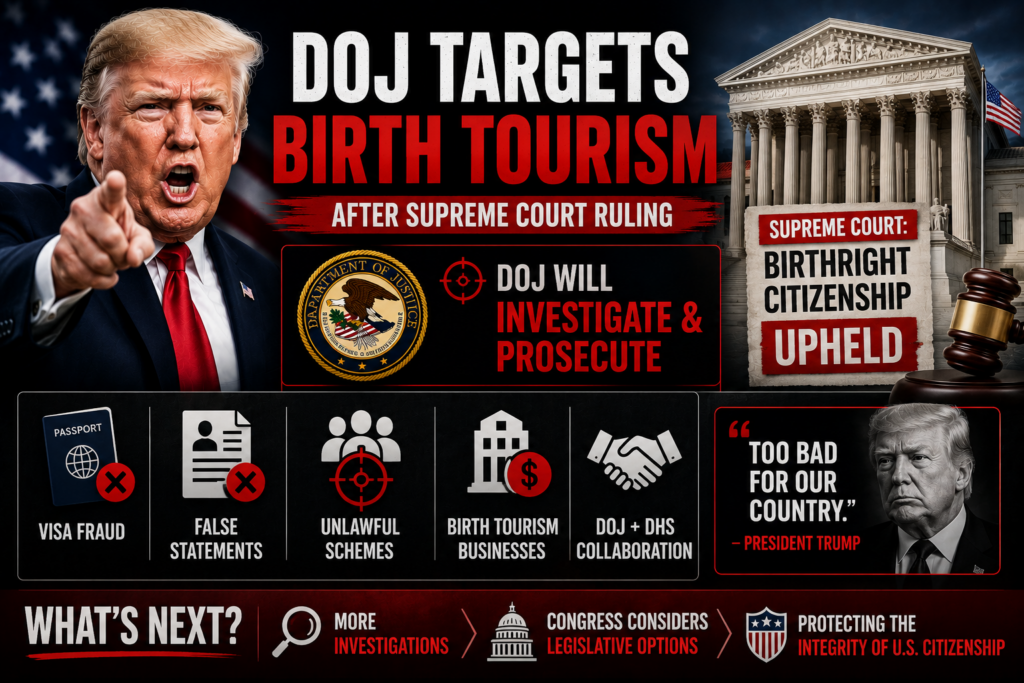
The Department of Justice (DOJ) announced it will prioritize investigations and prosecutions of alleged birth tourism schemes following the Supreme Court’s decision rejecting President Donald Trump’s effort to restrict birthright citizenship. The move signals that while the administration’s executive action was blocked, federal officials intend to intensify enforcement against individuals and organizations accused of exploiting U.S. immigration laws.
According to a report by TIME, the DOJ issued new guidance directing prosecutors to work with the Department of Homeland Security to investigate and prosecute birth tourism operations after the Supreme Court upheld birthright citizenship.
What Happened
On the same day the Supreme Court ruled against the Trump administration’s executive order limiting birthright citizenship, the Department of Justice issued a memorandum outlining a new enforcement priority.
Assistant Attorney General Colin McDonald instructed DOJ employees to prioritize criminal investigations involving birth tourism schemes, describing them as efforts by foreign nationals to travel to the United States under false pretenses to give birth so their children automatically receive U.S. citizenship.
McDonald said the department would pursue both individuals participating in such schemes and businesses or organizations that allegedly facilitate them.
DOJ Says Birth Tourism Exploits Immigration Laws
In the memorandum, McDonald argued that birth tourism schemes exploit the U.S. immigration system and violate federal criminal law.
He directed prosecutors to coordinate closely with the Department of Homeland Security to identify and prosecute cases involving fraudulent visa applications, misrepresentation to immigration authorities, and businesses advertising birth tourism services.
The DOJ stated that it intends to “zealously protect the sanctity of United States citizenship” by targeting those who profit from or participate in unlawful birth tourism operations.
Supreme Court Rejects Trump’s Executive Order
The enforcement announcement followed a major legal setback for the Trump administration.
In a closely divided 5-4 decision, the Supreme Court struck down President Trump’s executive order seeking to limit automatic birthright citizenship to children born in the United States with at least one parent who is either a U.S. citizen or lawful permanent resident.
The ruling preserved the long-standing interpretation of the Fourteenth Amendment while preventing the executive order from taking effect.
Readers can also explore the full Supreme Court ruling on Trump’s immigration policy and its implications for the administration’s broader immigration agenda.
Trump and Republicans Call for Legislative Action
Following the decision, President Trump criticized the ruling on Truth Social, describing it as “too bad for our Country.”
However, he also suggested Congress could pursue legislation addressing birthright citizenship.
Several Republican lawmakers echoed that position.
House Speaker Mike Johnson said birthright citizenship has been “overused and abused,” adding that lawmakers would continue examining legislative options. Some Republican members of Congress have also proposed pursuing a constitutional amendment to redefine birthright citizenship.
The administration’s renewed focus on immigration enforcement comes alongside other border security initiatives, including the Trump administration’s Smart Wall technology along the U.S.-Mexico border and expanded federal immigration enforcement efforts.
Political and Legal Impact
The DOJ’s announcement demonstrates that while the Supreme Court blocked one component of the administration’s immigration strategy, officials are shifting attention toward criminal enforcement rather than constitutional litigation.
Legal experts note that birth tourism itself is not explicitly prohibited under federal law. However, criminal prosecutions generally focus on allegations such as visa fraud, immigration fraud, conspiracy, or false statements made during entry into the United States.
Supporters argue stronger enforcement protects the integrity of the immigration system, while critics contend the renewed focus may lead to broader scrutiny of legal immigration and travel.
What Happens Next
The Department of Justice is expected to begin expanding investigations into birth tourism operations in coordination with the Department of Homeland Security.
Meanwhile, Republicans in Congress are expected to continue exploring legislative proposals related to birthright citizenship following the Supreme Court’s decision.
The outcome of those efforts could shape future immigration policy debates, but any constitutional changes would require significantly higher legal and political hurdles than executive action alone.
Birth tourism refers to foreign nationals traveling to the United States to give birth so their child acquires U.S. citizenship under the Fourteenth Amendment.
Following the Supreme Court’s birthright citizenship ruling, the DOJ announced it will prioritize investigations into alleged birth tourism schemes and related immigration fraud.