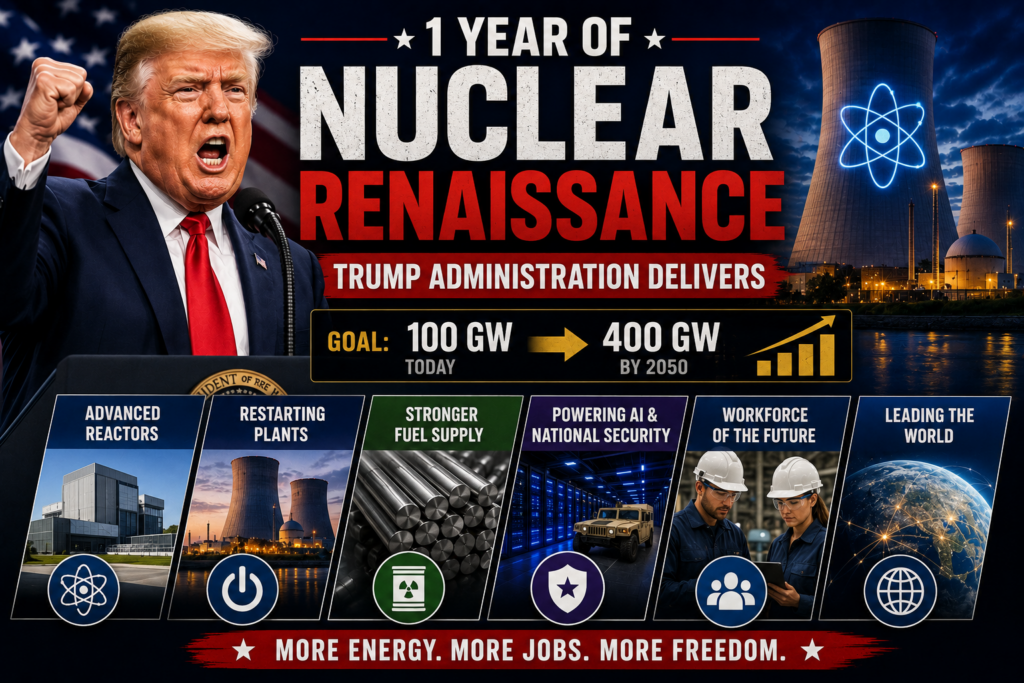
One year after President Donald Trump signed a series of executive orders aimed at revitalizing the U.S. nuclear industry, the administration says the country is experiencing a “nuclear energy renaissance.” Federal officials point to accelerated reactor development, expanded domestic fuel production, restarted nuclear plants, and new investments in advanced technologies as evidence that the administration’s energy strategy is reshaping America’s nuclear sector.
According to a report by the U.S. Department of Energy, the administration has implemented major reforms over the past 12 months designed to expand nuclear capacity, strengthen domestic fuel production, reduce regulatory delays, and position the United States as a global leader in next-generation nuclear energy.
What Happened
On May 23, 2025, President Trump signed four executive orders intended to accelerate nuclear energy development across the United States.
The initiatives focused on:
- Expanding U.S. nuclear generating capacity.
- Streamlining reactor licensing and testing.
- Increasing domestic uranium enrichment.
- Restarting retired nuclear power plants.
- Deploying advanced reactors for military installations and artificial intelligence infrastructure.
- Strengthening the nuclear workforce and fuel supply chain.
One year later, the Department of Energy says significant progress has been made across nearly every objective outlined in those executive orders.
Advanced Nuclear Reactors Move Forward
Faster Reactor Testing
The Department of Energy established the Reactor Pilot Program to speed the testing and commercialization of advanced nuclear reactors.
Officials selected 11 reactor projects, with several already completing major safety milestones. The administration’s stated goal is for at least three advanced reactor designs to achieve criticality by July 4, 2026.
The Department also opened DOME, the world’s first dedicated microreactor testing facility at Idaho National Laboratory, allowing private developers to test next-generation reactor technologies under federal oversight.
Nuclear Energy Launch Pad
The administration also created the Nuclear Energy Launch Pad, a program designed to accelerate deployment of advanced nuclear technologies on both federal and private lands.
Officials say the initiative is intended to shorten commercialization timelines while encouraging greater private-sector investment.
Expanding America’s Nuclear Capacity
One of the administration’s long-term objectives is increasing U.S. nuclear generating capacity from approximately 100 gigawatts today to 400 gigawatts by 2050.
Several major milestones have been announced, including:
- Up to $800 million in federal funding supporting early small modular reactor (SMR) projects led by the Tennessee Valley Authority and Holtec.
- $94 million awarded to strengthen domestic nuclear supply chains.
- A $40 billion U.S.-Japan partnership supporting deployment of GE Vernova Hitachi BWRX-300 small modular reactors.
- Nuclear Regulatory Commission approval of NuScale Power’s upgraded SMR design.
Meanwhile, TerraPower’s Natrium reactor project in Wyoming received a construction permit—the first issued for a commercial non-light-water reactor in the United States.
Restarting Retired Nuclear Plants
The Department of Energy has also prioritized bringing previously retired nuclear facilities back into service.
Federal financing includes:
- Up to $1.52 billion supporting the restart of Michigan’s Palisades Nuclear Plant.
- A $1 billion loan helping restart the Crane nuclear plant in Pennsylvania.
The administration says these projects will strengthen grid reliability while expanding carbon-free electricity generation.
The broader energy strategy complements other administration efforts focused on strengthening American infrastructure and industrial competitiveness. Readers may also be interested in Trump’s trade discussions with India as the administration pursues broader economic partnerships.
Strengthening Domestic Nuclear Fuel Production
The administration has significantly expanded investments in the domestic nuclear fuel supply chain.
Among the largest announcements:
- $2.7 billion to restore uranium enrichment capabilities.
- New contracts supporting production of low-enriched uranium (LEU) and high-assay low-enriched uranium (HALEU).
- Funding for advanced fuel transportation and recycling technologies.
- Establishment of a Defense Production Act consortium involving more than 90 companies to strengthen every stage of the nuclear fuel supply chain.
Officials say these investments are intended to reduce reliance on foreign suppliers while supporting advanced reactor deployment.
Nuclear Power for AI and National Security
The administration is also integrating nuclear energy into broader national security and technology initiatives.
Projects currently underway include:
- Project Pele mobile microreactor for military operations.
- Microreactor demonstrations at Army and Air Force installations.
- Nuclear-powered energy solutions for artificial intelligence data centers on federal lands.
- Research supporting future space nuclear reactors for NASA missions, including lunar surface power systems.
The administration’s emphasis on advanced technologies aligns with other initiatives supporting American innovation. Readers can also learn more about Trump’s OpenAI GPT-5.6 announcement and the administration’s broader technology agenda.
Workforce Development and Nuclear Exports
The Department of Energy has expanded scholarships, fellowships, university research funding, and safety training programs to prepare the next generation of nuclear engineers and technicians.
Internationally, the administration has also increased cooperation with allies through nuclear energy agreements involving Poland, Japan, Lithuania, Latin America, and other strategic partners to promote U.S. reactor technology abroad.
What Happens Next
The Department of Energy says the past year has laid the foundation for long-term expansion of America’s nuclear energy sector.
Future priorities include deploying additional advanced reactors, expanding uranium production, increasing nuclear exports, supporting AI-related energy demand, and achieving the administration’s goal of adding hundreds of gigawatts of new nuclear generating capacity over the coming decades.
Whether those objectives are fully realized will depend on continued federal investment, private-sector participation, and regulatory progress, but the administration argues the United States has already entered a new era of nuclear energy development.
They focus on expanding nuclear power, streamlining reactor licensing, increasing domestic fuel production, restarting retired plants, and advancing next-generation reactor technologies.
The administration cites faster reactor development, billions in nuclear investments, expanded uranium enrichment, restarted power plants, and new military and AI nuclear projects.