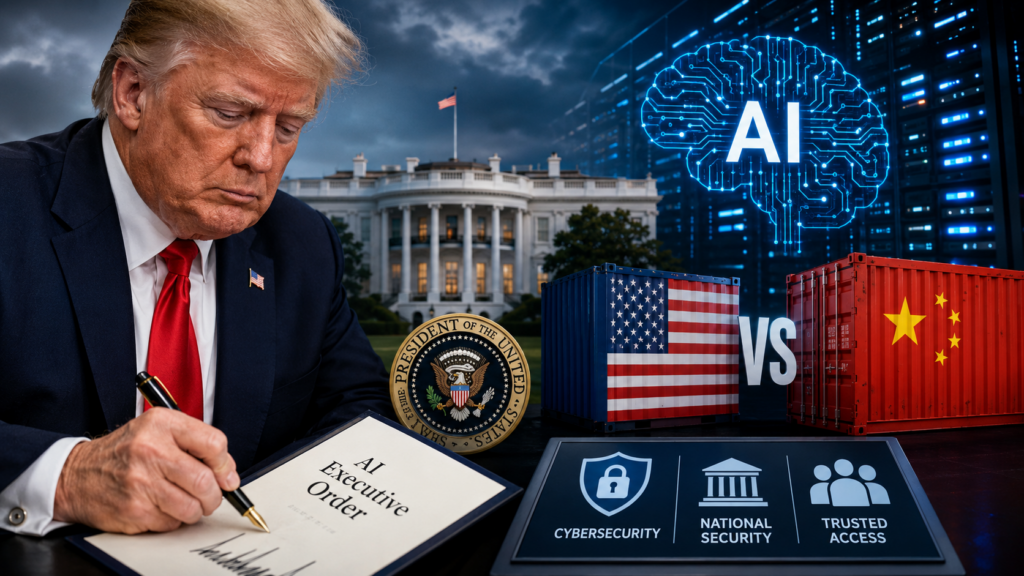
The Trump AI executive order is approaching a critical implementation deadline, with federal agencies expected to unveil a regulatory framework by Aug. 1 that could shape how advanced artificial intelligence models are evaluated before public release. The milestone comes as leading technology executives, government officials, and AI companies intensify discussions over balancing national security with innovation.
According to a report by CNBC, the White House remains on track to meet the 60-day deadline established in President Donald Trump’s executive order signed in early June.
What Happens When the Deadline Arrives?
Trump’s executive order directed multiple federal agencies to develop a framework for voluntary government review of frontier AI models before they are publicly deployed.
The framework is expected to involve several senior administration officials, including Treasury Secretary Scott Bessent, Defense Secretary Pete Hegseth, White House Chief of Staff Susie Wiles, Commerce Secretary Howard Lutnick, and other federal agencies responsible for cybersecurity and national security.
While the executive order does not impose mandatory licensing, it calls on AI developers to voluntarily submit advanced models for government evaluation to assess cybersecurity risks and determine whether they qualify as “covered frontier models.”
The White House has indicated it expects to meet the self-imposed deadline, although officials have not yet released the final framework.
AI Industry Pushes to Shape U.S. Policy
The Trump AI executive order has become a central issue across the technology sector.
OpenAI CEO Sam Altman and Nvidia CEO Jensen Huang spent the week in Washington, D.C., meeting with lawmakers and administration officials ahead of the deadline.
Altman confirmed he had reviewed a draft version of the framework and did not publicly suggest major revisions. Meanwhile, Huang has emerged as one of the strongest voices opposing restrictions on open-weight AI models.
His public letter urged policymakers to avoid “premature restrictions” that could slow American innovation while China rapidly advances its own AI capabilities.
The letter received support from Microsoft, Meta, Palantir, OpenAI, Elon Musk, and dozens of other technology companies, illustrating an unusually unified position among industry leaders. Anthropic chose not to sign, instead publishing its own policy recommendations.
As previously reported in Trump AI data centers backlash, debates surrounding AI infrastructure have already become politically sensitive as the administration seeks to accelerate American AI development.
Growing Debate Over Chinese Open-Weight AI Models
Much of the policy discussion now centers on Chinese-developed open-weight AI models.
These systems allow users to download, modify, and operate powerful AI models independently, often at significantly lower costs than proprietary alternatives offered by OpenAI or Anthropic.
Some policymakers have argued for tighter restrictions because of potential national security concerns.
However, most major U.S. technology companies have opposed broad bans, warning that limiting open-weight development could weaken America’s competitiveness in the global AI race.
Former White House AI adviser David Sacks has also publicly argued against sweeping restrictions, favoring policies that encourage innovation while addressing genuine cybersecurity risks.
Government and Industry Continue Close Cooperation
The forthcoming framework is expected to establish classified benchmarking procedures designed to evaluate advanced AI systems for cyber capabilities and identify trusted organizations eligible to access frontier models.
Since Trump’s executive order was signed, several AI companies have already adjusted product launches while working with federal officials.
Anthropic temporarily limited access to certain advanced models following Commerce Department export controls, while OpenAI delayed the wider rollout of GPT-5.6 before later expanding availability after consultations with the U.S. government.
Administration officials have repeatedly emphasized cooperation between government and private industry rather than mandatory regulation.
This broader AI strategy aligns with other technology initiatives, including Trump’s 6G alliance strategy against China, which focuses on maintaining U.S. technological leadership amid growing geopolitical competition.
What Comes Next?
The release of the AI framework will likely determine how voluntarily participating companies engage with federal agencies before launching future frontier AI systems.
Although the framework is expected to prioritize cybersecurity, national security, and trusted access rather than broad regulation, it could become one of the most significant federal AI policy initiatives introduced during Trump’s second term.
With rapid advances in artificial intelligence and increasing competition from China, the administration’s decisions over the coming days could influence both future AI development and America’s broader technology strategy for years to come.
It establishes a voluntary federal framework allowing advanced AI developers to work with the U.S. government on cybersecurity evaluations before releasing frontier AI models.
Federal agencies must complete the implementation framework that will guide how advanced AI systems are evaluated and how trusted partners gain access.