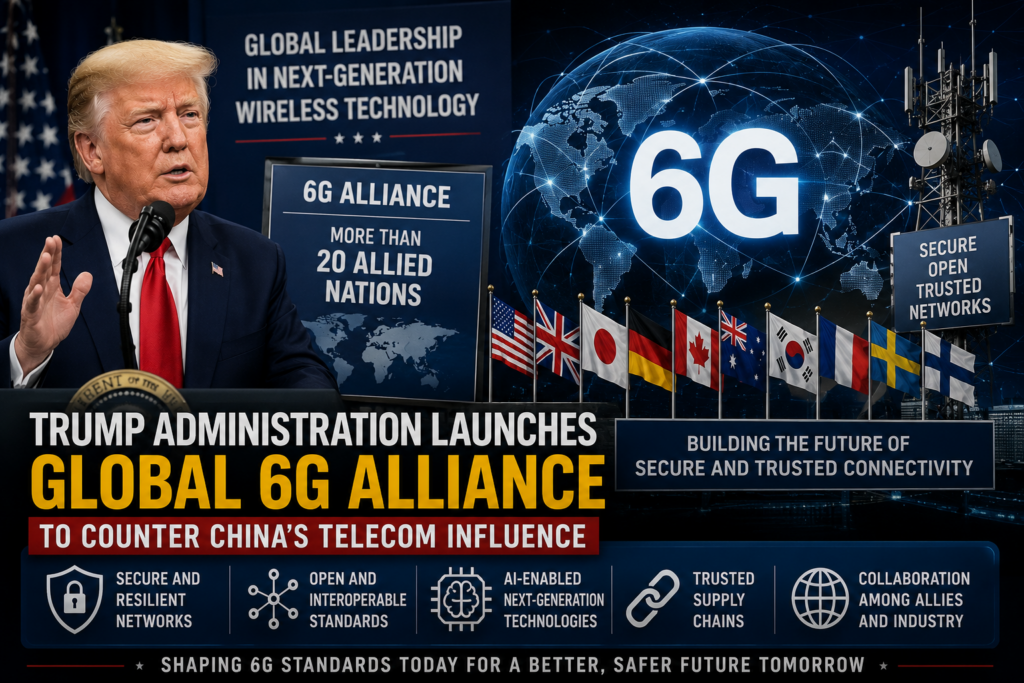
The Trump administration has unveiled a new international 6G alliance with more than 20 allied nations, aiming to secure U.S. leadership in next-generation wireless technology and reduce China’s influence over future telecommunications standards. The initiative comes years before commercial 6G deployment but reflects Washington’s broader strategy to shape the next era of global connectivity.
According to a report by POLITICO, the coalition will coordinate government strategies, share technical expertise, and strengthen cooperation among trusted partners ahead of key international negotiations that will define future 6G standards.
What Happened
The new Trump 6G alliance includes more than 20 countries, including the United Kingdom, Germany, Japan, Canada, Australia, South Korea, France, Sweden, Finland, and several other democratic partners.
The initiative establishes government-to-government points of contact, promotes technical collaboration, and creates a framework for developing secure and interoperable 6G networks before the technology is expected to replace 5G in the 2030s.
Administration officials say early coordination is essential because decisions made during the coming years will shape the future of global wireless communications for decades.
Why the U.S. Is Building a 6G Coalition
The Trump 6G alliance is designed primarily as a strategic counterweight to China’s growing influence in global telecommunications through companies such as Huawei and ZTE.
Washington has long argued that Chinese telecom infrastructure presents national security risks and has spent years encouraging allies to exclude Chinese vendors from critical communications networks. The United States has also invested billions of dollars removing Huawei and ZTE equipment from domestic telecommunications infrastructure.
Officials believe the next major opportunity to influence international standards will come before the World Radiocommunication Conference scheduled in Shanghai next year, where participating nations are expected to negotiate important decisions affecting future wireless spectrum and network development.
The administration says closer coordination among allied governments will help ensure that future communications infrastructure reflects shared security and economic interests rather than authoritarian models.
The announcement also aligns with broader technology initiatives from the White House, including new restrictions on advanced AI model access aimed at protecting sensitive U.S. technologies.
Key Goals of the Partnership
The participating governments committed to supporting wireless networks that are:
- Open and interoperable
- Secure and resilient
- AI-enabled
- Resource efficient
- Built on trusted supply chains
- Developed through cooperation with industry and academic institutions
The partnership also outlines milestones over the next month, three months, six months, and one year, including regular meetings among government officials and industry stakeholders to coordinate technical priorities.
Strategic Competition With China
The initiative reflects the growing geopolitical competition between Washington and Beijing over critical technologies.
During the rollout of 5G networks, the United States led an international campaign urging allies to avoid Chinese telecommunications suppliers over cybersecurity concerns. The administration now hopes to establish international consensus well before commercial 6G deployment begins.
Officials argue that acting early will allow democratic nations to shape technical standards before competing proposals gain broader global support.
The effort complements other administration policies focused on limiting China’s strategic influence, including actions affecting Hong Kong’s special status and U.S. sanctions on China.
What Happens Next
The coalition is expected to hold its first series of coordinated meetings over the coming months while preparing joint positions for international telecommunications negotiations.
Commerce Department officials and the National Telecommunications and Information Administration (NTIA) will continue working with partner governments to develop shared technical priorities and strengthen secure supply chains for next-generation communications infrastructure.
Although commercial 6G networks remain several years away, the Trump administration views today’s diplomatic coordination as critical to determining who will lead the global telecommunications industry throughout the next decade.
By building an international coalition well before 6G becomes commercially available, Washington hopes to strengthen its technological competitiveness while reducing China’s ability to shape the future of wireless communications.
It is a coalition of more than 20 allied countries working together to develop secure 6G technology and coordinate future wireless standards.
The administration says the partnership is intended to reduce China’s influence over future telecommunications networks and strengthen secure global connectivity.