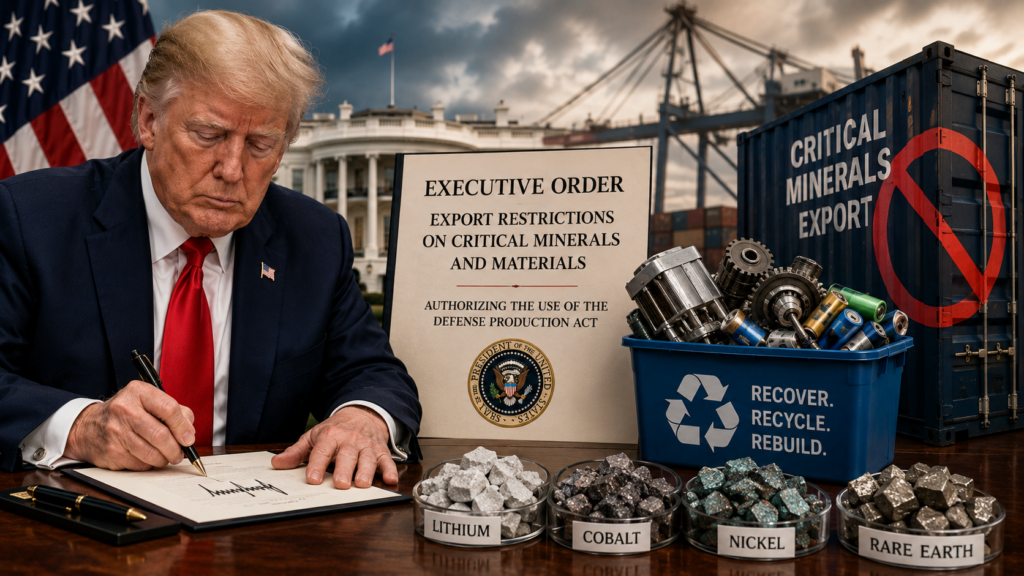
President Donald Trump has signed an executive order authorizing export restrictions on recoverable critical minerals and materials, expanding the administration’s efforts to strengthen domestic supply chains and reduce U.S. dependence on China for strategic resources. The move grants the Commerce Department new authority under the Defense Production Act (DPA) to limit exports of certain industrial waste that contains valuable critical minerals for recycling and reuse.
According to a report by Mining.com, citing Bloomberg News, the executive action is intended to retain recoverable critical minerals within the United States and support domestic manufacturing of advanced technologies.
What Happened?
President Trump signed a presidential determination on July 30 that authorizes the Commerce Secretary to impose export restrictions on recoverable critical minerals and materials (CMMs).
The order targets industrial waste and finished products that contain valuable minerals, including magnets and lithium-ion batteries. Instead of allowing these materials to leave the country, the administration aims to keep them in the United States where they can be reclaimed, recycled, and reintroduced into domestic supply chains.
The White House said these recoverable materials represent an important source of critical minerals needed for advanced manufacturing, defense systems, and emerging technologies.
Key Details of the Executive Order
Defense Production Act Authority
The executive order relies on the Defense Production Act, a Cold War-era law that gives the president broad authority to strengthen industries considered essential to national defense.
The law allows the federal government to direct private-sector production, expand domestic industrial capacity, and secure supplies of strategic materials during periods of national importance.
Trump has increasingly used the Defense Production Act during his second term, previously invoking it to support domestic coal-fired power generation and offshore oil production.
Focus on Recycling Critical Minerals
Rather than concentrating solely on new mining projects, the order emphasizes recovering valuable materials already contained in existing products.
According to the White House, recoverable critical minerals can be extracted from products such as:
- Permanent magnets
- Lithium-ion batteries
- Other finished industrial goods containing strategic minerals
Officials believe increasing domestic recycling will reduce supply chain vulnerabilities while improving access to minerals needed for electric vehicles, defense technologies, semiconductors, and other advanced manufacturing sectors.
The administration’s broader strategy also complements previous initiatives supporting domestic energy production, including Trump’s nuclear innovation strategy aimed at strengthening America’s long-term energy security.
Why Critical Minerals Matter
Critical minerals have become increasingly important as global competition intensifies over resources essential to modern technology.
Many of these materials are required for:
- Electric vehicle batteries
- Defense equipment
- Consumer electronics
- Renewable energy infrastructure
- Artificial intelligence hardware
- Semiconductor manufacturing
The United States has sought to reduce reliance on foreign suppliers, particularly China, which remains a dominant processor and exporter of many rare earth elements and critical minerals.
China’s export controls introduced last year disrupted global supply chains and increased concerns among U.S. manufacturers about long-term access to these strategic resources.
Economic and Geopolitical Impact
Although Washington and Beijing reached a broader trade agreement that eased tariffs and relaxed certain export restrictions, the Trump administration continues pursuing policies designed to diversify America’s critical mineral supply.
The new executive order reflects a broader effort to increase domestic resilience by retaining valuable recoverable materials that might otherwise be exported.
Supporters argue the policy could strengthen American manufacturing, improve recycling capacity, and reduce dependence on foreign processing.
The move also aligns with other administration efforts to strengthen strategic industries and domestic production, including Trump’s clean energy grants policy changes affecting federal support for energy infrastructure.
What Happens Next?
The Commerce Department will now have authority to determine which recoverable critical minerals and materials may be subject to export restrictions under the Defense Production Act.
Additional guidance and implementing regulations are expected to clarify how the restrictions will apply across industries that collect, recycle, process, and export industrial materials.
As competition for critical minerals continues to shape global trade and national security policies, the administration’s latest action underscores the growing importance of securing domestic supplies through both mining and recycling. The executive order represents another step in Washington’s broader strategy to strengthen critical supply chains while reducing long-term dependence on overseas sources of strategic minerals.
It authorizes the Commerce Department to restrict exports of recoverable critical minerals and materials under the Defense Production Act.
Critical minerals are essential for defense systems, batteries, semiconductors, electric vehicles, and other advanced technologies vital to national security and economic competitiveness.