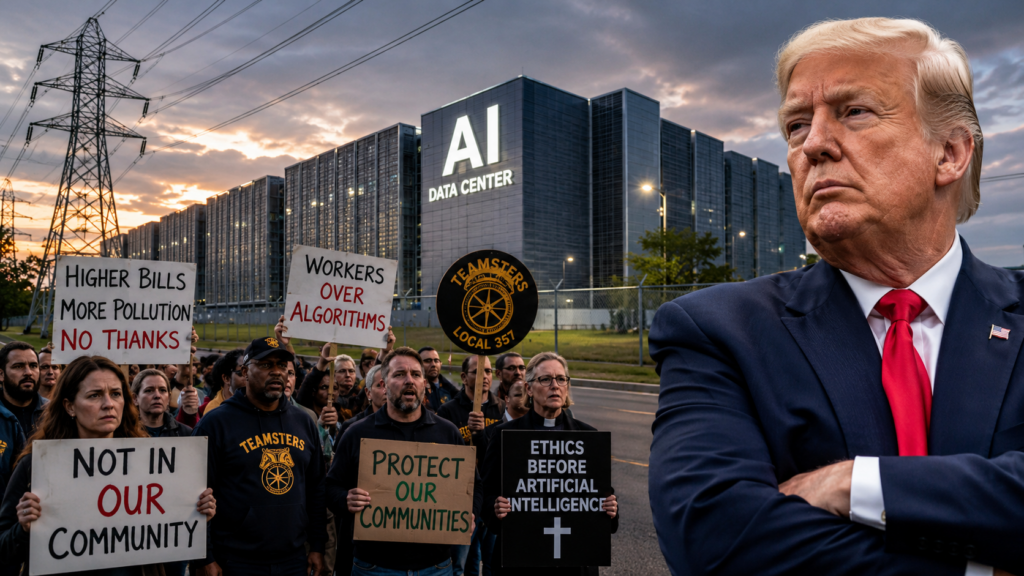
President Donald Trump’s push to accelerate artificial intelligence infrastructure is encountering growing resistance from religious leaders, labor unions, and local activists, creating a new political challenge as communities question the rapid expansion of AI data centers across the United States. While the administration argues the projects will boost economic growth and technological leadership, critics warn they could increase electricity costs, strain local infrastructure, and benefit major technology companies more than everyday Americans.
According to a report by CNBC, a broad coalition of AI skeptics is emerging across political and ideological lines, raising concerns that the backlash could become a significant issue heading into the 2026 midterm elections.
What Happened
The growing Trump AI data centers debate intensified after President Trump urged governors and local officials to embrace new AI infrastructure projects during an event at the Environmental Protection Agency.
While highlighting commitments from major technology companies and utility providers not to raise residential electricity prices, Trump encouraged state and local leaders to welcome large-scale data center developments.
“You can’t fight it. You have to go with it,” Trump said, arguing that communities should seize the economic opportunities created by AI investment rather than allow other regions to benefit.
The administration views expanded AI infrastructure as critical to maintaining U.S. leadership in artificial intelligence and advanced computing.
Growing Opposition From Religious and Labor Groups
The Trump AI data centers initiative is facing criticism from organizations that have traditionally held significant influence with Republican voters.
Walter Kim, president of the National Association of Evangelicals, echoed recent concerns raised by Pope Leo XIV, warning that artificial intelligence requires stronger ethical guardrails despite its potential benefits.
Kim argued that AI’s growing role in healthcare, education, and military decision-making risks reducing meaningful human involvement in critical decisions.
Labor organizations are also calling for stronger oversight.
AFL-CIO President Liz Shuler urged political candidates to prioritize workers over algorithms, while Teamsters President Sean O’Brien said organized labor wants a greater voice in shaping how AI affects employment and workplace conditions.
Together, religious leaders, labor unions, and grassroots activists are increasingly advocating for a slower and more regulated rollout of AI technologies.
The debate comes as the administration simultaneously advances other AI initiatives, including new White House restrictions on access to advanced AI models for sensitive government applications.
Local Communities Raise Economic Concerns
Opposition is also growing at the local level, where residents worry that massive AI data centers could increase electricity demand, strain aging power grids, and alter community development.
Although technology companies have pledged not to pass higher infrastructure costs directly to consumers, critics argue the long-term impact on utility systems remains uncertain.
Polling cited by CNBC suggests resistance extends across party lines.
A June survey conducted by the Yale Program on Climate Change Communication found that 58% of registered voters oppose building AI data centers in their local communities.
Among conservative Republicans, 53% opposed local data center construction, while opposition among liberal Democrats reached 74%.
The findings suggest concerns about AI infrastructure are not confined to a single political ideology.
Political Risks for Republicans
Analysts say the issue presents a potential political challenge for President Trump and Republican candidates ahead of the November midterm elections.
Although AI-related companies have fueled record gains in technology stocks, many voters remain skeptical that the economic benefits will be broadly shared.
Critics argue that ordinary Americans are more concerned about job displacement, rising energy costs, and growing wealth concentration than higher stock valuations enjoyed primarily by technology investors.
The administration has promoted AI expansion as a driver of economic competitiveness, but opponents increasingly argue that stronger government oversight is needed before large-scale deployment continues.
The broader AI strategy also complements other administration policies aimed at strengthening U.S. competitiveness, including efforts to build an international 6G alliance to counter China as part of its long-term technology agenda.
What Happens Next
As AI infrastructure projects continue moving forward, local governments will likely face increasing pressure from residents weighing economic development against environmental, energy, and quality-of-life concerns.
The administration is expected to continue promoting data center investment while emphasizing commitments from technology companies to manage electricity costs responsibly.
Meanwhile, advocacy groups, labor organizations, and faith leaders are expected to push for stronger safeguards governing AI deployment and infrastructure expansion.
With the 2026 midterm elections approaching, the debate over Trump AI data centers may become an increasingly important political issue as voters evaluate whether rapid AI growth primarily benefits local communities or the nation’s largest technology companies.
Critics cite concerns over electricity costs, environmental impacts, job displacement, and the concentration of economic benefits among major technology companies.
The backlash includes religious leaders, labor unions, local activists, and residents from communities where new AI infrastructure is proposed.