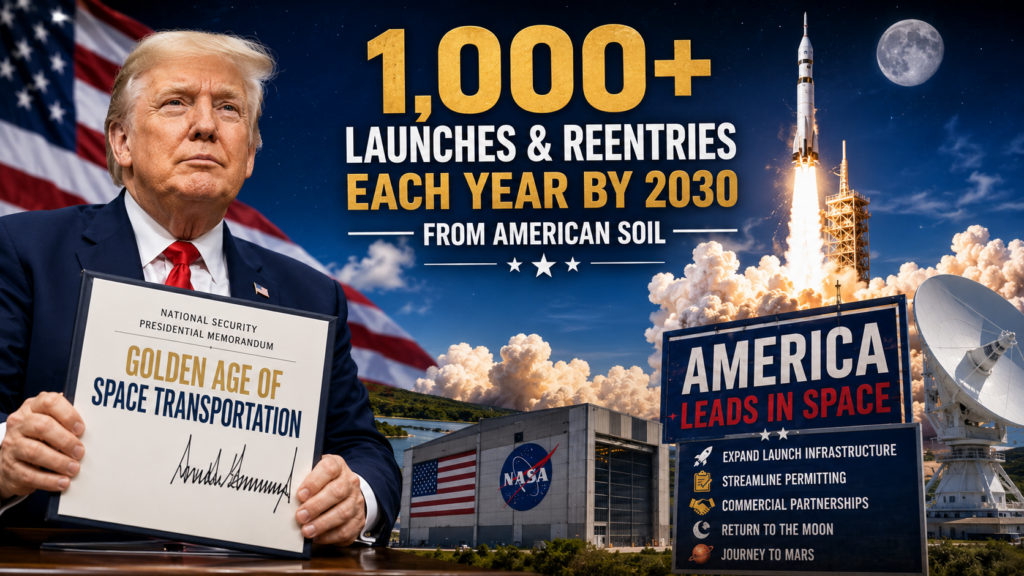
President Donald Trump has launched a new space transportation initiative aimed at enabling more than 1,000 launches and reentries on U.S. soil each year by 2030. The National Security Presidential Memorandum replaces an earlier national policy and directs federal agencies to expand launch infrastructure, streamline permitting, strengthen commercial partnerships and support new transportation capabilities to the Moon and Mars.
What Happened
Trump signed the National Security Presidential Memorandum on August 20, 2026, as the administration seeks to accelerate America’s commercial and national-security space capabilities.
According to a report by The White House, the memorandum sets a goal of supporting more than 1,000 launches and reentries annually on American soil by 2030.
That would represent a major expansion from recent U.S. launch activity. Reuters reported that the United States recorded 178 launches and reentries in the previous year, meaning the administration’s target would require a substantial increase in capacity.
The memorandum replaces the previous National Space Transportation Policy with what the White House describes as an America First approach focused on reliable, affordable and modernized access to space.
Building a Larger U.S. Launch Infrastructure
New Launch and Reentry Sites
The memorandum directs federal agencies to identify additional locations for space transportation infrastructure, including new launch and reentry sites on government-controlled land.
The Secretaries of Transportation and the Interior are instructed to work with the Secretary of War and NASA administrator on identifying potential locations.
The administration also wants priority airspace designated for critical launch corridors and greater integration between launch operations and modernization of the nation’s air traffic control system.
Reuters reported that Trump wants a new federal reentry site identified within 90 days, adding urgency to the infrastructure expansion effort.
Faster Permitting and Environmental Reviews
Another major part of the space transportation plan is reducing regulatory delays.
Federal agencies are directed to expedite permitting and environmental reviews associated with space transportation infrastructure.
The policy follows a July 2026 Federal Aviation Administration proposal aimed at speeding approval for commercial space missions by allowing certain environmental and regulatory requirements to be waived. Reuters reported that the FAA proposal could remove requirements under 13 environmental and related laws for qualifying commercial launch operations.
The administration argues that shorter approval timelines are necessary to accommodate rapidly increasing commercial launch demand.
Private Industry at the Center of the Plan
Commercial Partnerships
Trump’s memorandum places private companies at the center of the nation’s future space transportation system.
Federal agencies are instructed to encourage co-development of launch infrastructure with private-sector partners and establish cost-recovery policies for shared services and infrastructure.
The administration also wants transparent range-scheduling criteria and published launch-range schedules to maximize the use of available launch resources.
The White House describes the approach as a way to create a more competitive and resilient American space transportation industrial base.
Reuters reported that the strategy is explicitly commercial-first and could benefit major private operators such as SpaceX, which already dominates U.S. launch activity.
Moon and Mars Become Part of the Commercial Strategy
The new policy extends beyond Earth’s orbit.
NASA is directed to facilitate commercial transportation to and from the Moon, support commercial robotic access to Mars and explore commercial opportunities for human transportation to and from Mars.
The memorandum also calls on the Department of War to pursue and maximize in-space transportation services for existing and potential missions.
Reuters reported that the administration is targeting a return of American astronauts to the Moon by 2028, with initial Moon Base elements planned for 2030.
The strategy places commercial space companies alongside NASA and national-security agencies in developing the infrastructure needed for future lunar and Mars missions.
National Security and Economic Goals
The administration is presenting the space transportation initiative as both an economic and national-security policy.
The White House argues that protecting space assets is essential to military readiness and America’s economic position.
It also says a larger commercial space sector could generate high-paying aerospace manufacturing jobs, reduce the cost of developing and deploying space systems and strengthen America’s technology base.
New space transportation capabilities could also support services used on Earth, including satellite communications, weather forecasting and positioning, navigation and timing systems.
Those applications extend into industries such as agriculture, aviation and broadband communications.
The administration’s wider emphasis on strengthening national-security infrastructure can also be seen in U.S. Navy shipbuilding efforts, which similarly focus on expanding American strategic capacity.
Space Cybersecurity and Critical Infrastructure
The policy also reflects growing concern about protecting America’s space infrastructure.
The White House says defending critical space assets is essential for national security, while Trump’s earlier Space Policy Directives included cybersecurity principles for space systems.
As launch systems, satellites and commercial space networks become more important to the economy, cybersecurity is increasingly connected to the broader space transportation ecosystem.
This wider concern with protecting private-sector infrastructure is also reflected in efforts targeting cyber threats to private companies.
Trump’s Space Record
The administration is framing the latest memorandum as part of Trump’s longer-term space agenda.
During his first term, Trump issued seven Space Policy Directives, including policies supporting NASA’s return to the Moon, commercial space regulation and cybersecurity for space systems.
The White House also credits Trump with spearheading the creation of the U.S. Space Force.
In April 2026, American astronauts traveled to lunar orbit aboard Artemis II, marking the first U.S. crewed lunar-orbit mission in more than five decades, according to the White House.
Trump also signed an executive order in August 2025 designed to increase competition in the commercial space sector and another in December 2025 establishing an America First space policy focused on exploration, security and commerce.
Economic Impact of 1,000 Annual Launches
Reaching more than 1,000 launches and reentries per year would require significant expansion across the U.S. space industry.
That expansion could create demand for launch vehicles, engines, spacecraft, satellite systems, ground infrastructure, communications equipment, range operations and aerospace manufacturing.
A larger launch market could also increase competition and reduce costs for companies and government agencies seeking access to space.
However, achieving the administration’s target will depend on infrastructure development, regulatory changes, launch-site availability, airspace coordination and continued private-sector investment.
The scale of the goal means the government will need to expand capacity without creating new bottlenecks in safety, airspace management or launch-range operations.
What Happens Next
Federal agencies now face a series of implementation tasks under the new memorandum.
Among the priorities are identifying additional launch and reentry sites, establishing space-launch airspace corridors, improving range scheduling, accelerating regulatory reviews and developing a national space transportation industrial-base strategy.
The Department of State and Department of Commerce are also directed to promote U.S. access to international space transportation markets and support American standards and capabilities.
The administration’s space transportation strategy marks a major attempt to scale the American launch industry from today’s high activity levels toward an annual pace exceeding 1,000 launches and reentries by 2030. If implemented successfully, the policy could reshape America’s commercial space industry, strengthen national-security capabilities and accelerate the development of lunar and Mars transportation systems. The challenge will be turning the ambitious target into sustainable infrastructure, faster approvals and reliable launch capacity while maintaining safety and strategic resilience.
It aims to enable more than 1,000 launches and reentries on U.S. soil annually by 2030 through expanded infrastructure and commercial partnerships.
The plan calls for new launch sites, faster regulatory reviews, improved range scheduling and expanded cooperation with private space companies.