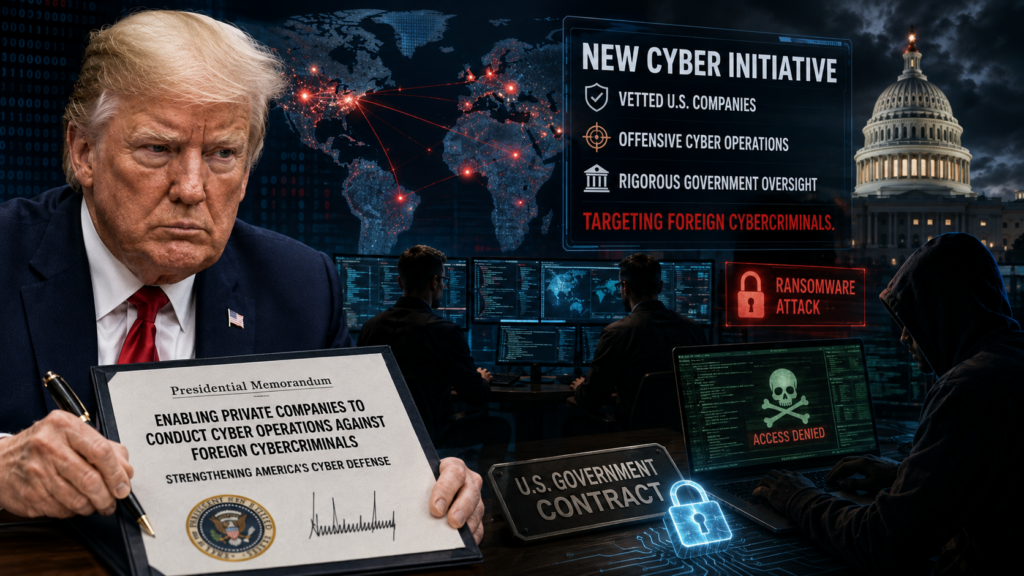
The Trump administration is moving toward allowing vetted U.S. companies to conduct offensive cyber operations against foreign cybercriminal groups, marking a significant shift in how the federal government could respond to international cybercrime.
According to a report by NPR, the initiative was outlined in a presidential memorandum issued by the Trump administration and would allow selected private companies to conduct cyber surveillance and disruptive operations under federal contracts and oversight. NPR
What Happened
President Donald Trump’s administration announced a program that could give private-sector cybersecurity companies a more direct role in targeting foreign cybercriminal organizations.
Historically, offensive cyber operations and intelligence activities of this kind have primarily been handled by U.S. government agencies. The new initiative would create a pathway for selected businesses to participate under federal supervision.
The memorandum does not itself change existing federal anti-hacking laws. Instead, participating companies would have to operate under contracts with the federal government.
How the New Cyber Program Would Work
Companies Could Conduct Offensive Operations
Under the memorandum, approved companies could potentially gain authorization to access foreign computer networks and conduct operations intended to manipulate, disrupt, degrade or destroy information systems.
The initiative could target organizations involved in activities such as ransomware, financial fraud, money laundering and other forms of transnational cybercrime.
The administration has not yet provided complete details about how companies would be selected, how targets would be identified or what legal authorities would govern individual operations.
The Department of Justice and Department of Homeland Security have been given two months to address some of those outstanding questions.
Strict Government Oversight Planned
Companies seeking to participate would need to enter into contracts with the federal government and undergo what the memorandum describes as rigorous vetting.
Participating firms would also have to set aside $1 million that the government could collect if contractual obligations are not met.
The program could attract cybersecurity startups and other private companies seeking government contracts. However, experts cited in the reporting said companies would face significant legal and operational questions before participating.
Why the Trump Administration Is Pursuing the Plan
The initiative comes as cybercrime continues to affect American businesses, individuals and critical infrastructure.
Cybercriminals routinely target private companies and public utilities with ransomware, data theft and financial scams. Cyberattacks have also become an increasingly important national security concern.
The administration has already pursued a broader strategy of using government and private-sector capabilities to combat foreign cyber threats. Earlier White House policy also emphasized cooperation with commercial cybersecurity firms to identify and disrupt foreign cyber-enabled criminal networks.
The Trump administration argues that private-sector technology companies could provide capabilities and speed that government agencies cannot always deploy as quickly.
Concerns Over Legal and Security Risks
The proposal has generated concerns within the cybersecurity industry about what could happen if private companies conduct offensive operations outside the United States.
One major issue is determining exactly who controls a targeted computer network. Foreign cybercriminals can operate through infrastructure belonging to innocent businesses, hospitals or other organizations.
An operation aimed at a criminal group could therefore unintentionally disrupt unrelated systems.
There are also questions about whether actions taken by private companies could violate the laws of countries where the targeted infrastructure is located.
Risk of Escalation
Cybersecurity experts have warned that offensive operations conducted by private companies could create diplomatic complications.
Foreign cybercriminal organizations may operate in countries where their relationship with governments is unclear. A mistaken assessment could therefore result in an operation against infrastructure connected to a foreign government or another legitimate organization.
The possibility of retaliation is another concern. A cyber operation that causes unintended damage could expose a participating company and the U.S. government to legal, financial and security consequences.
The proposal therefore represents a significant departure from the traditional division between government authorities and private cybersecurity firms.
A Broader Trump Cybersecurity Strategy
The initiative fits into a wider effort by the Trump administration to strengthen U.S. cyber capabilities and confront foreign cyber threats more aggressively.
The administration’s cybersecurity strategy calls for the United States to pursue foreign hackers and disrupt malicious cyber networks while working more closely with industry.
This broader approach also includes efforts to protect critical infrastructure and improve cooperation between federal agencies and private companies.
The administration’s policies are developing alongside other national security initiatives, including Trump administration’s financial system policy, which reflects the broader effort to protect U.S. economic and strategic interests from external risks.
Political and National Security Implications
The proposal could reshape the relationship between the federal government and America’s cybersecurity industry if it moves from a memorandum into a functioning program.
Supporters argue that private companies possess specialized technical expertise and could help the government respond more rapidly to sophisticated cybercriminals.
Critics, however, question whether private organizations should be given responsibilities traditionally reserved for government agencies.
The debate also comes as the administration pursues tougher measures against foreign criminal networks. Its broader foreign-policy approach includes Trump’s Russia sanctions legislation, illustrating the administration’s willingness to use additional tools against international threats.
What Happens Next
The memorandum gives federal agencies a two-month window to resolve important questions surrounding the program, including its legal framework and operational procedures.
It remains unclear how many companies will participate or how frequently they would be authorized to conduct operations.
The government will also need to establish safeguards for target selection, prevent accidental damage to third parties and determine how participating companies would be protected from legal consequences arising from operations conducted under federal authorization.
Broader Implications
The Trump administration’s plan could mark a major change in U.S. cybersecurity policy by bringing private companies closer to the front line of offensive cyber operations.
The central challenge will be balancing the potential speed and technical expertise of private firms against the legal, diplomatic and security risks of allowing businesses to conduct operations traditionally controlled by the government. How those safeguards are ultimately designed will determine whether the initiative becomes a meaningful new tool against cybercrime or creates new risks for the United States and its private-sector partners.
The Trump administration is creating a program that could authorize vetted private companies to conduct cyber operations against foreign cybercriminal groups under federal contracts.
The administration says private-sector expertise could strengthen U.S. efforts to disrupt foreign cybercrime, ransomware and other threats targeting Americans.