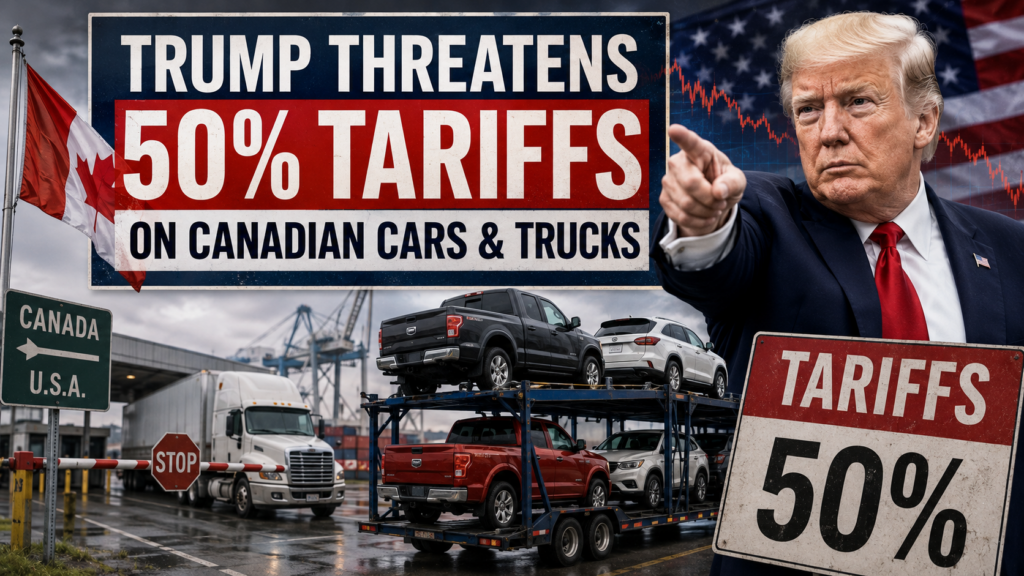
President Donald Trump is threatening to raise Canada auto tariffs to 50% on cars, trucks and automotive parts beginning January 1, 2027, after U.S.-Canada trade negotiations collapsed. The move would escalate an already tense trade dispute and could disrupt the deeply integrated North American auto industry.
What Happened
Trump announced the potential 50% tariff increase on August 24 after trade talks between Washington and Ottawa broke down over the weekend.
According to a report by Reuters, the proposed tariffs would apply to all Canadian cars, trucks and automotive parts starting January 1, 2027.
The proposed trade agreement had offered a substantially lower rate. Under the deal that collapsed, tariffs on Canadian cars and light-duty trucks would have fallen from 25% to 15%, while tariffs on Canadian steel and aluminum would have declined from 50% to 25%.
Trump said Canadian manufacturers could avoid the tariffs by building vehicles in the United States, while also arguing that the United States does not need Canada as much as Canada needs the U.S. market.
Why the Trade Deal Collapsed
Dispute Over Truck Tariffs
The negotiations reportedly broke down over several points, including whether proposed tariff reductions would apply to medium- and heavy-duty trucks.
The disagreement prevented the two governments from finalizing a broader agreement that had appeared close to completion.
The latest threat now puts the future of North American auto trade back at the center of the dispute.
Canada Auto Tariffs Could Disrupt U.S. Production
The potential Canada auto tariffs are particularly significant because manufacturing in the United States and Canada is highly integrated.
Automakers routinely move vehicles, engines, components and other parts across the border during the production process.
Reuters reported that Canada’s Automotive Parts Manufacturers’ Association warned that a tariff on Canadian auto parts would ultimately affect U.S. vehicle assembly because American plants depend on Canadian components. Association President Flavio Volpe said production could halt if critical parts were unavailable.
That creates a risk that tariffs intended to encourage more U.S. production could initially increase costs for American manufacturers and consumers.
The uncertainty also comes as automakers have already considered reducing production in Canada because of the broader trade dispute.
Canada Prepares Retaliation
Canada is already preparing retaliatory measures against U.S. goods.
Reuters reported that Canada plans to impose tariffs on additional U.S. products beginning September 8 in response to 50% U.S. levies already ordered on $20 billion worth of Canadian goods.
Canadian Prime Minister Mark Carney described the situation as a trade war after being asked about the deteriorating relationship.
The escalation threatens a trading relationship that remains extremely important to both countries.
In 2025, U.S.-Canada trade in goods and services totaled $872.3 billion, according to Reuters. Canada exported more than three-quarters of its goods to the United States and imported nearly half of its goods from the U.S.
Possible Impact on American Consumers
The economic consequences of higher Canada auto tariffs could extend beyond manufacturers.
Higher duties on imported vehicles and components can increase production costs, potentially raising prices for cars, trucks and replacement parts sold in the U.S.
American manufacturers could also face higher costs if Canadian-made engines, transmissions or other components become significantly more expensive.
The final impact would depend on how automakers restructure supply chains and whether companies ultimately absorb the costs, shift production or pass higher expenses to consumers.
The dispute is another example of Trump’s broader use of tariffs as an economic and negotiating tool. The administration has pursued similar measures in strategic industries, including Trump administration drone tariff policies aimed at influencing production and supply chains.
What It Means for the North American Auto Industry
The United States, Canada and Mexico operate one of the world’s most interconnected automotive manufacturing networks.
Factories and suppliers on both sides of the U.S.-Canada border rely on cross-border shipments to keep production moving.
A broad 50% tariff therefore presents a different challenge from tariffs applied to finished vehicles alone. Parts and components could become significantly more expensive before a finished vehicle reaches an American consumer.
Automotive executives cited by Reuters expressed skepticism about whether the threatened tariffs would actually take effect, noting that Trump has previously announced large tariffs that were later not implemented. They also warned that a 50% levy could trigger major Canadian retaliation.
Trump May Be Using Tariffs as Negotiating Leverage
Some auto industry executives believe the threat could be intended to bring Canada back to the negotiating table.
Reuters noted that the proposed January 1 implementation date comes after the November midterm elections, giving the administration additional time to negotiate before the threatened increase would take effect.
Trump has previously used threatened tariffs in negotiations with Canada.
In January, he threatened 50% tariffs on Canadian aircraft and said the United States could decertify Bombardier business jets. Those measures ultimately did not occur, although Canada later certified several Gulfstream aircraft.
That history has contributed to skepticism over whether the newest auto tariff threat will become permanent policy.
Broader Trump Trade Strategy
The dispute with Canada is part of a much broader administration effort to use tariffs to reshape international trade and encourage manufacturing in the United States.
Trump has repeatedly argued that companies can avoid tariffs by producing goods domestically.
The administration’s strategy also intersects with its broader push to expand American infrastructure and industrial capacity, including Trump administration rail investment plans designed to strengthen domestic transportation networks.
For the auto industry, however, the immediate challenge is maintaining supply-chain efficiency while governments negotiate new trade rules.
What Happens Next
The next major test will be whether Washington and Ottawa can revive negotiations before January 1, 2027.
A renewed agreement could prevent the threatened 50% tariffs from taking effect, while continued disagreement could lead to broader retaliation and further disruption across the North American economy.
Automakers and parts suppliers are also likely to assess whether they need to change production plans, sourcing arrangements or investment decisions in response to the uncertainty.
The proposed Canada auto tariffs represent a significant escalation in the U.S.-Canada trade dispute because of the auto industry’s deep cross-border integration. While Trump is using the threat to pressure Canada and encourage more production in the United States, the tariffs could also raise costs and disrupt American assembly operations if they are implemented at the proposed level. The outcome of the next round of negotiations will determine whether the threat becomes a lasting trade barrier or another tool used to bring Canada back to the negotiating table.
Trump has threatened to impose the tariffs on Canadian cars, trucks and automotive parts starting January 1, 2027.
The threat follows failed trade talks and is intended to pressure Canada while encouraging more vehicle production in the United States.