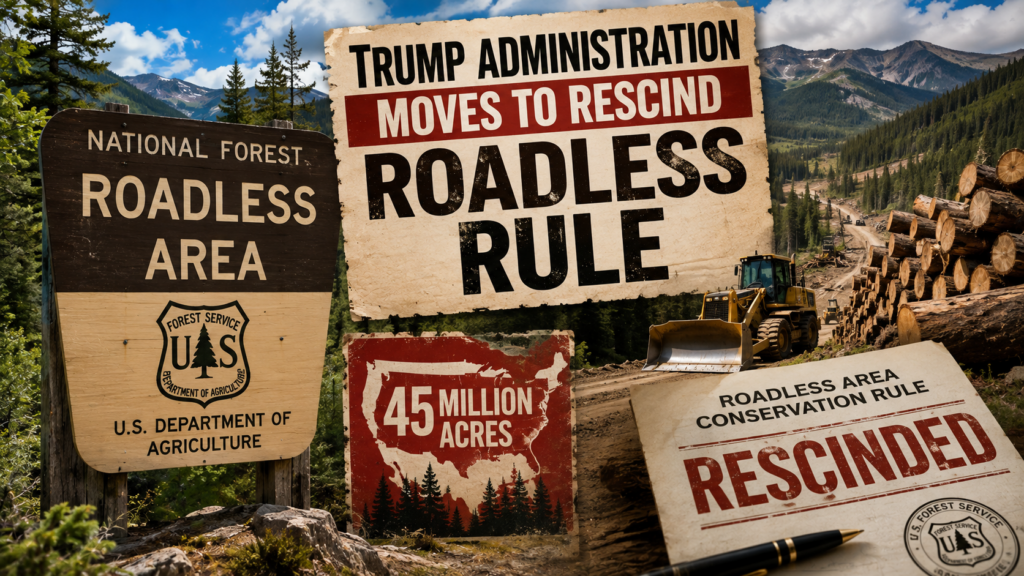
The Trump administration has proposed rescinding the 2001 Roadless Area Conservation Rule, potentially changing how nearly 45 million acres of national forests are managed and allowing local officials greater flexibility over road construction, logging and wildfire-prevention projects. The proposal was announced by Agriculture Secretary Brooke L. Rollins on August 18, 2026, and is now entering a federal public-comment process.
What Happened
The U.S. Forest Service has filed a proposed rule to repeal the national 2001 Roadless Area Conservation Rule, which has restricted new roads and commercial logging in designated roadless areas for roughly 25 years.
According to a report by Woodworking Network, Agriculture Secretary Brooke L. Rollins said the rule has become a barrier to active forest management and wildfire-risk reduction.
The proposal would remove the national roadless designation and shift more decision-making authority to individual national forest managers.
The administration argues that local officials are better positioned to determine whether roads, forest treatments or other management activities are appropriate for specific landscapes.
Reuters and The Associated Press separately reported that the Forest Service is seeking to rescind the 2001 rule, with the broader protected area described by federal agencies as roughly 59 million acres, or about 30% of the National Forest System.
Why the Trump Administration Wants to End the Roadless Rule
Wildfire Risk and Forest Health
Rollins said forests across the country face conditions including overgrown stands, insect outbreaks and disease that can increase wildfire risk.
Forest Service Chief Tom Schultz said more than 40% of inventoried roadless areas have high or very high wildfire hazard potential, particularly in Western states.
The agency also said only about 5% of those areas have received hazardous-fuel reduction treatments since 2014.
Officials argue that greater access could allow land managers to carry out forest thinning, fuel reduction and other projects intended to improve forest health and reduce risks to nearby communities.
The Forest Service says more than 11.3 million acres of roadless land are already located near existing roads, potentially making some of the proposed management changes easier to implement.
The Proposal Does Not Automatically Open Every Acre to Logging
A key distinction in the administration’s announcement is that rescinding the rule would not itself order logging or road construction across the affected acreage.
Instead, the proposal would remove the nationwide regulatory restriction and return decisions to individual national forest managers.
The Forest Service said this would allow local officials to evaluate conditions on a forest-by-forest basis rather than applying one national standard to every roadless area.
That distinction is important because the proposed rule changes the legal framework governing these lands but does not require every roadless parcel to be developed.
What the 2001 Roadless Rule Protects
The Roadless Area Conservation Rule was adopted in 2001 to protect undeveloped national forest lands from new road construction and commercial logging.
The federal government has described the rule as covering roughly 59 million acres across the National Forest System, although the Woodworking Network report and USDA announcement focused on more than 44 million currently inventoried roadless acres subject to the national rule.
The proposal would therefore represent one of the largest changes to federal forest-management policy in decades.
The administration says the rule has constrained Forest Service access and limited the agency’s ability to carry out active management. Critics argue the protections help preserve wildlife habitat, water resources and old-growth forests.
Western States Would See Most of the Impact
More than 95% of inventoried roadless areas are located across 10 Western states: Alaska, Arizona, California, Montana, Nevada, New Mexico, Oregon, Utah, Washington and Wyoming.
The proposed federal rule would not apply to national forests in Colorado and Idaho because those states operate under separate state-specific roadless regulations.
Montana Gov. Greg Gianforte and Utah Gov. Spencer J. Cox both welcomed the proposal.
Gianforte argued that the existing federal restrictions have made it harder for Montana to address wildfire risks and road development on Forest Service land.
Cox said eliminating the national rule would give local forest managers greater flexibility to make decisions based on the needs of individual forests and communities.
Environmental Groups Oppose the Proposal
Environmental organizations have strongly criticized the planned repeal.
The Sierra Club, WildEarth Guardians and other conservation groups argue that eliminating the protections could increase road construction, logging and human activity in sensitive forest areas.
The Associated Press reported that environmental advocates warned the proposal could threaten old-growth forests, wildlife and water supplies.
Reuters also reported that conservation groups challenged the administration’s argument that additional roads would reduce wildfire risk, citing research suggesting wildfire density can be lower in protected and wilderness areas.
Opponents are also questioning whether the Forest Service has the resources to maintain additional roads.
One conservation advocate cited by AP pointed to the agency’s existing maintenance backlog and argued that expanding road access could create additional infrastructure costs.
Wildfire Policy Becomes Central to the Debate
Wildfire management is one of the administration’s main arguments for changing the rule.
Officials say federal restrictions have prevented some fuel-reduction projects that could make forests more resilient to severe fires.
Critics counter that roads can increase human access and the potential for new fire ignitions, while forest management decisions should be based on scientific evidence and local ecological conditions.
The debate comes during a severe U.S. wildfire season. Reuters reported that about 7.3 million acres had burned across roughly 49,000 fires by August 17, according to the National Interagency Fire Center.
The administration’s broader focus on emergency preparedness also includes FEMA emergency management efforts, although the Forest Service proposal is a separate policy initiative.
Economic and Infrastructure Implications
Supporters of the proposal argue that expanded forest access could create opportunities for timber production, improve forest health and support economic activity in rural communities.
The policy could also have implications for transportation infrastructure because additional roads may be required to reach areas targeted for active management.
That raises both potential economic benefits and additional maintenance costs. The Forest Service already manages hundreds of thousands of miles of roads, meaning any increase in road construction could create long-term infrastructure obligations.
The administration’s broader emphasis on physical infrastructure is also reflected in Trump administration rail investment plans, although the rail program and the forest-management proposal address different federal priorities.
Alaska’s Tongass National Forest Is a Major Test Case
The Tongass National Forest in Alaska is one of the most prominent examples in the debate over roadless protections.
During Trump’s first term, the federal government removed roadless restrictions from the Tongass, allowing additional road building and logging opportunities. The Biden administration later restored protections.
The Tongass is the nation’s largest national forest and supports salmon fisheries, wildlife habitat, tourism and other industries.
Conservation groups have argued that reducing protections there could have significant environmental and economic consequences, while Alaska officials have maintained that federal restrictions have limited development opportunities.
What Happens Next
The Forest Service will accept public comments on the proposed rule and a draft environmental impact statement.
Comments must be submitted by midnight on September 21, 2026, through Regulations.gov.
The agency is expected to evaluate public input before determining whether and how to finalize the rescission.
The process could also generate legal challenges from environmental organizations and public-land advocates, particularly because the Roadless Rule has been in place for more than two decades and affects millions of acres across the country.
The proposed repeal of the Roadless Rule represents a major shift in federal land-management policy. The Trump administration argues that local forest managers need greater authority to reduce wildfire risks and improve forest health, while environmental groups warn that removing national protections could accelerate development in sensitive landscapes. The outcome will help determine how the federal government balances forest access, wildfire prevention, timber production, infrastructure costs and conservation on some of America’s most important public lands.
The administration wants to repeal the 2001 rule restricting new roads and commercial logging in designated roadless national forests.
No. It removes the national restriction but leaves decisions about roads and timber projects to local forest managers.