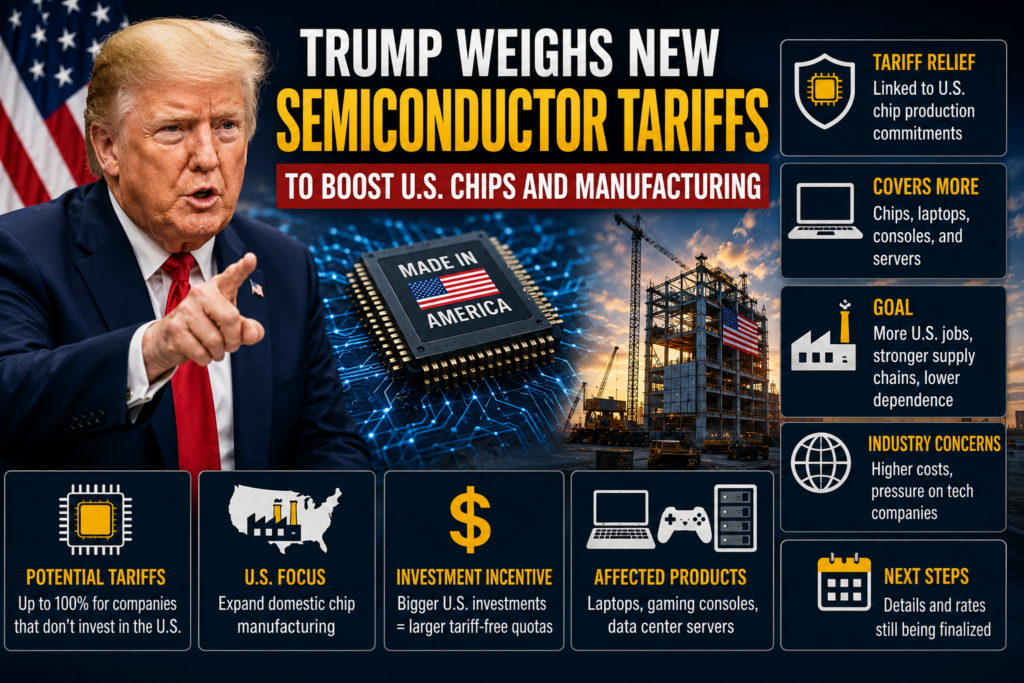
The Trump administration is considering new semiconductor tariffs that could extend beyond imported chips to laptops, gaming consoles and data center servers, as President Donald Trump seeks to accelerate domestic chip manufacturing and strengthen U.S. supply chains.
According to a report by BusinessKorea, the administration is weighing a system that would tie tariff exemptions for foreign semiconductor companies to the amount of chip production they commit to build in the United States.
What Happened
The Trump administration is considering a new tariff strategy designed to pressure foreign semiconductor manufacturers into expanding production inside the United States.
Politico reported that the proposal could cover not only semiconductor chips but also products containing chips, including laptops, gaming consoles and servers used in data centers.
Commerce Secretary Howard Lutnick reportedly favors a system in which foreign companies would receive tariff-free import quotas based on the amount of semiconductor manufacturing they commit to establish in the United States.
The approach would make access to the U.S. market increasingly dependent on domestic production.
Key Details of the Semiconductor Tariff Proposal
Tariff Relief Could Depend on U.S. Investment
Under the proposed system, foreign chipmakers could receive exemptions from tariffs if they commit to producing a certain amount of semiconductors in the United States.
Companies that make larger domestic investments could potentially receive larger tariff-free allowances.
Lutnick has previously taken a hard-line position toward foreign semiconductor producers, indicating that South Korean and Taiwanese companies could face tariffs as high as 100% if they fail to invest in American production.
The administration has not yet finalized the tariff rates or the exact structure of the proposed system.
Tariffs Could Extend to Chip-Based Products
One of the most significant elements of the proposal is its potential reach beyond semiconductor components.
The administration is considering tariffs on products containing chips, including computers, gaming consoles and equipment used in data centers.
That could make the policy considerably broader than a tariff imposed solely on imported semiconductor components.
The approach could also affect businesses that assemble products in Asia but sell them in the United States.
Why Trump Wants More Chip Production in America
The administration argues that greater domestic semiconductor manufacturing is necessary for national security, economic resilience and technological leadership.
Semiconductors are essential to artificial intelligence systems, computers, automobiles, telecommunications equipment, defense systems and data centers.
Trump’s strategy is intended to reduce U.S. reliance on overseas manufacturing while encouraging companies to build factories and expand production capacity domestically.
The policy follows other administration efforts to strengthen strategic supply chains and encourage American manufacturing.
The semiconductor push also fits with the broader effort to strengthen U.S. technology and industrial capacity, including federal support for strategic transportation and space infrastructure.
Industry Warns of Higher Costs
Technology companies and industry representatives have raised concerns that broad semiconductor tariffs could work against Trump’s goal of winning the artificial intelligence race.
Building semiconductor manufacturing capacity in the United States can take years, meaning tariffs could increase the price of imported chips well before domestic factories are capable of replacing foreign supply.
Higher chip prices could also raise the cost of constructing data centers, which are already experiencing enormous demand because of artificial intelligence.
U.S. chip designers such as Nvidia and AMD could be affected because much of their manufacturing remains dependent on overseas semiconductor producers.
That creates a potential short-term conflict between Trump’s long-term goal of reshoring production and the immediate need for affordable semiconductor supplies.
South Korean Chipmakers Face Limited Near-Term Impact
South Korean semiconductor companies may have some protection from immediate supply disruptions because global memory-chip supplies remain tight.
Demand for DRAM and high-bandwidth memory remains strong, particularly from artificial intelligence and data-center operators.
Even U.S.-based companies such as Micron have significant manufacturing operations outside the United States, including facilities in Asia.
That means quickly shifting large volumes of semiconductor production to America would be difficult even for domestic companies.
Technology companies could consequently absorb some of the additional costs through higher prices.
Samsung and LG Could Face Greater Pressure
The consumer electronics industry could feel the effects of the policy more directly.
Higher semiconductor prices combined with import tariffs could increase costs for smartphones, personal computers and other electronic devices sold in the United States.
South Korean manufacturers such as Samsung Electronics and LG Electronics could therefore face pressure from rising input costs and weaker consumer demand.
The combination has been described as a form of “chipflation,” in which more expensive semiconductors feed through into higher prices for finished products.
Over the longer term, South Korean companies could face stronger incentives to increase semiconductor production in the United States to preserve tariff-free access to the American market.
Taiwan and South Korea in the Crosshairs
Taiwanese and South Korean companies occupy a central position in the global semiconductor industry, making them particularly important to Trump’s strategy.
The administration’s proposed approach would build on an emerging trade model in which foreign manufacturers receive favorable tariff treatment in exchange for major U.S. production commitments.
Taiwanese companies have already agreed to significant U.S. manufacturing investments under a separate trade arrangement, with tariff exemptions linked to domestic production capacity.
South Korea previously secured a pledge of most-favored-nation treatment from Washington, although the BusinessKorea report said the commitment had not yet been formally documented in writing.
That uncertainty could become more significant if the administration moves ahead with a production-based tariff system.
Market Reaction
Financial markets reacted to the tariff proposal in South Korea.
As of 10:24 a.m. local time on August 28, Samsung Electronics shares had fallen 1.69% to 261,500 won, while SK hynix shares were down 1.16% at 1.71 million won.
The declines reflected investor concerns about the potential impact of higher U.S. trade barriers on South Korea’s semiconductor and technology industries.
Markets could remain sensitive to further announcements as the administration develops the details of the plan.
Political and Economic Impact
The proposed semiconductor tariffs could reshape investment decisions across the global chip industry.
For Washington, the objective is to increase domestic manufacturing, create American jobs and reduce dependence on foreign supply chains.
For foreign manufacturers, the policy could create a choice between absorbing higher tariffs or committing billions of dollars to U.S. factories.
For American technology companies, however, tariffs could create higher costs if domestic production does not expand quickly enough to replace imported chips.
The strategy therefore presents a trade-off between long-term industrial resilience and short-term price pressures.
The tariff approach also fits the administration’s broader use of trade policy to push companies toward U.S. production. Other sectors have faced similar pressure, including tariff policies affecting the U.S.-Canada automotive industry.
National Security Argument
The Trump administration is expected to emphasize national security as a central justification for semiconductor tariffs.
Advanced chips are critical to artificial intelligence, defense technology, communications and other strategic industries.
Dependence on foreign semiconductor manufacturing can create vulnerabilities if geopolitical tensions or disruptions interrupt the supply chain.
By encouraging companies to build more capacity in the United States, the administration argues that the country can improve control over critical technologies and reduce exposure to overseas disruptions.
What Happens Next
The administration is expected to finalize details of the semiconductor tariff proposal over the coming weeks or months.
Important questions remain over the tariff rates, the products covered, the size of tariff-free quotas and the amount of domestic investment required to qualify for relief.
Officials are also considering whether the new tariffs should include a phase-in period to give companies more time to adjust their supply chains.
Until the administration formally announces the policy, the exact structure remains subject to change.
Broader Implications
The Trump administration’s semiconductor strategy represents a major effort to use trade policy to accelerate the reshoring of a strategically important industry.
If implemented broadly, the tariffs could encourage foreign chipmakers to expand U.S. factories and strengthen domestic supply chains. But they could also increase costs for data centers, electronics manufacturers and consumers before American production capacity is large enough to fill the gap.
The outcome will depend on how aggressively the administration links tariff exemptions to domestic investment and whether semiconductor companies conclude that building in the United States is preferable to paying higher import duties.
For the global chip industry, the policy could mark another major shift toward geographically diversified semiconductor manufacturing, with the United States seeking a larger share of production as competition over artificial intelligence and advanced technology intensifies.
The administration wants to encourage foreign chipmakers to build more semiconductor manufacturing capacity in the United States.
Yes. Higher import costs could raise expenses for data centers, computers and other products that rely on imported semiconductor components.