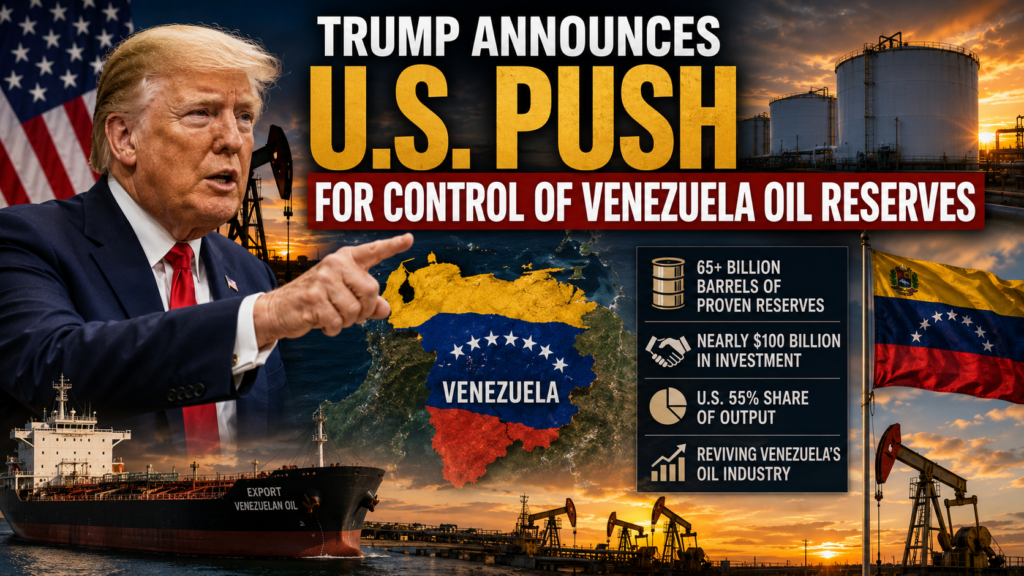
President Donald Trump has announced a major Venezuela oil deal that would give the United States a significant role in developing more than 65 billion barrels of Venezuelan oil reserves through a new partnership with private companies.
According to a report by EnergyNow, the agreement could attract nearly $100 billion in investment, revive Venezuela’s damaged oil industry and eventually increase crude supplies available to U.S. refiners. Reuters and AP separately reported that the arrangement would give the United States an effective 55% share of output from a new private company tied to 17 oil fields, although many details remain unresolved.
What Happened
Trump announced the agreement on August 28, saying his administration had secured majority U.S. control of more than 65 billion barrels of Venezuela’s proven oil reserves through a partnership with private business.
The announcement followed weeks of negotiations between Washington and Venezuela’s interim government. Secretary of State Marco Rubio and Defense Secretary Pete Hegseth were involved in the talks with Venezuela’s interim President Delcy Rodriguez.
The precise structure of the transaction was initially unclear. Reuters reported that Venezuelan authorities were preparing agreements granting exploration and production rights to several companies, with a lease-based model under consideration.
AP later reported that the U.S. government and an unnamed private operator had formed a new company with rights to develop the fields for 100 years. A U.S. official said the arrangement gives the United States 55% of the company’s effective output, including an ownership stake and rights to buy oil at cost.
Key Details of the Venezuela Oil Deal
17 Strategic Oil Fields
The agreement covers 17 oil fields located in Venezuela’s major producing regions, including the Orinoco Oil Belt and Lake Maracaibo basin.
Rodriguez’s government said the fields have a proven potential of 65 billion barrels and estimated that development could generate more than $209 billion in tax revenue for Venezuela.
The plan is intended to bring U.S. capital, technology and operational expertise into a petroleum sector that has suffered from years of underinvestment and deteriorating infrastructure.
Nearly $100 Billion in Investment
Rubio has described the agreement as beneficial to both countries.
He said the arrangement could attract nearly $100 billion in private investment, create thousands of jobs and help rebuild Venezuela’s economy while providing the United States with a stable source of relatively low-cost crude.
The administration is also linking the agreement to its efforts to manage elevated U.S. gasoline prices.
Trump faces pressure to demonstrate that his energy policies can increase supplies and reduce costs for consumers, particularly ahead of the November midterm elections.
Why Venezuela’s Oil Matters
Venezuela has the world’s largest proven oil reserves, but its actual production remains far below its geological potential.
Reuters reported that Venezuela was producing roughly 1.25 million barrels per day after years of underinvestment, mismanagement and sanctions.
The country’s crude is predominantly extra-heavy, which makes extraction, transportation and refining more complicated than for lighter grades of oil.
Increasing production would therefore require much more than drilling new wells.
Infrastructure Creates a Major Challenge
Venezuela’s petroleum infrastructure has deteriorated significantly.
Developing the targeted fields would require investment in pipelines, production facilities, storage, export terminals, power systems and equipment needed to process and transport heavy crude.
The country’s oil industry also needs reliable supplies of diluent to make its extra-heavy crude easier to move through pipelines and prepare for export.
AP reported that experts do not expect a major increase in Venezuelan production to happen quickly because repairing and expanding the country’s infrastructure would take years and require substantial investment.
That means the Venezuela oil deal is unlikely to produce an immediate increase in U.S. gasoline supplies.
Legal and Political Questions
The agreement faces significant questions over its legal structure.
Reuters reported that analysts questioned whether a U.S. government lease to operate Venezuelan oil fields would comply with Venezuela’s constitution and its newer hydrocarbons legislation.
David Goldwyn, president of Goldwyn Global Strategies, said there was no precedent for the U.S. government directly entering a lease to operate oil fields. He also questioned whether the arrangement could overcome the political and infrastructure problems that have discouraged international investment in Venezuela for years.
Venezuela has historically kept tight state control over its oil industry, creating additional uncertainty about long-term investment protections.
Venezuela’s History of State Oil Control
Venezuela nationalized its petroleum industry in the 1970s and placed the state oil company PDVSA at the center of the sector.
Under former President Hugo Chavez, the government tightened control over foreign oil operations and required companies to participate in state-controlled joint ventures. Some foreign-owned projects were later expropriated.
Production declined sharply under Nicolas Maduro as investment fell, skilled workers left the industry and infrastructure deteriorated.
The Trump administration is now betting that American companies can reverse those trends by supplying capital, technology and management expertise.
U.S. Gasoline Prices and Energy Security
One of the central arguments for the agreement is that increased Venezuelan oil production could eventually help lower U.S. fuel costs.
Trump and Rubio have emphasized the possibility of securing additional crude for American refineries, while the administration is also examining ways to replenish the Strategic Petroleum Reserve.
However, the timing is uncertain.
Even a large investment program would likely require years before Venezuela could restore significant production capacity. AP reported that experts do not expect a substantial immediate decline in U.S. gasoline prices from the agreement.
The deal is therefore better understood as a long-term energy strategy rather than an immediate solution to fuel-price pressures.
Political and Economic Impact
The agreement could significantly expand U.S. influence over Venezuela’s energy industry while creating a major commercial opportunity for American companies.
For Venezuela, the potential benefits include foreign investment, higher production, increased government revenue and the restoration of an industry that has been central to the country’s economy.
For the United States, the strategic benefits could include greater access to heavy crude, stronger leverage over Venezuela’s energy sector and an opportunity to help diversify supplies.
The move also fits into Trump’s broader use of trade and economic policy to pursue strategic goals. Recent U.S. trade policy affecting Canada and American industries illustrates how economic measures are increasingly being linked to wider national interests.
At the same time, the agreement could face criticism if it is seen as favoring U.S. commercial interests over Venezuelan sovereignty or transparency.
Venezuela and the Wider Energy Strategy
The administration’s Venezuela strategy also has implications for broader U.S. policy in the Western Hemisphere.
Securing additional Venezuelan crude could become more strategically important as global energy markets face disruptions and Washington seeks alternatives to vulnerable supply routes.
The situation is also connected to the administration’s broader approach to energy security and geopolitical competition, including U.S. policy toward Iran and its energy-related sanctions.
Increasing U.S. access to Venezuelan crude could therefore serve both an economic purpose and a strategic one.
What Happens Next
Venezuelan authorities are expected to move forward with agreements granting oil development rights to companies involved in the planned projects.
The biggest unanswered questions concern the final ownership structure, the companies participating, the legal basis for the arrangement and the amount of capital that can realistically be deployed.
Investors will also assess whether Venezuela can provide sufficient legal protections and political stability to support long-term projects.
The administration will meanwhile be watching whether the arrangement can increase Venezuelan production quickly enough to contribute to U.S. energy security and, eventually, gasoline affordability.
Broader Implications
The Venezuela oil deal represents one of the most ambitious attempts by the Trump administration to reshape a foreign country’s energy sector through U.S. commercial involvement.
The agreement could eventually unlock billions of dollars in investment and substantially increase Venezuelan oil production, but major legal, political and infrastructure barriers remain.
For Washington, the potential reward is access to a vast source of crude and greater influence over Venezuela’s petroleum industry. For Caracas, the agreement offers a possible path toward economic recovery and higher government revenue.
Whether those promises become reality will depend on the details of the final agreements, the ability to rebuild Venezuela’s oil infrastructure and the willingness of U.S. companies to commit capital despite the country’s long history of political and legal uncertainty.
It is a U.S.-Venezuela arrangement involving 17 oil fields with more than 65 billion barrels of proven potential and private-sector development.
Probably not. Experts say rebuilding Venezuela’s damaged oil infrastructure and significantly increasing production could take years.