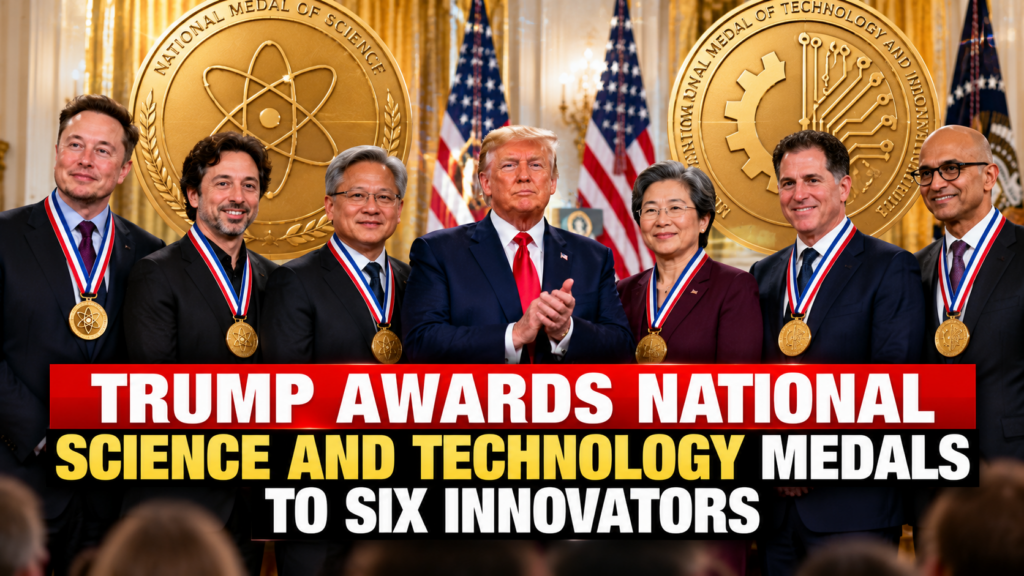
President Donald Trump presented the National Medal of Science and the National Medal of Technology and Innovation to six prominent technology leaders during the “Science: A New Golden Age” Summit on October 8, 2026, in Washington, D.C. The National Medals of Science and Technology recognize achievements in scientific research, engineering, computing, and technological innovation that have contributed to American progress.
According to a report by The White House, Trump presented the National Medal of Science to Elon Musk, Sergey Brin, Jensen Huang, and Lisa Su. Michael Dell and Satya Nadella received the National Medal of Technology and Innovation.
What Happened at the White House Science Summit?
The awards were presented during the “Science: A New Golden Age” Summit, an event focused on the future of American scientific discovery and technological development.
The National Medal of Science has been awarded by U.S. presidents since 1963 to recognize outstanding contributions to science. The National Medal of Technology and Innovation, first awarded in 1985, honors American innovators whose work has strengthened the economy and improved quality of life.
The White House said this year’s six recipients have contributed to advances in computing, semiconductor technology, artificial intelligence infrastructure, communications, and space exploration.
The ceremony formed part of the Trump administration’s broader effort to promote U.S. leadership in science and technology.
Who Received the National Medal of Science?
Four technology leaders received the National Medal of Science for their contributions to scientific and technological progress.
Elon Musk
Musk was recognized for engineering achievements in space exploration, intelligent systems, communications, and manufacturing. The White House highlighted his role in advancing technologies intended to strengthen American technological leadership.
Sergey Brin
Brin received the medal for developing foundational algorithms for information retrieval and data processing. These innovations helped transform how people access and use information across science, commerce, and everyday life.
Jensen Huang
Huang was recognized for advancing graphics processing units into general-purpose computing architectures through innovations in processor design and software.
These developments have supported massively parallel computation and contributed to advances in scientific computing and artificial intelligence.
Lisa Su
Su received the medal for leadership in semiconductor engineering and high-performance computing. The White House highlighted her work in processor architecture and chiplet-based integration, which helped enable the world’s first exascale supercomputer.
Who Received the National Medal of Technology and Innovation?
Two business leaders received the National Medal of Technology and Innovation for their contributions to computing infrastructure and technology development.
Michael Dell
Dell was recognized for expanding the adoption of personal and enterprise computing. The White House cited his technical and business leadership in building a global technology company, as well as his support for future generations of scientists, engineers, and technologists.
Satya Nadella
Nadella received the award for his leadership at Microsoft during the expansion of cloud computing and for helping build the hyperscale infrastructure used to train and deploy advanced artificial intelligence systems.
The recognition highlights the growing role of large-scale computing infrastructure in scientific research and technological development.
Why the National Science and Technology Medals Matter
The awards recognize individual contributions, but this year’s selections also reflect the increasingly close relationship between scientific research and commercial technology.
Computing systems, semiconductor innovation, AI infrastructure, and space engineering are becoming central to scientific discovery. Many breakthroughs now depend on collaboration between researchers, technology companies, universities, and government agencies.
The recipients represent different parts of this ecosystem, from foundational computing algorithms and chip design to global technology infrastructure and space exploration.
The ceremony also reinforces the administration’s emphasis on using American scientific and technological capabilities to strengthen the country’s global position.
Trump’s Broader Science and Technology Agenda
The awards ceremony was part of the administration’s “Science: A New Golden Age” initiative, which seeks to reshape how the United States supports research and technological innovation.
A report released by White House Office of Science and Technology Policy Director Michael Kratsios in July 2026 called for changes to the country’s science and technology enterprise. Its recommendations included stronger support for early-career researchers, ambitious national scientific missions, new research funding models, and improved infrastructure for evaluating scientific research.
The report also emphasized scaling scientific discovery through the administration’s Genesis Mission, an initiative focused on using advanced AI capabilities in research.
At the October summit, the administration announced a broader set of science initiatives involving federal agencies, industry, academia, and philanthropic organizations.
The medal presentations therefore served as both a recognition of individual achievement and part of a wider policy effort to promote American research and innovation.
What Happens Next?
The White House summit brought together scientific and technology leaders to discuss how research, funding, and private-sector capabilities could contribute to future breakthroughs.
The administration’s next challenge is turning its science and technology priorities into sustained research progress. That will depend on how initiatives are implemented, how resources are allocated, and whether cooperation between government, universities, and industry produces measurable results.
The six awards recognize achievements that have already influenced computing, engineering, and scientific research. Their broader significance lies in the administration’s attempt to connect those achievements with its future vision for American innovation and global technological leadership.
Related Reading
- Trump Creates “Super Intelligence Force” AI Task Force
- Taiwan Presses Trump Administration on $14 Billion Arms Sale
Elon Musk, Sergey Brin, Jensen Huang, and Lisa Su received the National Medal of Science for contributions to engineering, computing, semiconductor technology, and scientific innovation.
Michael Dell and Satya Nadella received the National Medal of Technology and Innovation for their contributions to personal and enterprise computing, cloud technology, and computing infrastructure.