The relationship between the Federal Reserve and presidential politics remains one of the most consequential yet misunderstood aspects of American governance. As the nation's central bank, the Federal Reserve wields enormous influence over economic conditions that directly affect presidential approval ratings, election outcomes, and policy agendas. Yet the institution was deliberately designed to operate independently from direct presidential control, creating an inherent tension that has shaped political dynamics for over a century. Understanding this delicate balance between monetary authority and political accountability is essential for anyone following presidential elections and governance.
The Constitutional Framework of Central Banking Independence
The Federal Reserve operates within a unique constitutional space that sets it apart from traditional executive agencies. Congress created the Fed through legislation in 1913, establishing a hybrid structure with both public accountability and operational autonomy. This design reflects a fundamental principle: monetary policy decisions should be insulated from short-term political pressures that might prioritize electoral cycles over long-term economic stability.
Governance Structure and Presidential Appointments
Presidents exercise their most direct influence through appointments to the Board of Governors. The President nominates all seven Board members, including the Chair and Vice Chair, subject to Senate confirmation. These appointments carry 14-year terms, deliberately staggered to prevent any single president from reshaping the entire Board.
Key appointment powers include:
- Nominating the Federal Reserve Chair for a four-year renewable term
- Selecting the Vice Chair for Supervision
- Appointing governors to fill vacancies on the seven-member Board
- Influencing regional Federal Reserve Bank presidents indirectly through Board authority
This appointment structure creates a natural intersection between federal reserve and presidential politics. Presidents often face criticism when Fed policies appear to undermine their economic agenda, yet they possess limited tools to directly alter monetary policy decisions in real time.
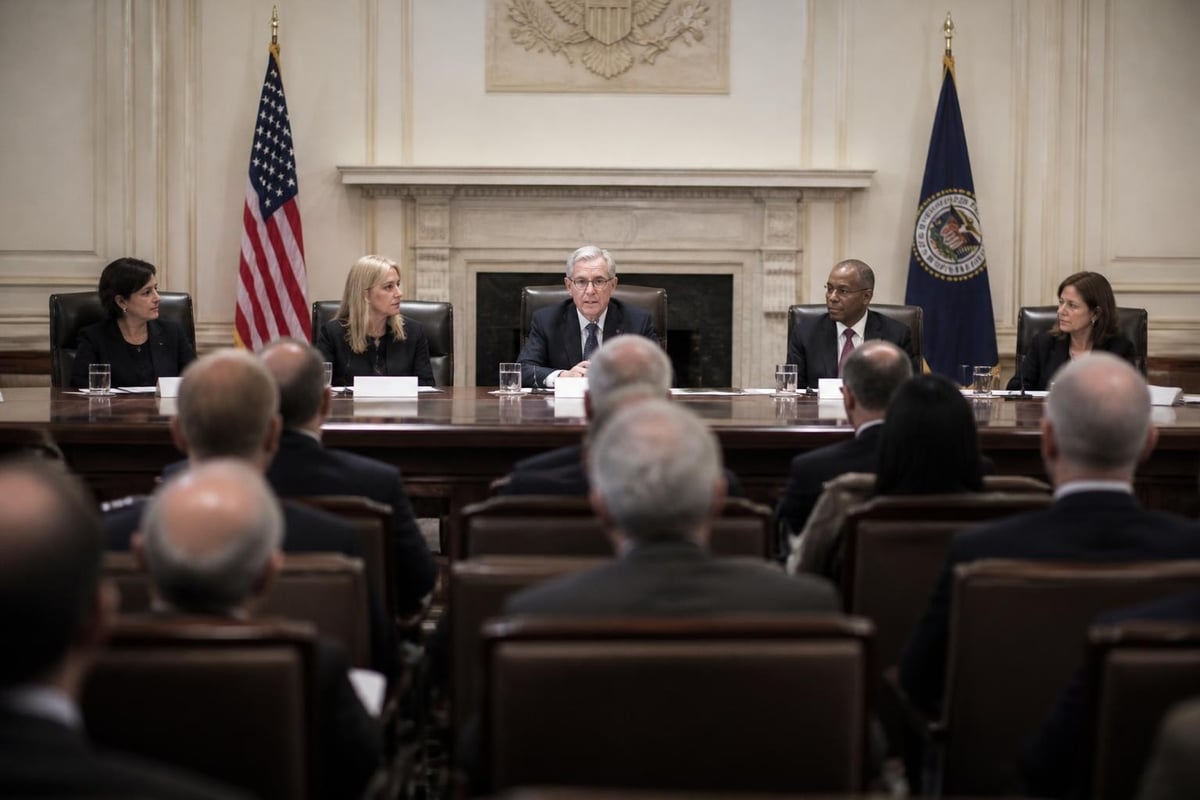
The Federal Reserve Board explains the legal basis for independence as essential for maintaining credibility in inflation control and financial stability. Markets respond not just to current policy but to expectations about future actions, making institutional credibility a crucial economic asset.
Historical Patterns of Presidential Pressure
Throughout American history, presidents have attempted various strategies to influence Federal Reserve policy, with mixed results and consequences. These efforts illuminate how federal reserve and presidential politics intersect during critical economic moments.
| President | Period | Pressure Tactic | Outcome |
|---|---|---|---|
| Richard Nixon | 1969-1974 | Direct lobbying of Chair Arthur Burns | Accommodative policy, later inflation |
| Jimmy Carter | 1977-1981 | Appointed Paul Volcker, then resisted rate hikes | Volcker prioritized inflation control |
| Donald Trump | 2017-2021 | Public criticism via social media | Fed maintained policy independence |
| Joe Biden | 2021-2026 | Reappointed Powell, minimal public comment | Traditional norms observed |
The Nixon administration exemplifies the risks of excessive political influence. Nixon's pressure on Federal Reserve Chair Arthur Burns to maintain loose monetary policy ahead of the 1972 election contributed to the inflationary spiral of the 1970s. This episode reinforced the economic case for institutional independence.
The Modern Era of Public Commentary
Recent decades have witnessed presidents becoming more vocal about monetary policy, breaking with longstanding norms of public restraint. This shift has intensified the connection between federal reserve and presidential politics in ways that concern institutional scholars.
Presidential commentary now includes:
- Direct policy critiques through press conferences and social media
- Personnel criticism targeting individual Fed officials by name
- Speculative statements about desired rate changes before meetings
- Appointment threats suggesting removal or non-reappointment
These tactics raise questions about whether traditional norms protecting Fed independence remain durable in an era of hyper-partisan politics and instant communication. While presidents cannot directly dictate interest rate decisions, persistent public pressure can create market uncertainty and complicate the Fed's communication strategy.
Election Cycles and Monetary Policy Timing
The intersection of presidential election calendars and Federal Reserve policy decisions creates recurring political dynamics. Incumbent presidents facing reelection naturally hope for economic conditions that boost their approval ratings, while the Fed must maintain focus on its statutory mandate regardless of electoral timing.
Interest Rate Decisions in Election Years
Monetary policy decisions in election years receive exceptional scrutiny. Rate cuts that stimulate growth may appear politically motivated, while rate increases that slow the economy can draw accusations of political bias against the incumbent. The Federal Reserve faces a no-win situation when economic conditions require significant policy shifts during campaign seasons.
Economic research shows that Fed chairs generally resist political pressure, maintaining policy consistency across election cycles. However, the Federal Reserve’s historical governance structure evolved specifically to prevent the kind of electoral manipulation that characterized some central banks in other nations.
Considerations during election years include:
- Communication timing: Avoiding policy announcements immediately before Election Day
- Data dependency: Emphasizing objective economic indicators over political narratives
- Bipartisan appointments: Maintaining Board composition that reflects both parties
- Transparency: Publishing detailed meeting minutes and economic projections
Presidents approaching reelection often face temptation to publicly lobby for accommodative policy. These efforts rarely succeed in altering Fed decisions but can generate media coverage that frames monetary policy as a political issue rather than a technical economic judgment.
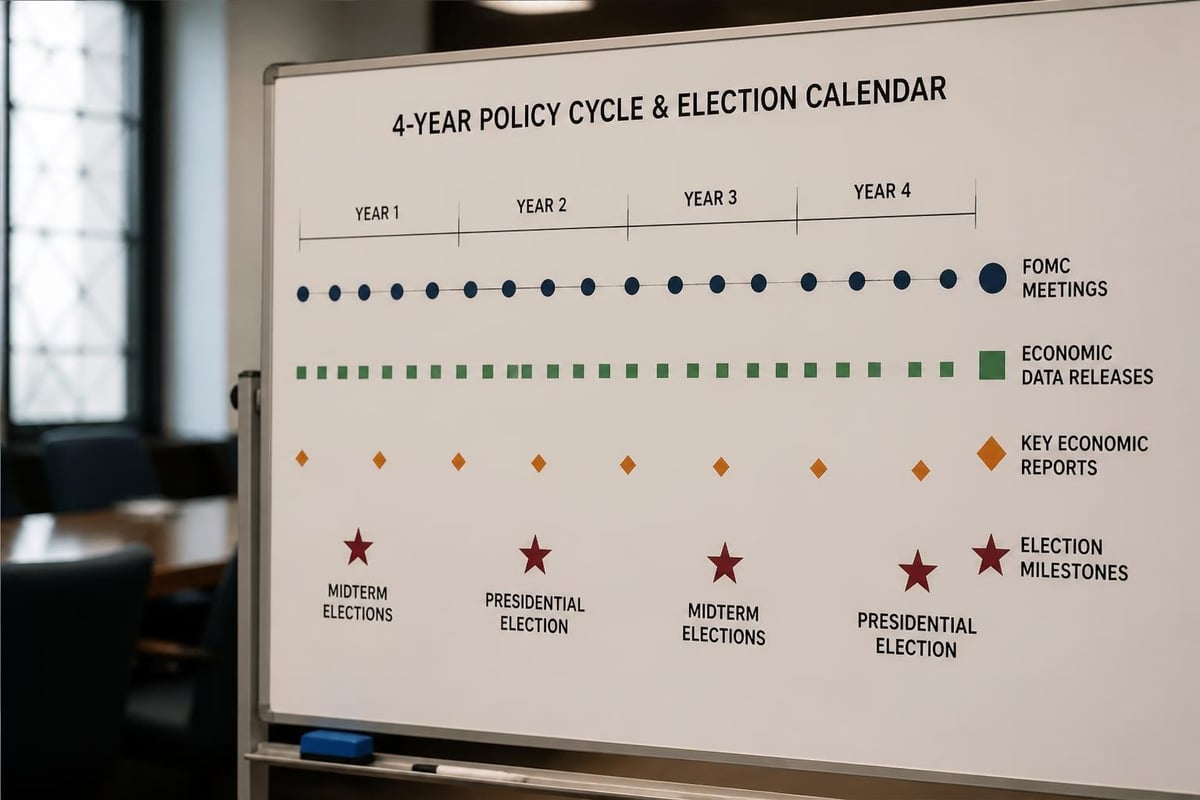
Recent analysis from Brookings on Fed independence highlights legal and institutional safeguards that protect against political interference, while acknowledging that norms can erode over time without formal legal changes.
Presidential Rhetoric and Market Impact
When presidents publicly comment on Federal Reserve policy, financial markets respond immediately. This reality creates a feedback loop where presidential statements about desired monetary policy can influence economic conditions even without actual policy changes, complicating the relationship between federal reserve and presidential politics.
Communication Channels and Economic Effects
Presidential communications about the Fed now reach markets instantaneously through multiple channels. A single tweet or press conference comment can move interest rate expectations, currency values, and stock indices within minutes. This amplification effect means presidential rhetoric carries economic consequences independent of actual Fed decisions.
Markets interpret presidential criticism through several lenses:
- Policy signal: Does criticism suggest future appointment changes?
- Political pressure: Will sustained attacks compromise Fed independence?
- Economic outlook: Does the president's desired policy reflect privileged economic information?
- Institutional risk: Are traditional governance norms eroding?
The international financial community watches American federal reserve and presidential politics closely. The Bank for International Settlements has documented how central bank independence globally faces political pressures, with implications for inflation expectations and capital flows across borders.
Legal Boundaries and Institutional Safeguards
Despite intense political pressures, several legal protections limit presidential power over Federal Reserve operations. These safeguards have withstood legal challenges and presidential criticism, though their durability depends partly on continued adherence to institutional norms.
| Protection Mechanism | Legal Basis | Practical Effect |
|---|---|---|
| For-cause removal standard | Federal Reserve Act as interpreted by courts | President cannot fire Chair for policy disagreements |
| 14-year Board terms | Statutory requirement | Limits ability to reshape Board quickly |
| Federal Open Market Committee structure | 12 members including regional presidents | Dilutes Board-level political appointments |
| Budget independence | Self-funding through market operations | Congress cannot use appropriations as leverage |
The Supreme Court's jurisprudence on independent agencies provides additional protection. While presidents oversee executive branch functions, the Federal Reserve's hybrid structure as a congressionally created entity with both public and private elements places certain operations beyond direct presidential control.
Removal Authority and Its Limits
Presidents cannot remove Federal Reserve Board members simply for disagreeing with their policy views. The for-cause removal standard requires demonstrable misconduct or neglect of duty. This protection, established through legal precedent and statute, represents a cornerstone of Fed independence.
Recent litigation has tested these boundaries. Brookings research on historical challenges to independence examines how central banks maintain credibility when political actors push legal limits or threaten institutional norms.
Legal protections include:
- Statutory limitations on removal authority
- Due process requirements for any disciplinary action
- Congressional oversight providing additional accountability
- Judicial review of executive branch actions affecting Fed independence
These safeguards create a robust framework, though no system is entirely immune to sustained political assault. The strength of institutional independence ultimately depends on broader political culture and respect for technocratic expertise in economic policy.
Congressional Oversight and Accountability Balance
While presidential power over the Federal Reserve is intentionally limited, Congress maintains extensive oversight authority as the institution's creator. This legislative relationship provides democratic accountability while preserving day-to-day operational independence, creating a different dimension of the federal reserve and presidential politics dynamic.
Reporting Requirements and Transparency
The Federal Reserve Chair testifies before Congress twice annually, explaining monetary policy decisions and economic outlook. These appearances allow elected representatives to question policy choices while stopping short of dictating specific decisions. Additional reporting requirements include regular updates on balance sheet operations, regulatory actions, and financial stability assessments.
Congressional oversight mechanisms serve several purposes:
- Democratic accountability for an unelected institution with vast power
- Policy transparency through mandated public reporting and testimony
- Technical expertise input on complex financial system issues
- Legislative recalibration allowing Congress to modify the Fed's statutory mandate
This legislative relationship sometimes creates triangular political dynamics involving the White House, Congress, and the Federal Reserve. Presidents may encourage congressional allies to pressure the Fed through oversight hearings, while opposition party members use the same forums to criticize both presidential economic policy and Fed decisions.
Global Comparison and American Exceptionalism
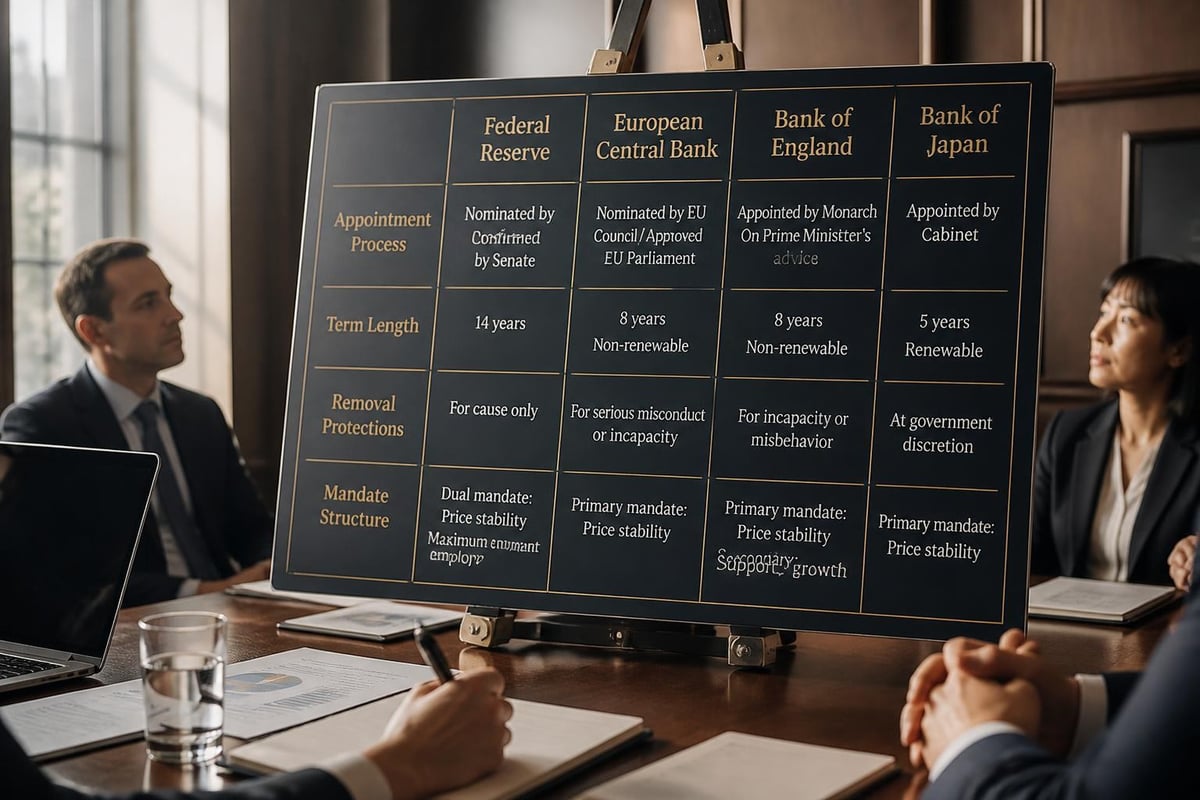
The American approach to central bank independence falls within international norms while exhibiting unique characteristics. Comparing the relationship between federal reserve and presidential politics to other major economies illuminates what makes the U.S. system distinctive.
Most advanced economies grant their central banks statutory independence for monetary policy while maintaining government authority over fiscal policy. The Bank of England, European Central Bank, and Bank of Japan all operate under governance frameworks that insulate interest rate decisions from direct political control.
Key international comparisons:
- Appointment terms: U.S. 14-year terms exceed most other central banks
- Government representation: Some central banks include finance ministry officials; Fed does not
- Transparency practices: Fed pioneered detailed policy communication now standard globally
- Dual mandate: U.S. explicitly requires maximum employment focus alongside price stability
The American system's regional Federal Reserve Bank structure represents its most distinctive feature. Twelve regional banks with private-sector board members participate in monetary policy through the Federal Open Market Committee, creating geographic and institutional diversity absent in more centralized systems.
Contemporary Challenges and Future Outlook
As 2026 unfolds with another presidential election approaching, the relationship between federal reserve and presidential politics faces evolving pressures. Several contemporary trends threaten traditional norms while new circumstances test institutional resilience.
Digital Communication and Norm Erosion
Social media has fundamentally altered how presidents communicate about monetary policy. What once required formal press conferences or carefully crafted statements now occurs through instant public posts that bypass traditional communication channels. This shift enables more frequent and less considered commentary on Fed decisions.
The normative expectation that presidents avoid specific monetary policy commentary has weakened considerably. When these informal constraints erode, formal legal protections become more important, yet may prove insufficient if political culture shifts decisively away from respecting institutional independence.
Emerging pressures include:
- Heightened political polarization extending to previously technocratic domains
- Economic populism questioning expertise-based institutional design
- Social media enabling direct presidential communication with financial markets
- Partisan media ecosystems amplifying criticism of Fed independence
Political scientists debate whether these represent temporary conditions or permanent shifts in American governance. The answer will significantly shape how federal reserve and presidential politics interact in coming decades.
Implications for Presidential Governance
The Federal Reserve's independence constrains presidential economic policy options while simultaneously providing political cover for difficult economic conditions. This dual role creates complex incentives for how presidents approach monetary policy and central bank leadership.
Presidents inherit economic conditions partly shaped by previous Fed decisions. Interest rates, inflation expectations, and financial market conditions at Inauguration Day reflect monetary policy choices made independently of the new administration. This reality sometimes creates immediate tension as presidents seek to implement campaign promises.
- Economic inheritance: New presidents face Fed-influenced starting conditions
- Policy coordination: Fiscal policy must work alongside independent monetary policy
- Blame allocation: Fed independence allows presidents to deflect criticism for high interest rates
- Appointment legacy: President's Fed nominees influence policy years after leaving office
Understanding this dynamic proves essential for voters evaluating presidential candidates' economic proposals. Campaign promises about economic growth or interest rates must be assessed against the institutional reality that presidents cannot directly control monetary policy. Readers interested in how presidential politics intersects with governance can explore additional coverage at U.S. Presidential Report.
The tension between democratic accountability and technocratic expertise embodied in federal reserve and presidential politics reflects broader questions about institutional design in modern governance. No perfect balance exists; each system makes tradeoffs between responsiveness to electoral mandates and insulation from short-term political pressures.
Appointment Strategy and Long-term Influence
Despite limited direct control, presidents shape monetary policy through strategic appointments. Choosing Fed governors with particular economic philosophies allows indirect influence that extends far beyond a single presidential term. This appointment power represents the most durable presidential impact on central banking.
Successful appointments require balancing several considerations:
| Factor | Presidential Consideration | Senate Consideration |
|---|---|---|
| Economic philosophy | Alignment with administration priorities | Professional credibility |
| Political affiliation | Ideally bipartisan acceptability | Confirmation prospects |
| Technical expertise | Respected by financial markets | Qualified for role |
| Communication skills | Ability to explain policy publicly | Effective in testimony |
Presidents who prioritize long-term economic stability over short-term political advantage tend to nominate highly credentialed technocrats with mainstream economic views. Those seeking more dramatic policy shifts may nominate ideologically committed governors, risking Senate confirmation battles and market uncertainty.
The intricate relationship between federal reserve and presidential politics embodies fundamental tensions in American democracy: the balance between electoral accountability and expert judgment in managing complex economic systems. As presidential campaigns unfold and economic conditions evolve, this institutional relationship will continue shaping both market expectations and political dynamics. For non-partisan coverage of how presidents navigate monetary policy challenges alongside other governance questions, U.S. Presidential Report provides comprehensive analysis of presidential decision-making, appointments, and economic policy across administrations.