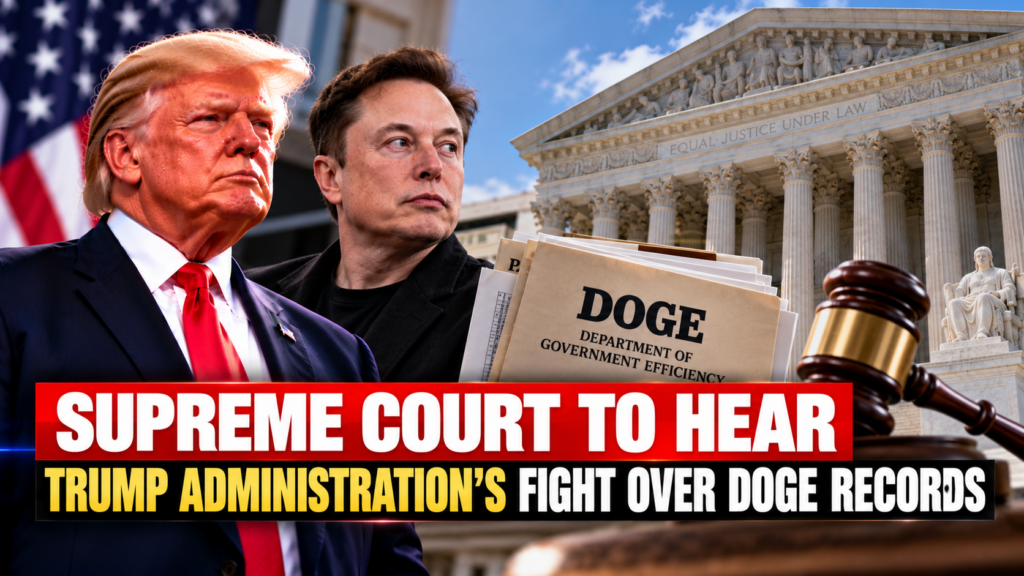
The U.S. Supreme Court has agreed to hear the Trump administration’s appeal seeking to prevent a government watchdog from obtaining records about the Department of Government Efficiency (DOGE). The DOGE records case will examine whether the initiative, which was led by Elon Musk during the early months of President Donald Trump’s second term, must comply with federal public records disclosure requirements.
According to a report by Reuters, the case centers on a lawsuit filed by Citizens for Responsibility and Ethics in Washington (CREW), which is seeking information about DOGE’s operations and decisions. The Supreme Court agreed on October 13, 2026, to review the administration’s challenge, with a decision expected by the end of June 2027.
What Happened in the DOGE Records Case?
The Supreme Court agreed to review the Trump administration’s effort to block the disclosure of records requested by CREW under the Freedom of Information Act (FOIA).
DOGE was established through an executive order after Trump returned to office in January 2025. The initiative aimed to reduce federal spending, shrink the government workforce, and restructure government operations. Musk initially played a leading role in the effort.
CREW requested records concerning DOGE’s activities, arguing that the organization exercised sufficient authority to qualify as a federal agency subject to FOIA. After the government did not provide the requested information, the watchdog group filed a lawsuit.
The administration argues that DOGE functioned as a presidential advisory body and should therefore be exempt from the disclosure requirements that apply to federal agencies.
Why Is the Trump Administration Challenging Disclosure?
The Government’s Argument
The Trump administration contends that requiring DOGE to disclose records would interfere with the president’s ability to receive confidential advice from his advisers.
Government lawyers have argued that presidential advisory bodies should remain outside FOIA’s reach to protect executive branch decision-making and separation-of-powers principles.
The administration is challenging lower-court orders that required DOGE to respond to CREW’s requests. It argues that the courts did not adequately account for the constitutional concerns surrounding presidential advisers and their communications.
CREW’s Transparency Argument
CREW maintains that DOGE should be subject to FOIA because of its role in federal government operations.
The watchdog wants access to information that could help the public understand how DOGE operated, including its involvement in spending reductions, workforce changes, and other government decisions.
The dispute raises a central question: can an initiative that plays a substantial role in government operations avoid public records requirements by being classified as an advisory body to the president?
How Lower Courts Ruled
The dispute has already passed through multiple stages of federal litigation.
In April 2025, U.S. District Judge Christopher Cooper ruled that DOGE likely qualified as a government agency covered by FOIA and ordered the government to process certain records requests. The court also permitted discovery involving a DOGE official.
The Trump administration challenged the order, and the case reached the U.S. Court of Appeals for the District of Columbia Circuit. The appeals court declined to halt the lower court’s order.
The Supreme Court previously intervened in the dispute in 2025, narrowing aspects of the earlier discovery requirements. The administration subsequently continued its challenge, bringing the broader dispute over DOGE’s status and disclosure obligations back before the justices.
Political and Legal Implications
Public Access to Government Records
The DOGE records case could have implications for the public’s ability to obtain information about presidential initiatives that influence federal operations.
If the Supreme Court sides with CREW, the decision could clarify when an executive branch initiative must comply with FOIA. If it sides with the administration, it could reinforce the limits of disclosure requirements for presidential advisory bodies.
The ruling could also affect how future administrations structure government initiatives and determine which records are subject to public access.
Executive Power and Accountability
The dispute highlights the tension between executive branch confidentiality and public accountability.
Presidents rely on advisers to discuss policy options and make decisions. At the same time, transparency advocates argue that the public needs access to records when government initiatives exercise substantial influence over federal spending, staffing, and agency operations.
The justices’ decision will help determine how those competing interests are balanced under existing federal law.
What Happens Next?
The Supreme Court is expected to hear arguments during its current term, with a ruling anticipated by the end of June 2027. The case will focus on whether DOGE’s role and structure bring it within FOIA’s disclosure requirements and whether the lower courts’ orders improperly intrude on executive branch authority.
Until the Court rules, the legal dispute over access to DOGE records remains unresolved. The outcome could establish an important precedent for transparency surrounding presidential initiatives and the limits of public records laws.
The decision will matter beyond DOGE itself. It could shape how future administrations organize advisory bodies, document government decisions, and respond to requests for information about the exercise of federal power.
Related Reading
- Appeals Court Pauses Reinstatement of Fired Seattle Federal Prosecutor
- Appeals Court Weighs Trump Administration’s Harvard Research Funding Block
The Court will review whether DOGE must disclose records under the Freedom of Information Act or qualifies as a presidential advisory body exempt from those requirements.
Citizens for Responsibility and Ethics in Washington (CREW), a government watchdog group, is seeking records about DOGE’s operations and decisions.