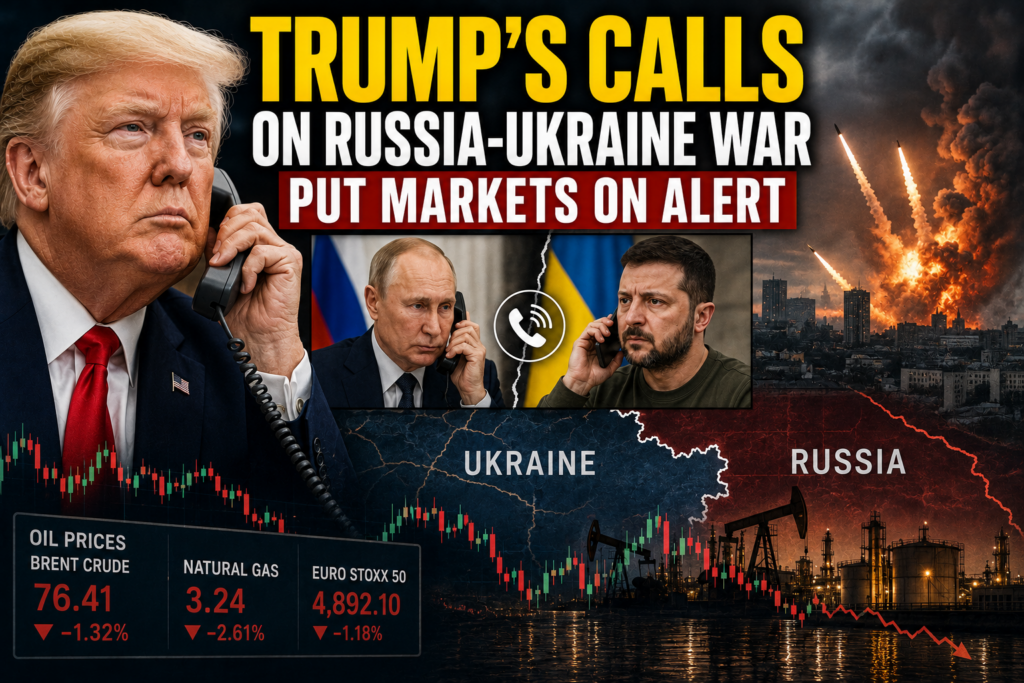
Global markets are closely watching the latest developments in the Russia-Ukraine war after President Donald Trump held separate phone calls with Russian President Vladimir Putin and Ukrainian President Volodymyr Zelenskyy over the weekend. The diplomatic outreach, combined with escalating military strikes by both sides ahead of this week’s NATO summit in Turkey, has heightened investor concerns over geopolitical risk, energy security, and European defense.
According to a report by CNBC, the combination of renewed diplomatic efforts and intensified military action has created uncertainty for financial markets as investors assess the possibility of either peace negotiations or further escalation.
Trump Holds Separate Calls With Putin and Zelenskyy
President Trump reportedly spoke separately with both Russian President Vladimir Putin and Ukrainian President Volodymyr Zelenskyy in the days leading up to the NATO summit in Ankara.
Zelenskyy said the discussion focused on the battlefield situation after more than four years of war and confirmed that both leaders agreed to continue talks during the NATO summit.
Meanwhile, the Kremlin said Trump held a 90-minute phone conversation with Putin, during which the U.S. president expressed interest in helping bring the conflict to an end.
According to Kremlin aide Yury Ushakov, the conversation was “businesslike and very constructive,” with both leaders discussing opportunities for broader U.S.-Russia cooperation if the war is resolved.
The diplomatic outreach comes shortly after Trump’s interim peace agreement involving Iran, adding to speculation that his administration is seeking a broader foreign policy strategy ahead of key international meetings. Readers can also learn more about Trump’s response to Iran and the Strait of Hormuz tensions, which continue to shape global security discussions.
Ukraine Expands Strikes on Russian Energy Infrastructure
While diplomatic discussions continued, Ukraine significantly increased its military operations inside Russian territory.
Ukrainian officials reported successful drone strikes targeting a major oil terminal in St. Petersburg as well as the Kronstadt Naval Base, home to Russia’s Baltic Fleet. Additional overnight attacks reportedly targeted oil refineries in Russia’s Yaroslavl and Leningrad regions.
Although CNBC noted it could not independently verify all battlefield claims, Ukrainian officials said the operations were intended to reduce Russia’s energy revenues and increase pressure on the Kremlin.
Military analysts believe these strikes represent an increasingly sophisticated campaign aimed at weakening Russia’s logistics and fuel supplies.
Russia Launches Another Major Attack on Kyiv
Russia responded with another large-scale missile and drone barrage against Kyiv early Monday, marking its second major assault on the Ukrainian capital in less than a week.
Ukrainian authorities said at least 11 people were killed while dozens more were injured as residential buildings sustained significant damage.
The attacks occurred just one day before NATO leaders gather in Turkey, placing renewed attention on Europe’s security challenges and the alliance’s support for Ukraine.
Markets Monitor Geopolitical and Energy Risks
Financial markets are increasingly sensitive to developments surrounding the conflict because of their potential impact on global energy supplies, commodity prices, and investor confidence.
The possibility of renewed diplomatic negotiations has offered some optimism. However, continued missile strikes and attacks on critical energy infrastructure underscore the ongoing risks facing European markets.
Analysts say investors are now balancing hopes for peace talks against the possibility of further military escalation, particularly as NATO prepares to discuss future security commitments and defense spending.
These discussions also coincide with broader U.S.-European negotiations on economic policy. Readers may also be interested in Trump’s digital tax and tariff negotiations with Europe, another issue affecting transatlantic relations.
Putin and Ukraine Present Conflicting Battlefield Narratives
The Kremlin continues to argue that Russian forces are making steady territorial gains in eastern Ukraine, including claims that troops have captured the strategic town of Kostyantynivka.
However, researchers from the Institute for the Study of War (ISW) said Moscow is likely promoting optimistic battlefield narratives to influence Western policymakers and encourage reduced support for Ukraine.
ISW also noted that the Trump administration has increasingly acknowledged Ukraine’s successful long-range strikes against Russian military and energy targets, suggesting battlefield momentum may be shifting in Kyiv’s favor.
What Happens Next
Attention now turns to the NATO summit in Ankara, where Trump is expected to meet Zelenskyy and other allied leaders to discuss the future of the Russia-Ukraine war, European defense commitments, and regional security.
Whether renewed diplomacy gains traction or military escalation continues will likely influence not only geopolitical stability but also global financial markets in the weeks ahead.
Investors are weighing the possibility of renewed peace negotiations against escalating military conflict that could affect energy markets and global stability.
Trump is expected to discuss the Russia-Ukraine war, NATO defense commitments, European security, and ongoing diplomatic efforts with allied leaders.